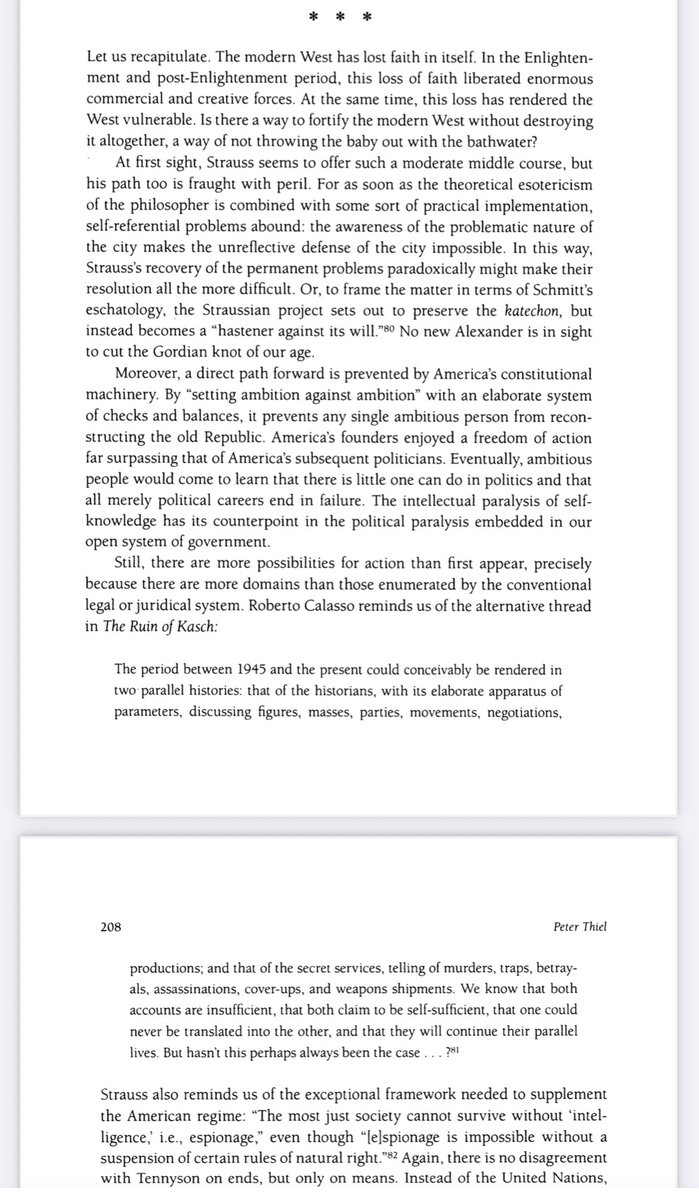
(1/10)
Solution:
Step one. Read Irving Kristol’s essay “The Neoconservative Persuasion” (2003)
In it he describes, in his own words, what neoconservatism is.
https://t.co/C6t1m0eUSL
What is your alternative? That's the real question here. If you think our strategy is bad, that we're cutting corrupt deals, what do you think is a better solution?
For those who are upset about the inclusion of rappers, lgbt, etc in the Christopher Nolan Odyssey film:
The academy awards now require not only on screen representation but also thematic engagement of certain “groups” within the story in order to qualify for an award.
@millerman This latest essay, taken with the Straussian moment, are strong rejections of Strauss, both regarding his academic and broader political projects:
There is also a fairly strong rejection of Strauss, Straussianism, and the general philosophical practice of obscurantist esoteric writing itself, probably intended by Thiel to distance himself from the exoteric interpretation of his other eschatological writing (that he is a Straussian).
Strauss believes (implicitly here) time continues on forever, and so philosophical writing has a very long timescale in which its “true” meaning can be transmitted and decoded by other potential philosophers. Elsewhere in this essay this belief is described as a “primordial heresy” linked to “Averroist Aristotelianism” and the reintroduction of Greek thought into the west.
From the last paragraph:
“We can excuse Benedict the academic for believing that his world would last forever, but for Benedict the Christian, it was a great error. Plato, Aristotle, and the philosophers who followed them wrote between the lines about the permanent questions. They wrote not only for their brilliant contemporaries, but for people who love to think in all times and places. They affirmed the eternity of the world and did not doubt that the future would bring new students with the intelligence and time to indulge in the very long, never easy, but always pleasant work of interpretation proper to a philosopher. But the Christian knows that nothing lasts forever, for this world has a beginning and an end. The apocalypse, the revelation of all secrets and the end of all interpretations, arrives eventually. There is a time and a place for esotericism, whose antonym is revelation. But not in matters concerning the fate of the world—and our souls. For when the time is short and the hour late, who can hope for salvation in philosophical reticence?”
From @TheAthleticFC: Michael Olise, France's balletically brilliant footballer, is truly unique. Quick-witted and smart, the enigmatic player scored 127 on an IQ test in 2024. As for his football intelligence, it’s off the scale. https://t.co/kI5JPZKUpt
(10/10)
Henry VIII pursued a strategy of “deal making” and a “march through the institutions” via Wolsey and More.
It didn’t work and never does because of human nature.
What worked was the Cromwellian revealing, dissolution, and destruction of the monasteries.
Knot cut.
(6/10)
You will find Thiel’s essay is — aside from being astonishingly prescient about the motivation of states to pursue nuclear weapons for reasons of *status and envy* — itself laden with esoteric “Straussian” messages.
Consider the context here:
(9/10)
Once you have thought about these two essays for a long time (it took me a long time) I think it would be good to consider history.
The last time anyone extricated themselves successfully from this kind of situation it was Henry VIII…
(5/10)
Read it carefully. Ask yourself why Thiel, who had received funding from and apparently worked under the guidance of Irving Kristol (the most famous Straussian) while editor in chief of the Stanford Review, is writing headings like: “Leo Strauss: Proceed with Caution”
(3/10) What the neocons offer is a political program that they design and control, with certain “red meat” social conservative promises wrapped in to secure “the base”. What they receive is carte blanche to use the power of the US military to settle their old ethnic rivalries.
(1/10)
Solution:
Step one. Read Irving Kristol’s essay “The Neoconservative Persuasion” (2003)
In it he describes, in his own words, what neoconservatism is.
https://t.co/C6t1m0eUSL
What is your alternative? That's the real question here. If you think our strategy is bad, that we're cutting corrupt deals, what do you think is a better solution?
(2/10) While reading “The Neoconservative Persuasion” you will find that the stated aim of the neocons is to manipulate, mislead, constrain, and otherwise take advantage of the “old” “religious” American voter base in order to surreptitiously advance their own agenda.