TOKEN2049 Singapore is next week 🇸🇬
Serialized will be there for #TOKEN2049 week, October 5–9.
Smart contract audits + real-time on-chain data & APIs. If you're launching a token or building a trading app, wallet or dashboard, let's connect.
DMs open, see you there 👇
We called it 17 days early.
CME Markets (@launchonCME) commodity coins: Unsafe on our engine since Sep 8, flagged for liquidity removal risk.
Sep 25, the admin wallet pulled $178K out of 62 peg pools in 3.5 minutes.
No exploit. The code allowed it.
https://t.co/tOJP5OPoIF
🛰 RadarDEX happy to announce that tokens launched through our Launchpad have been reviewed by @SerializedAudit.
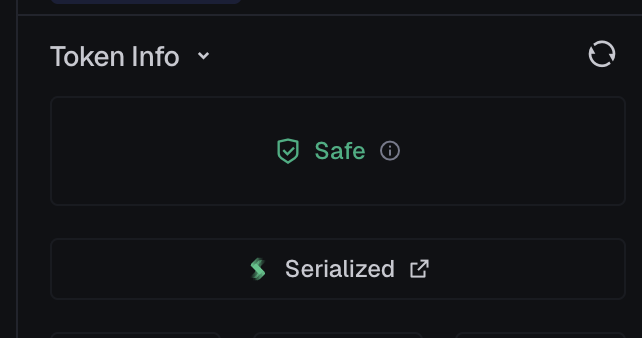
Tokens audited and showing as safe 🛡
https://t.co/T1TbnGJkul
More news coming!
The hooks flagged here are closed-source.
Nothing to read on-chain.
We decompiled them:
• BNB: fees could be set to 100%
• Base: implementation could be set to 80%
0x caught them at settlement (12.8% / 18%).
But the same red flag was already sitting in the bytecode before the first trade.
Read the hook. Then route.
A malicious hook doesn't need a UI to scam you.
👉 It just needs to look like the best quote.
After analyzing over 84,000 v4 hooks, we determined only 19% of hooks to be safe.
It's time to get real about hooks. https://t.co/bhbBOvocJg
Serialized Audit is now becoming Serialized.
Audit is just one of the API sets we provide.
Serialized is a full-stack data provider for the apps and terminals that want to scale fast and don’t worry about data infrastructure that’s easy to deploy and customizable to one’s needs.
We’re powering the most popular apps and terminals out there across security, market data and routing
Built for world’s scale
A honeypot rarely blocks your sell outright. It lets the deployer out, and quietly fails yours.
The trap sits in a transfer hook that checks a list you were never added to.
A scan is not an audit. But it can read the transfer path and show you whose sells are conditional.
Money leaves a contract through a function anyone was allowed to call.
No exploit chain. No clever trick. A missing permission check.
A scan is not an audit. But before you deploy it will tell you which money-moving functions have no access control.
Tempo support is live.
Paste any contract, get one straight verdict — honeypots, hidden taxes, owner powers, TIP-20 policy roles.
Verified and closed-source both.
https://t.co/pGcNhRBJAR
@lunarwalletapp Hi,
you may want to audit all tokens shown on the wallet and flag as safe or unsafe for users to safely trade.
We provide an API that does just that: DM if interested
The cheapest security question in crypto, and you can answer it before you deploy:
For every function that moves money, who can call it?
A scan is not an audit. But it will tell you that, in seconds.
Roughly $8M left a vault last week because a function that moved money was public.
Not a clever exploit. A missing permission check.
Before deploy, ask the boring question about every money-moving function: who can call this, and what is the worst they can do with it?
Every H1 report this week says it differently: more incidents than ever, fewer dollars than last year.
The counts themselves differ by over a hundred, because no two firms publish the same method.
Scanners have the same gap. You get a verdict, never an accuracy number.
The contract you read is not always the contract you run.
If a token sits behind a proxy, the logic can be swapped after launch. The address never changes.
Before you trust it:
- Who holds upgrade rights: an EOA, a multisig, or a timelock?
- Is there a delay, or does the swap land in one transaction?
- Can initialize() be called a second time?
- Ownership renounced, but is the admin slot still live?
All of it is readable before you buy. That is what a pre-deploy scan is for.
The useful question about a token is not "is the team trustworthy."
It is: assume the owner key leaks tomorrow. What can that role still do?
Mint unlimited supply? Swap the logic in one transaction? No timelock, no cap?
Then the key was never the only problem.