WE ARE NOW SERIESA.
For the past few years, We’ve created a window into the people, companies, ideas, and stories shaping Africa’s technology and business ecosystem.
we’ve created and given a stage to the ones nobody was watching yet, the builders before the traction, before the headlines, before anyone else thought to ask
We started with a simple belief: Africa’s most important stories deserve to be told.
Today, we’re taking that belief further.
Welcome to SeriesA.
SeriesA is the next chapter of what we started — a new media company built to cover the people, companies, capital, technology, culture, and ideas shaping the future.
Africa remains at the heart of what we do.
But our ambition is bigger than a name that puts a geographical boundary around us.
We’ll continue telling the stories coming out of Lagos, Nairobi, Accra, Johannesburg, Cairo, Kigali and across the continent while following the people and ideas connecting Africa to the rest of the world.
Expect more stories. More original reporting. More conversations. More analysis. More perspectives. And a lot more interesting content.
From the founders building the next generation of African companies…
To the investors backing them.
From emerging technologies changing how we live and work…
To the businesses, creators, institutions and communities shaping what comes next.
This is SeriesA.
A new name.
A bigger canvas.
The same obsession with telling the stories that matter.
Welcome to the next chapter.
Welcome to SeriesA.
#SeriesA #SeriesAmedia #Tech #Startups #Business
Before Calendly, Tope Awotona failed three times. A projector business. A garden tools venture. Both flopped, and both times he walked away with nothing but the lesson to try again.
Awotona founded Calendly out of his own frustration with the back-and-forth emails required to schedule meetings. Simple problem, universal pain — but almost no one wanted to fund it. He invested his entire life savings into the company after struggling to raise venture capital as a Black immigrant founder, in an industry that overwhelmingly backs people who look and sound like itself.
So he built without them. Calendly grew primarily through word-of-mouth and product-led growth, reaching profitability without significant outside funding — proof that the product could speak louder than a pitch deck ever could. It wasn't until 2021 that a $350 million Series B from OpenView and ICONIQ valued the company at $3 billion, years after most founders would've needed the capital just to survive.
Today, Calendly serves over 20 million users across 230+ countries, and Awotona's story has become something bigger than a scheduling app. It's a case study in what happens when a founder refuses to let "no" be the final word and builds the thing so well, the world eventually has to notice.
#FounderSpotlight #Calendly #TopeAwotona #SeriesA #StartupStory
Ventures Platform ( @vplatformhub ) just closed its second fund at $84 million oversubscribed in a year where African VC has been anything but easy to raise.
The final close of VP Pan African Fund II beat its initial $75 million target, and it did it against a brutal backdrop: African startups have raised just $930 million across roughly 200 deals this year, compared to $1.16 billion across 447 deals the year before. When the market shrinks and LPs get pickier, most managers struggle to close. Ventures Platform closed bigger.
That's not an accident, it's discipline showing up in the numbers. Some 70% of Fund I's LPs came back for Fund II, and the fund pulled in serious new institutional weight: the European Bank for Reconstruction and Development, Norway's Norfund, and Dutch family office Alphatron all joined the cap table. Founding partner Kola Aina put it plainly , LPs aren't asking "why Africa?" anymore, they're asking "why your fund?" and demanding sharper proof of performance, not just a bet on the continent's growth story.
The strategy is also evolving, not just scaling. Fund I was concentrated on pre-seed and seed checks inside Nigeria. Fund II is bigger and wider, the firm has already backed five companies in Kenya, South Africa and Egypt, with check sizes climbing up to $3 million deployed over the next three to four years. Same conviction in early stage African founders. Bigger cheques, broader map.
In a year when the headlines have mostly been about African startups struggling to raise, this is the other half of the story: the funds with real discipline are still finding capital and putting it to work.
#VentureCapital #Africa #VenturesPlatform #SeriesA #StartupFunding
CardinalStone Capital Advisers(@CardinalStoneNG ) just hit a $76 million first close for its second growth fund and the mix of capital behind it says a lot about where West African private equity is headed.
The Lagos-based, West Africa-focused private equity manager secured $76 million toward its $120 million target for CCA Growth Fund II, which will invest in high-growth small and medium-sized enterprises across Nigeria, Ghana, Côte d'Ivoire and Senegal. That puts the fund at more than 63% of its target before it's even reached final close.
What stands out isn't just the number, it's who's writing the checks. Returning investors like IFC, British International Investment and SCM Capital are joined by new backers including the Dutch Good Growth Fund and three Nigerian pension fund managers: Stanbic IBTC, Access ARM Pensions and FCMB Pensions. For a region where African private equity fundraising has historically leaned on international development institutions and overseas investors, real participation from domestic pension capital is a meaningful shift — it signals local institutions are starting to bet on their own SME ecosystem, not just foreign DFIs.
CCA's leadership — Femi Ogunjimi, Yomi Jemibewon and Shirley Somuah have called out that domestic participation as one of the most important parts of this raise. And with ticket sizes on the first fund ranging from $5 million to $10 million per investment, this isn't spray and pray capital targetbut ed growth financing for SMEs that are already proving they can scale but can't access the long-term capital to do it.
West Africa's private equity story is still being written. Rounds like this are the chapters that matter.
#PrivateEquity #WestAfrica #CardinalStone #SME #SeriesA
Moniepoint just shut down MonieWorld, its UK remittance business, barely 18 months after launch — and the timing tells its own story.
The product wasn't failing. Monthly transaction volumes among UK diaspora users had climbed 70%, and the company says it "validated its cross-border infrastructure" in the process. But validation isn't the same as conviction. Building MonieWorld meant standing up an entirely new regulatory and operational stack from scratch — including a reported £1.2 million in UK setup costs and a $2.5 million deal to acquire an FCA-licensed EMI just to operate legally in the market.
That's the real lesson here. Expanding into a new geography doesn't just cost capital — it costs focus. And for a fintech sitting on $294 billion in annualised transactions out of Nigeria and fresh momentum in Kenya, the math on where to point that focus wasn't close.
So Moniepoint is doing something a lot of "hypergrowth" startups struggle to do: admitting a bet didn't clear the bar, and redeploying people and capital back to where the moat is deepest. No dramatic collapse. No spin about "pausing to reassess." Just a straightforward pivot back to Africa, where the company already has the customer base, the trust, and the infrastructure to compound.
In a landscape littered with startups that keep funding sunk-cost expansions because shutting them down feels like admitting defeat — this is worth paying attention to.
#Fintech #Africa #Moniepoint #StartupStrategy #SeriesA
As a software engineer, Tosin Eniolorunda kept seeing the same problem: businesses weren’t necessarily struggling to find customers — they were struggling with unreliable financial infrastructure.
In 2015, he co-founded TeamApt with a simple idea: build the technology that banks and businesses could depend on. What started as financial software for banks eventually evolved into Moniepoint, as Tosin and his team moved closer to the businesses they were building for.
The lesson was simple: sometimes the biggest opportunities aren’t found by building something entirely new, but by fixing what everyone has learned to live with.
Today, @moniepoint stands as one of Africa’s leading business-focused financial platforms.
Tosin’s story is a reminder that great founders don’t just chase markets. They notice the friction everyone else has accepted — and build the infrastructure to remove it.
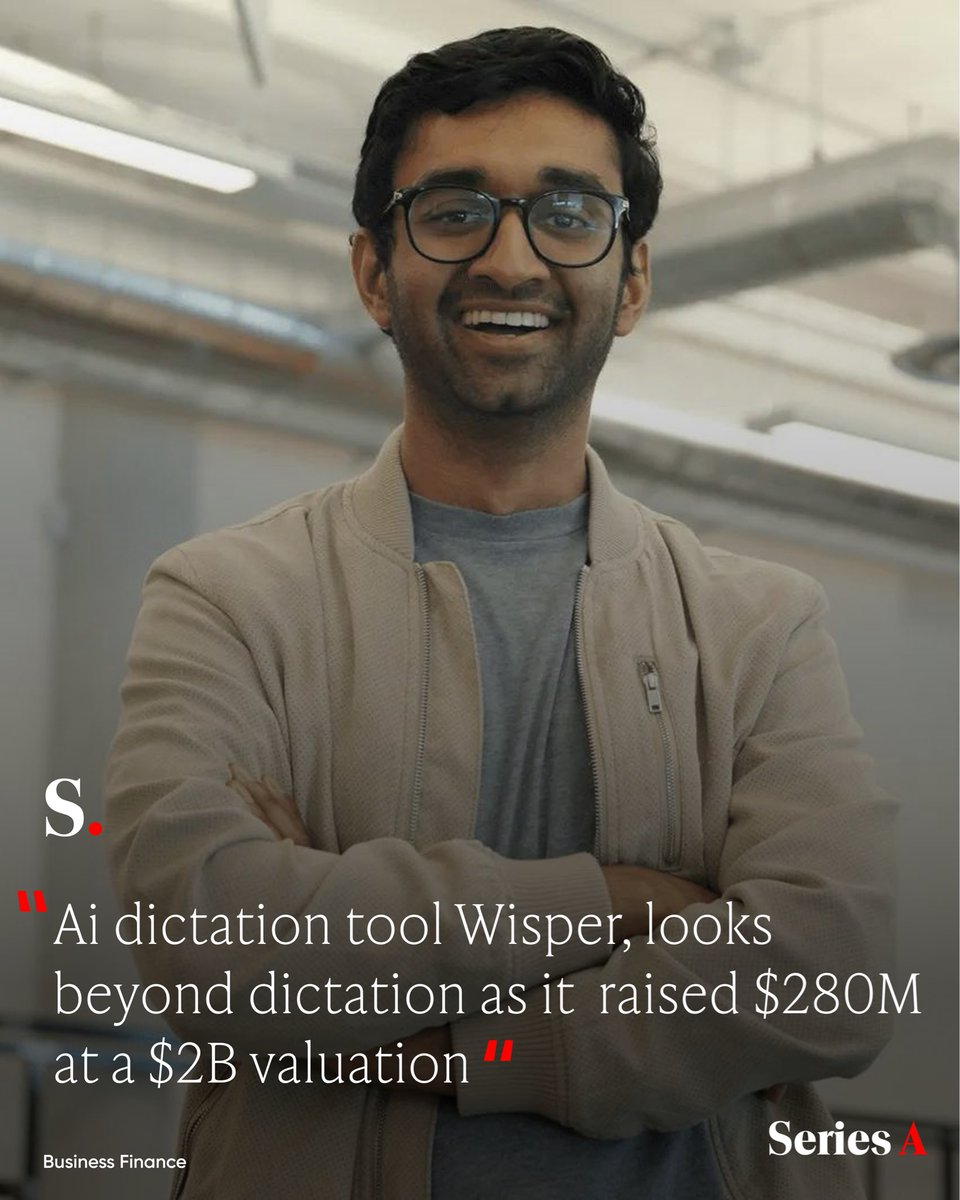
AI is moving beyond dictation.
On August 17, 2026, @WisprFlow announced a $280M Series B at a $2B valuation, led by Menlo Ventures—bringing its total funding to $361M.
What makes this interesting isn’t just the size of the round. It’s the shift in ambition.
Wispr Flow started by helping people turn speech into text faster. But the company is now looking beyond dictation—toward meetings, workflows, hardware, and ultimately a new way for people to interact with software.
The bigger bet is simple: voice may not just replace the keyboard; it could replace the text box as the primary interface for interacting with AI.
As AI becomes more capable, the question is increasingly less about what AI can do and more about how naturally we can tell it what we want.
For startups, that shift creates an enormous opportunity: build the interface between humans and increasingly autonomous AI.
Dictation may have been the entry point. The interface is the real market.
#SeriesA #AI #VoiceAI #Startups #VentureCapital #ArtificialIntelligence #FutureOfAI
Uber is taking its Eats delivery network to the skies. 🚁
The company is adding drones to its Uber Eats delivery network through a partnership with @zipline , marking another step toward making autonomous delivery a reality at scale.
The partnership will bring Zipline’s drone technology into Uber Eats, giving customers another way to receive orders while potentially making deliveries faster, more efficient and less dependent on traditional road-based logistics.
It’s another sign that the future of last-mile delivery is being shaped by automation from the streets to the skies.
The future of delivery might not be on the road.
#SeriesA #Business #Technology #Uber #Zipline #Drones #DroneDelivery #Logistics #FutureOfDelivery
🇳🇬 Nigeria’s @terraindustries is raising the bar for African defense technology.
Terra Industries has closed its seed round at $52 million in funding, marking one of the biggest funding rounds for an African defense technology company.
Founded by Nathan Nwachuku and Maxwell Maduka, Terra is building autonomous systems designed to help governments and critical infrastructure operators monitor, secure and respond to threats across land, air and maritime environments.
The company is developing its technology in Africa with its engineering and manufacturing operations based in Abuja and Accra while expanding deployments across the continent.
The new capital will support increased manufacturing capacity, expansion into additional markets and the continued development of Terra’s autonomous systems and software platform.
For a continent that has historically relied heavily on imported defense and security technology, Terra’s growth represents something bigger: the emergence of homegrown companies building the infrastructure and technology needed to secure Africa.
Africa isn’t just becoming a market for deep tech.
It’s becoming a place where deep tech is being built.
#SeriesA #SeriesANews #AfricaTech #Nigeria #TerraIndustries
The Founder Who Helped Build Africa’s Tech Infrastructure
From co-founding Andela to co-founding Flutterwave, Iyinoluwa Aboyeji has played a defining role in shaping Africa’s technology ecosystem.
He’s built companies that didn’t just create products—they opened doors for African talent, businesses, and innovation to compete on a global stage.
For this edition of Founder Spotlight, we look at the journey, vision, and impact of one of Africa’s most influential tech founders.
Iyinoluwa Aboyeji — Founder Spotlight.🌍🚀
#FounderSpotlight #IyiAboyeji #Andela #Flutterwave #AfricanTech
At 21, Aliko Dangote borrowed money from his uncle and started trading commodities Nigeria depended on.
Sugar. Rice. Cement.
But he wasn’t satisfied with simply becoming one of the country’s biggest suppliers. He saw a deeper problem: Nigeria was importing what it could produce.
So he moved upstream.
From trading, to manufacturing. From cement and flour to fertilizer, petrochemicals and one of the world’s largest oil refineries.
The journey wasn’t easy. The bets were enormous. The projects took years. And many questioned whether they would ever work.
They did.
Today, Dangote has built one of Africa’s largest industrial empires, generating billions in revenue and operating across some of the continent’s most critical industries.
But the bigger lesson isn’t how much money he made.
It’s where he chose to build.
The greatest fortunes are often created by solving problems at their source — not simply profiting from them.
So, what problem are you solving?
Follow Series A for more stories on the people, companies and ideas shaping Africa and the world.
#SeriesA #SeriesASpotlight #AlikoDangote #Dangote #AfricanBusiness
We're looking for founders to spotlight on SeriesA, 🔊🔊 the ones building quietly right now, not just the ones who've already arrived.📈
If you've got a business you're proud of (even if it's early, even if it's messy), we want to hear about it🤩. A few spots open each month for a full feature, your story, your journey, your business highlight.📸
Tell us about it here: https://t.co/Y2Tz695sEV
Takes less than 5 minutes🕰️⏳.
A new chapter begins.
Every founder starts somewhere unseen.
Every builder has a moment when the world starts paying attention.
Series A is here.
We’re building a new home for the stories behind Africa’s most ambitious founders, creators, companies, and ideas — the people shaping what comes next, often long before the rest of the world really notices.
From the first idea to the breakthrough.
From Africa to everywhere.
This is Series A.
For the moment they arrive.
Welcome to the next chapter.
In this clip from my conversation with William Nwogbo, CEO of @Prodevs_io , we break down how local talent models are quietly powering global companies and why Africa, especially Nigeria, is becoming a key player in the future of work.