@foundmyfitness@DorkusDawg Speaking as someone who writes meta-analyses, I'm afraid the evidence here is a mess. Probably the most egregious thing is that *observed* effects are in the opposite direction and null
https://t.co/JPQuCKDmfY
@MeganTStevenson@captgouda24@lakens omg it gets worse, the self-reported effect was large and significant but the observed effect was null and in the opposite direction.
You could use this paper as a teaching example of misleading abstracts and irreproducible methods
@MeganTStevenson@captgouda24@lakens omg it gets worse, the self-reported effect was large and significant but the observed effect was null and in the opposite direction.
You could use this paper as a teaching example of misleading abstracts and irreproducible methods
@MeganTStevenson@captgouda24 oh no do I have to write this letter?? Blargh what a time sink...OTOH this stuff really bothers me. There are no even theoretical reason to withhold code & data for a meta
(cc'ing @lakens -- an egregious example of non-reproducible meta-analysis, 10.1016/j.avb.2024.101956)
@captgouda24@MeganTStevenson Well there's a forest plot 😃 2 problems tho:
1) Many studies listed are missing from refs (Antypa, Bègue, Bellino, Bles, Bos, Dean, Gast, Hallahan, &c.). Not in supplement either :(
2) 11/29 studies are from lead author!!
This merits letter of concern to editor, IMHO
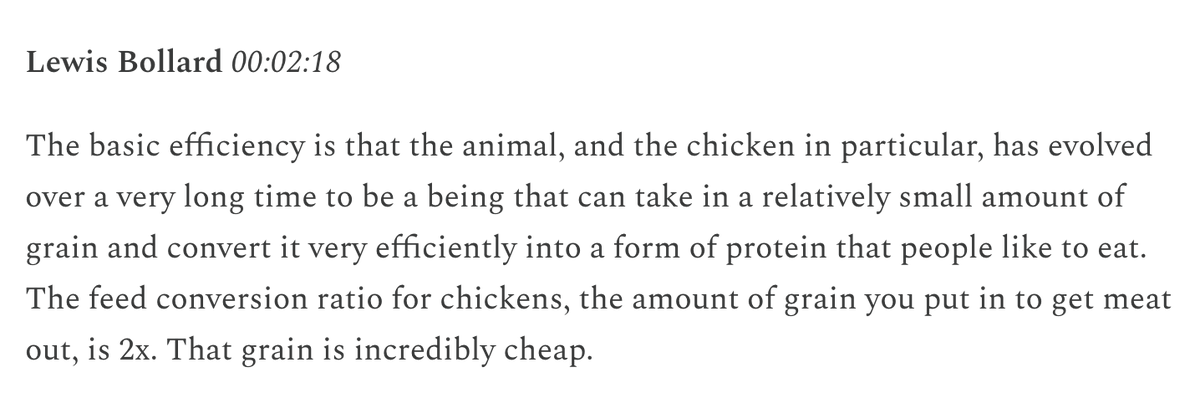
@KennyTorrella Hmm, @Lewis_Bollard said in his interview with @dwarkesh_sp that the ratio for poultry meat is ~2 cal grain : 1 cal protein https://t.co/uoGc8Y1fgl
I might be misunderstanding (Lewis?). Tho I think this is a nontrivial estimation problem if estimates range from ~2 to ~8.8
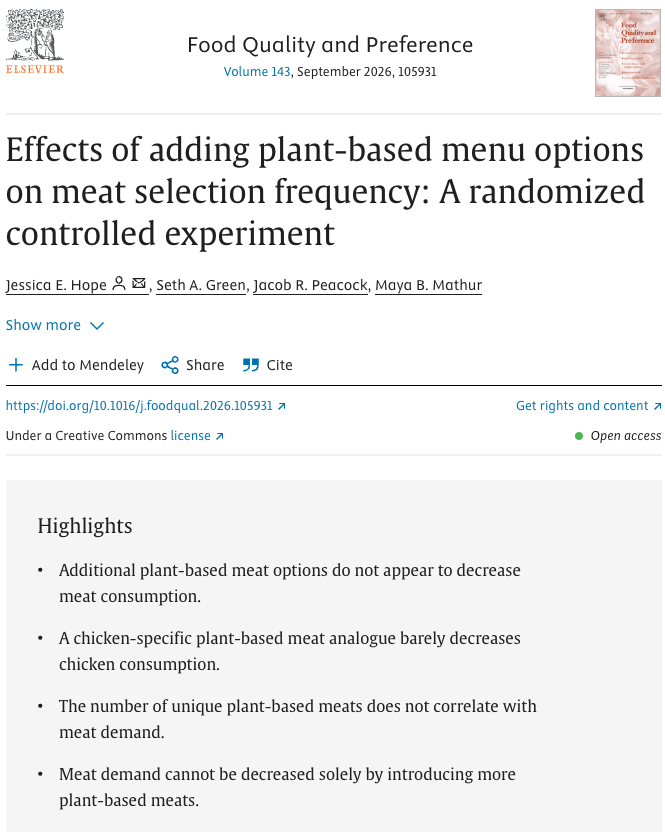
Meaningfully reducing meat consumption is a 0 to 1 problem, not 1 to N. It'll take new patterns & systems. Some folks hope we'll get there by introducing new plant-based meat analogues. We tested that in a Chipotle-like setting & found, alas, not much: https://t.co/aup2wbtmJk
@deanwball No, I am not saying that is my plan. I said in my second tweet that I think their concerns are wrong. I am saying that *if* a person thought we were all going to be killed by AI, they would take these problems seriously and think they were worth dealing with.
@deanwball (I think they are *wrong* about the risks of AI and I think the costs of war and recession are much more real and important than the ones they worry about. But if you really thought apocalypse was looming, you’d risk recession or regional war to avoid it .)
@deanwball I think they’d say to these: yes there is a price be paid and/or hard problem to figure out, but because the alternative is AI will kill us all, we should pay & figure it out together. If that was your POV, 1st you’d try to convince on “kill us all”, then worry about mechanics.
@Lewis_Bollard "Compassion by the Pound" changed my thoughts on this. The eye procedures are particularly gruesome and dogs are especially cute but even in the best of times, farms are smelly, full of pain and fear, and unnatural. This discrepancy is not a surprise:
https://t.co/y3Phw6PLtB
@paulgb esp. annoying because the inimitable @3YearLetterman has described his process in great detail and was profiled in the NYT https://t.co/egFCHotmlS
https://t.co/23BKcGrC4g
What more training data could the AI need??
Who is most likely to take the bait? It’s a question I get asked a lot, so here goes:
Self-importance - this is EASILY the trait that has the strongest correlation to taking the bait. People who take themselves seriously simply cannot resist the urge to tell someone else they are wrong
Age - The Boomers and Gen Z are the easiest to troll for very different reasons. Millennials and Gen X are the hardest.
Stans - if someone stans for a celebrity or a politician, they will take even the lowest quality bait. Tyler Swift and BTS have the most deranged stans you’ll find.
Politics - I haven’t really noticed a left or right correlation. Sometimes it seems like liberals take the bait more and sometimes it seems like conservatives do, but it all balances out. But the more someone truly cares about politics, and especially social issues, the easier they are to troll whether they are left or right. So if someone makes 50% of their tweets about politics, they’ll be many times more likely to take the bait than someone who never does. The stronger they believe they are on the correct side, the easier they are to bait. People who believe the worst about the “other side” are easy to troll. Often the same post will have people calling me both a “Trumptard” and a “libtard.” People who are focused on economic issues are harder to troll. People who care primarily about social issues are easier to troll.
Doomsayers - this is where left and right are equally easy to troll. If someone believes that America is about to devolve into a fascist or communist hellscape based on the outcome of the next election, you should be able to troll the bejesus out of them. Optimists are harder to troll.
Religion - The more militant they are, the easier they are to troll. And that includes atheists.
Geography - The more someone hates America, the easier they are to troll.
Sports fans - Sports fans are actually a lot harder to troll repeatedly than the politics crowd. They might take the bait once but are less likely to do so repeatedly unless they also hold strong political views, then you can mix the two and they’ll take the bait. That’s where Barry was truly unmatched.
Education - The easiest people to troll are (1) Those academia and those with advanced degrees, particularly those who list their degrees in their Twitter bio; and (2) Homeschoolers/those who were home schooled or who went to a primarily religious school. Your average HS or college graduate is harder to troll because they’ve spent more of their lives around normal people and don’t take themselves as seriously.
Eating Meat - Vegans are obscenely easy to troll.
@MartinVGould In general, this is a hard kind of paper to evaluate as a non-specialist. An RCT, I intuit where to scan to get a sense of what parts of the design are really doing the work. A modeling paper -- where does one begin? (were I really doing this, I would ask Claude for help)
@literalbanana and finally, the more you add, the more likely it is that your estimates dont' really correspond to any cognizable, identifiable real-world thing because the DVs and interventions are too non-harmonized: https://t.co/t2hpw4YLrN
(N/N)
@literalbanana IMO, the completionist mindset of trying to include every darn paper prioritizes being an accurate literature review over saying something meaningful about the world, and more interesting papers aim for the second goal rather than the first.