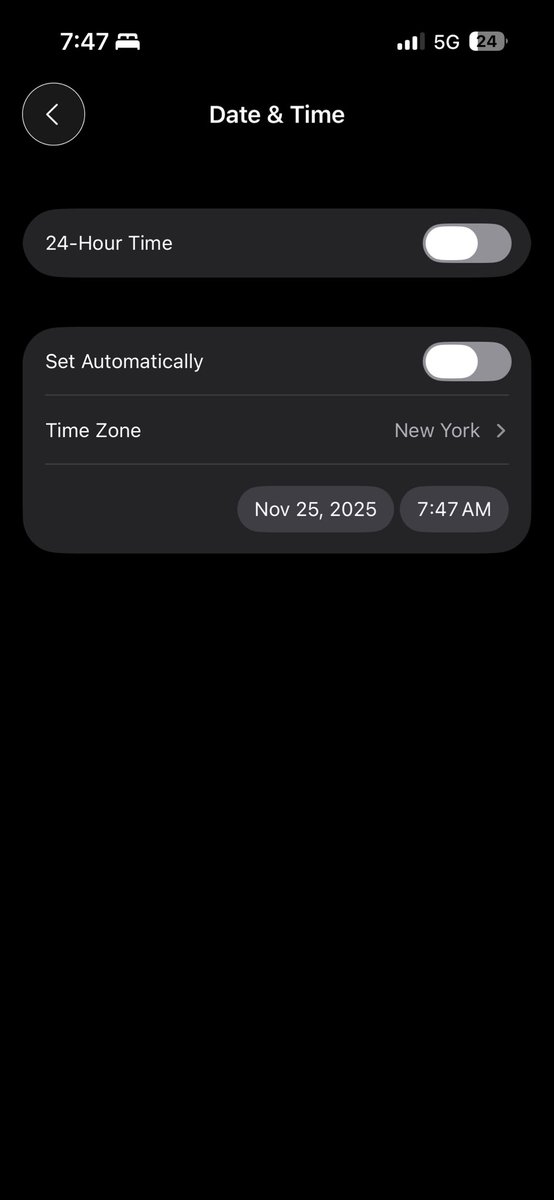
top action items for any world dictator
1. standardize electrical sockets
2. standardize kids shoe measurements
3. end daylight savings time
4. YYYY-MM-DD
5. Standardize paper to a4
6. ?
@arthuralvim Hmm yes there’s some research to support your claim:
https://t.co/Ufm1mqPDbW
Not sure how dissolutions like Yugoslavia get counted here though.
Supposedly, in human evolutionary time, cross-clan marriage helped secure peace and cooperation.
Does this still work in modern times across communities and nations? Does the presence of cross-border families cause less conflict? Is it convex or S-shaped wrt density of ties?
@eliguerron If you resurrect (or improve) https://t.co/OOA0J3o6f1 you will receive my eternal gratefulness.
Fixing a typo should be deterministic automatic behavior like option+Delete. The user shouldn’t have to think hard just to get typing right.
The last time I faced this, I tried “Oh I already did mobile check-in on the hotel app” using that credit card (and indeed I had).
Magically, that worked.
A situation that has happened to me more times than I care to admit. Arriving in a city for a speaking engagement after a 7 hour flight.
Me “Checking in for Rob Henderson”
Hotel staff “Okay just need an ID and credit card”
Me “Sure. There should be a credit card on file there.”
Hotel staff “Ah yes I see there is. But there’s no note here authorizing us to charge this card.”
Me “You have the card there on file. Can we just use that one?”
Hotel staff “Unfortunately we require a note confirming we can authorize the charge.”
Me “I have the email of the person who represents the organization paying for the hotel, where they specify that the room should be covered. Can I show you this email?”
Hotel staff “Sure! But we would still require them to complete and submit a credit card authorization form.”
Me “You have the card there on file. Can you charge it? I know there’s no note but the person literally gave you the credit card information, why do you need a note too...sorry, can I speak with the manager (my inner karen awakens)?
Hotel staff “There’s no manager on duty.”
Me “Okay (karen dies on the vine).”
Smash cut to me pulling out my own credit card to cover the stay.
Why do we put credit cards on file for hotels then? What’s the point of this? Either use the card on file or don’t. But why is it we can book a flight on an app, get through the airport security with a face scan, and then you arrive at a hotel and they need a notarized blood oath signed in triplicate? For most people I get that this is trivial who cares. But for anyone whose company or a third party covers travel, hotel check-in remains the final frontier. Why hasn’t this caught up with the rest of modern life?
@sebkrier I mean just stop what you’re doing and watch the first 10 minutes of this speedrun of Mario 64. How far is your mouth hanging open?
https://t.co/Bd4jDfdyPP
Usually if I know some content was written by AI, I get less interested.
But, add a human endorsement that sounds genuine… much more interesting.
And this is a pretty good story.
We’ll also need new ways to cheaply measure the value of a dataset or paper.
Like, oh I dunno… “does this data improve our forecasts about phenomena we care about?”
The reward function needs to change: people should be rewarded primarily for creating new datasets, rather than primarily for analyzing existing datasets. There is no longer any meaningful skill component to the latter
You can tell prediction markets are having a moment when crypto bros issue explainer tweets on Expected Value, complete with \times and AI clipart of cash pipes.
Expected Value in Prediction Markets: Turning Intuition into Edge
1) Prediction Markets Are Still Inefficient
Prediction markets are supposed to be the ultimate truth-pricing machine. In theory, prices reflect all available information
In practice, they don’t. Most retail traders are just playing with a number in their head: 'This feels like a 60% chance, not 45%'
The problem is that these quick estimates are rarely based on complete information. They might come from a headline, a tweet, or a hunch. That’s not enough. If you want to build real edge, you need to gather more data than the average trader and actually translate it into probabilities
The more angles you cover, the closer you get to seeing the market clearly
2) What Information Matters?
The kind of information you need depends entirely on the type of market. Here are a few categories to make it concrete:
a) Politics
Useful signals: polling data, demographic splits, fundraising reports, historical turnout, campaign ground game, local endorsements
Where to look: poll aggregators like FiveThirtyEight, RealClearPolitics, FEC filings, state election websites, and even local newspapers that catch stories before they go national
b) Sports
Useful signals: injuries, lineup announcements, historical head-to-head matchups, advanced stats (xG in soccer, DVOA in football), even weather conditions
Where to look: stat sites like FBRef, Basketball-Reference, ESPN injury reports, and sharp betting lines from sportsbooks. Twitter is often ahead of the news here
c) Crypto & Finance
Useful signals: on-chain wallet flows, derivatives data, funding rates, options implied volatility, central bank policy
Where to look: dashboards on Dune, Glassnode, CME futures data, Fed minutes, crypto whale trackers
d) Event-driven markets (e.g. “Will Apple launch a foldable iPhone by 2026?”)
Useful signals: company filings, patent applications, analyst reports, supplier rumors, leaked prototypes.
Where to look: SEC filings, Bloomberg, Nikkei Asia supply chain scoops, industry blogs, and forums where leaks pop up
If you’re only looking at the obvious headlines, you’re playing the same game as everyone else. Edge comes from digging where others don’t
3) From Information to Expected Value
Collecting info is only half the job. You need to turn it into numbers. That’s where expected value comes in
a) Estimate your probability
Start with your own assessment based on all the information you’ve gathered. Say you’ve weighed the polls and turnout models and decide Candidate A has a 55% chance of winning
b) Compare it to the market
If the “Yes” side is trading at $0.45, that means the market is implying a 45% chance
Run the EV calculation
In this case:
Your probability: 55%
Market price: $0.45
Payout if correct = 0.10
That’s a positive expected value of 10 cents per dollar bet.
Over time, that edge compounds.
4) Building Strategies
Knowing how to calculate EV is the start. Building strategies around it is where the real money is made
- Play the long game
- Don’t chase one 'big win.' Place lots of positive EV bets across many markets. Even if you lose some, the math works out over time
- Pick your niche
It’s impossible to be the best at everything. Focus where you consistently have better info than the crowd. That could be local politics, niche sports, or a corner of crypto
- Stay flexible
Probabilities aren’t static. As new information arrives, your estimates should change. Updating quickly is often where the edge lies
- Manage your risk
A positive EV doesn’t mean you can’t lose. Bankroll management, sizing, and guardrails like stop losses and take profits keep you alive long enough for the edge to matter
Closing Thoughts
Prediction markets are inefficient because most people trade them on gut instinct. That leaves room for traders who take information seriously
If you can gather more data, translate it into better probabilities, and consistently identify positive expected value, you’ll be on the right side of the long-term math
At the end of the day, the market rewards those who move beyond 'this feels about right' and start playing with actual numbers.
Is there some weird reason this unravels?
What happens in the ambitious intermediate states?
Does having a Prob[fire the CEO] market fix the nonuniqueness of equilibrium somehow?
I think I got a non-pathological example - a status quo bias.
Imagine a fire-the-CEO market: company’s stock price if we do or don’t switch bosses.
Behaviors:
- “normal times”: revenues & stock are fine, we keep the CEO.
- “bad times”: revenues & stock down, we fire her.
In a futarchy, could we have multiple equilibria? In what circumstances? Just weird ones, on reasonable too?
@robinhanson 's decision selection bias means that price_A ≠ value_A, but: E[value_A | choose A over B].
What if the decision rule is "follow the market, mostly"?