The failure rate among Leadership hires in big tech seems pretty high (anecdotally). Few hypotheses:
1/ Internal network is critical for being successful at that level. They don’t have one.
2/ Limited understanding of the company culture leads to unforced errors
3/ It’s hard for them to add value to high functioning teams unless they are domain experts or awesome people managers
Risk minimization is the primary lens Enterprises use when selecting vendors. The old adage “No one ever got fired for hiring [insert large co]” rings true once again.
AI might change the relative competitiveness of emerging markets in two contrasting ways
1/ Job losses might make the governments more populist, reversing the gains of capitalism (free market)
2/ AI Agents might help fill skill gaps in the labor market, thereby accelerating progress
In the 2000s, Computer Science eclipsed Electronics as the engineering discipline of choice for undergraduate studies. Maybe the pendulum is swinging back again with Nvidia being the hottest thing and computer programming getting increasingly commoditized by AI.
Reasons why startups offer a better opportunity to develop Product Sense compared to large companies
1/ Need to make decisions without full information (data is sparse). Builds confidence in making decisions.
2/ Engage in direct problem solving with customers as opposed to relying on Research team or vendors. Builds empathy.
3/ More latitude to take greater risks and thereby have a larger learning radius.
4/ Have fewer internal experts to guide you, resulting in more mistakes. Learning from mistakes is more durable.
5/ Higher urgency to iterate rapidly. Accelerates the feedback loop.
Bots on X are the platform’s hack (at scale) for giving tweeters new followers, especially in their early days. As long as you tweet, more and more bots will follow you and give you fake street cred (follower count). This cred presumably would give real people FOMO to follow you someday.
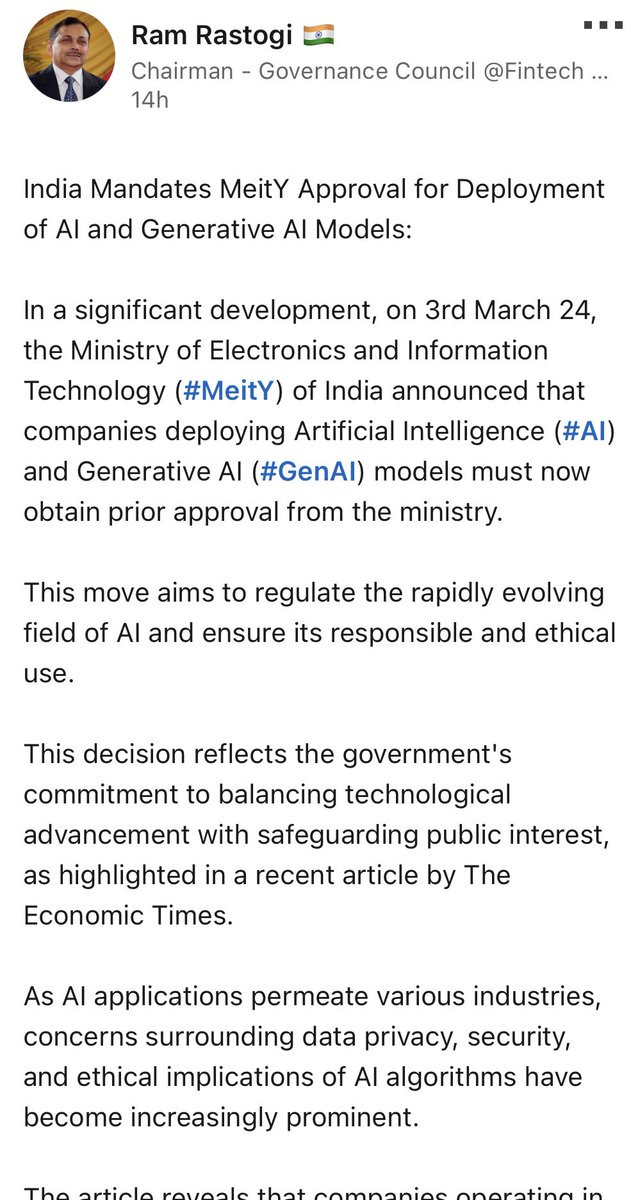
This is more likely a move to preserve jobs (and social cohesion) than to safeguard privacy & security. India is the back office of the knowledge economy and is especially susceptible to GenAI.
Good fucking lord. What a travesty. Requiring government approval to deploy a model.
This is the inevitable outcome of rhetoric like Vinod’s.
It’s anti innovation. It’s anti public. And we all loose.
Keep AI open!!!!
When I was at TripActions (now Navan), Customer support was their biggest cost and also their biggest differentiator.
People implications aside, good news is that AI might significantly improve their margin profile. Bad news is that the barrier to entry might reduce.
ROI on AI:
AI is handling 2/3 of Klarna’s customer service chats with a 2 minute resolution time vs. 11 minutes for previously and a 25% drop in repeat inquiries.
AI is going to have a massive impact on every industry.
Google bears are missing 3 things
1/ Cost to serve (inference) is likely to decrease significantly over time. This reduces the margin hit.
2/ Figuring out ads in an answer engine world might not be that hard (especially if the product is free to use)
3/ The number of queries (market size) in the answer engine world might be significantly larger than in the 10 blue links world. And OS (Android) is likely to be the top of funnel in this new world.
This quote from Morgan Housel’s recent podcast gets to the value of reading history -
“To develop foresight you need to practice hindsight. You only develop a deep appreciation for what never changes when you engage in history.”
https://t.co/et36SqFC3s
What resonated was Ackman’s focus on identifying ‘less disruptable’ businesses that are going through a moment of vulnerability - being a verb is a good proxy for being less disruptable. Curious to see how this thesis plays out with his Google investment.
Here's my conversation with @BillAckman, a legendary activist investor who has led some of the biggest and most controversial financial trades in history. We cover a lot of topics from the basics of investing to the stories of multi-billion dollar financial battles to the recent saga of Harvard president testimony/resignation and the chaos that followed.
First 3 hours are posted here (current X limit), and full version is up on YouTube, Spotify, and everywhere else. Links in comment.
Timestamps:
0:00 - Introduction
0:47 - Investing basics
5:39 - Investing in music
14:00 - Process of researching companies
18:39 - Investing in restaurants
24:08 - Investing in Google
29:50 - AI
35:05 - Warren Buffet
37:14 - Psychology of investing
46:45 - Activist investing
56:33 - General Growth Properties
1:12:49 - Canadian Pacific Railway
1:20:13 - OpenAI
1:24:24 - Biggest loss and lowest point
1:39:13 - Herbalife and Carl Icahn
1:56:03 - Oct 7
2:02:34 - College campus protests
2:21:01 - DEI in universities
2:41:52 - Neri Oxman
3:07:22 - X and free speech
3:11:46 - Trump
3:19:22 - Dean Phillips
3:26:28 - Future
Last month we demonstrated Figure 01 making coffee only using neural networks
This is a fully learned, end-to-end visuomotor policy mapping onboard images to low level actions at 200hz
Next up: excited to push the boundaries on AI learning with OpenAI
Apple is famously late to market with category redefining products. With EVs, it ended up being too late to make it worth their time. https://t.co/oRHKeMwrCF
When shipping products, be mindful of the balance between ‘battles at hand’ and ‘relationship capital in the bank’. Overdrawing the capital too soon can negatively impact both product success and your effectiveness long-term.
When initiating collaboration with partner product teams, start by shipping less controversial and simple features. It builds mutual trust that is crucial for doing more ambitious things together.
There is a high premium on team inclusivity when
1/ There is an urgency to get to market OR
2/ Next unlock in product growth is possible only through creative ideas/bets