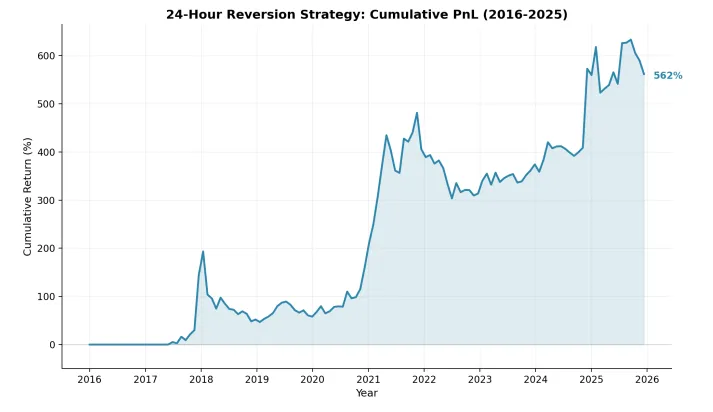
It's even worse than that: REST API reports l/s ratios with a delay of up to 2 minutes. I have to reevaluate my features building on l/s ratios with lagged data...
Just found out that Binance Vision historical data for l/s ratios is timestamped at -5 minutes to what the REST API reports and also fluctuates by ~0.025%. It is important to get the basic data right that the analytics pipeline builds on.
@ScottPh77711570@HerrOak@therobotjames In that case would you recommend to also adapt the target from e.g. 24h to 1h or would you simply adjust the position based on the updated prediction on the 24h?
@the_delta_dog Yes, this is less trivial than I expected. I suspect that the target definition and position sizing might matter more than the feature engineering and model selection. Still a lot of stuff to unpack makes me certain that I will succeed.
@the_delta_dog - ridge with alpha determined by CV on spearman correlation
Could you answer the following questions as far as you feel comfortable with:
- what kind of target are you using (ranked, vol adj log returns)?
- How many features did you include in your model for it to beat costs?
@the_delta_dog I have been following your posts as I am developing something similar. However I couldn't get stable results by now. What I tried so far is:
- selecting features based on Pearson/spearman IC sampled by day/month
- using ranked returns as target (demeaned, z-scored, pct ranked)
@annanay Could you elaborate why the new MM need limited retail activity to scale up their liquidity? I hope to learn something about MMing because I assumed that MM favors activity.
There are signals that just "makes sense", and when you find them, you need to do almost no kind of backtesting and fitting.
This is one such example. Once you understand this signal, you will go, "That totally makes sense, why didn't I think of that?!"
Most people don't understand what it means to be "creative". Every signal must be momentum or mean reversion or *shudders* pairs trading. I hope to share with everyone that good signals can be found by thinking deeply about behavioral effects and existing algorithmic signals.
Random comments and retweets will get this article for free.
There are signals that just "makes sense", and when you find them, you need to do almost no kind of backtesting and fitting.
This is one such example. Once you understand this signal, you will go, "That totally makes sense, why didn't I think of that?!"
Most people don't understand what it means to be "creative". Every signal must be momentum or mean reversion or *shudders* pairs trading. I hope to share with everyone that good signals can be found by thinking deeply about behavioral effects and existing algorithmic signals.
Random comments and retweets will get this article for free.