Time to leave Twitter/X
I have been wanting to leave for a while but the @elonmusk doing the Nazi salute after buying his position into the US government.
US is going downhill into a fascist state quickly.
The Pope is making exactly our point. LLMs “may imitate or even simulate, but they do not understand.”
This is the core epistemic fault line.
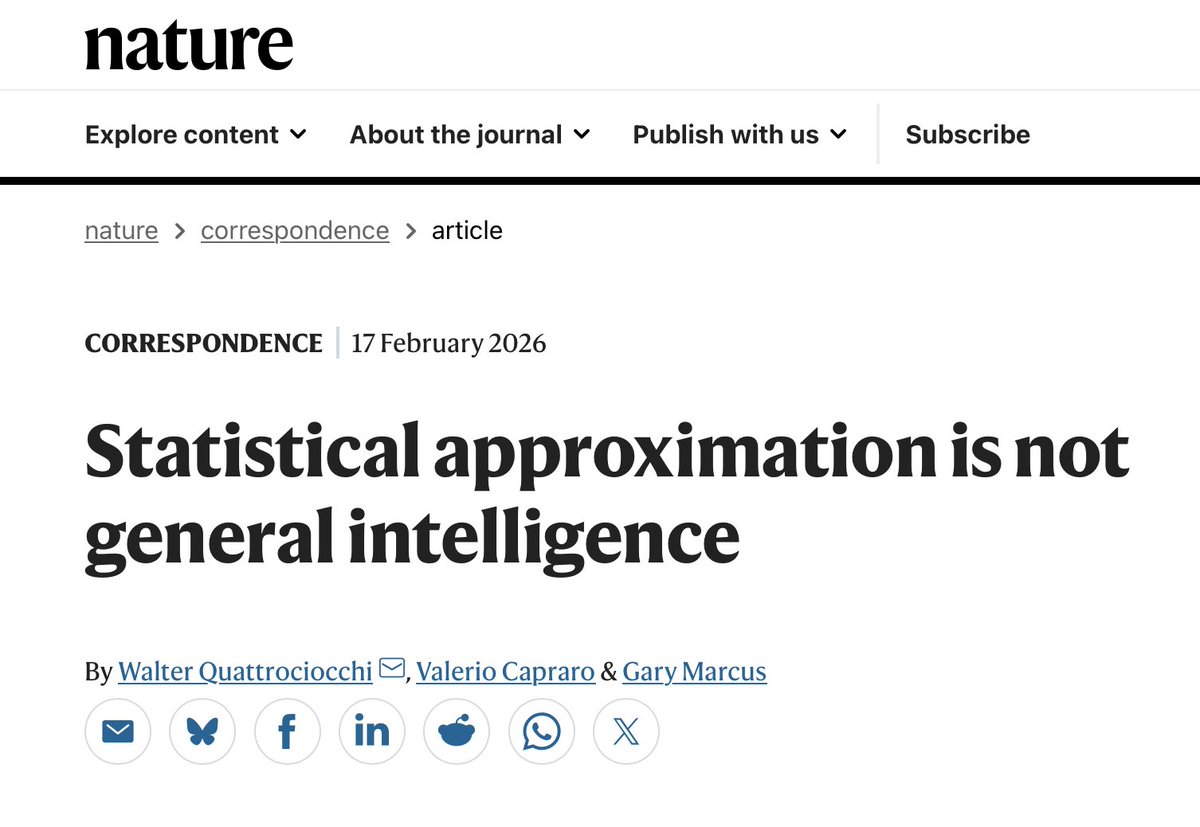
Most AI evaluation is still based on one assumption: if a system statistically approximates human behaviour, then it is close to human intelligence.
But approximation is not intelligence.
Simulation is not understanding.
LLMs can produce the right answer without knowing why it is right. They can simulate empathy without feeling. They can imitate judgment without responsibility. They can generate coherent explanations without having a world to which those explanations are accountable.
Stop confusing behavioural similarity with cognitive equivalence.
Human understanding is embodied, affective, relational, motivational, and normative. It is not just the production of plausible text.
*
Full paper in the first reply
AI agents are advancing research-level math. 🚀
I’m thrilled to share @GoogleDeepMind’s AlphaProof Nexus - an agentic framework for formal proof search powered by Gemini.
When applied to a set of open formal math problems, our agent autonomously solved:
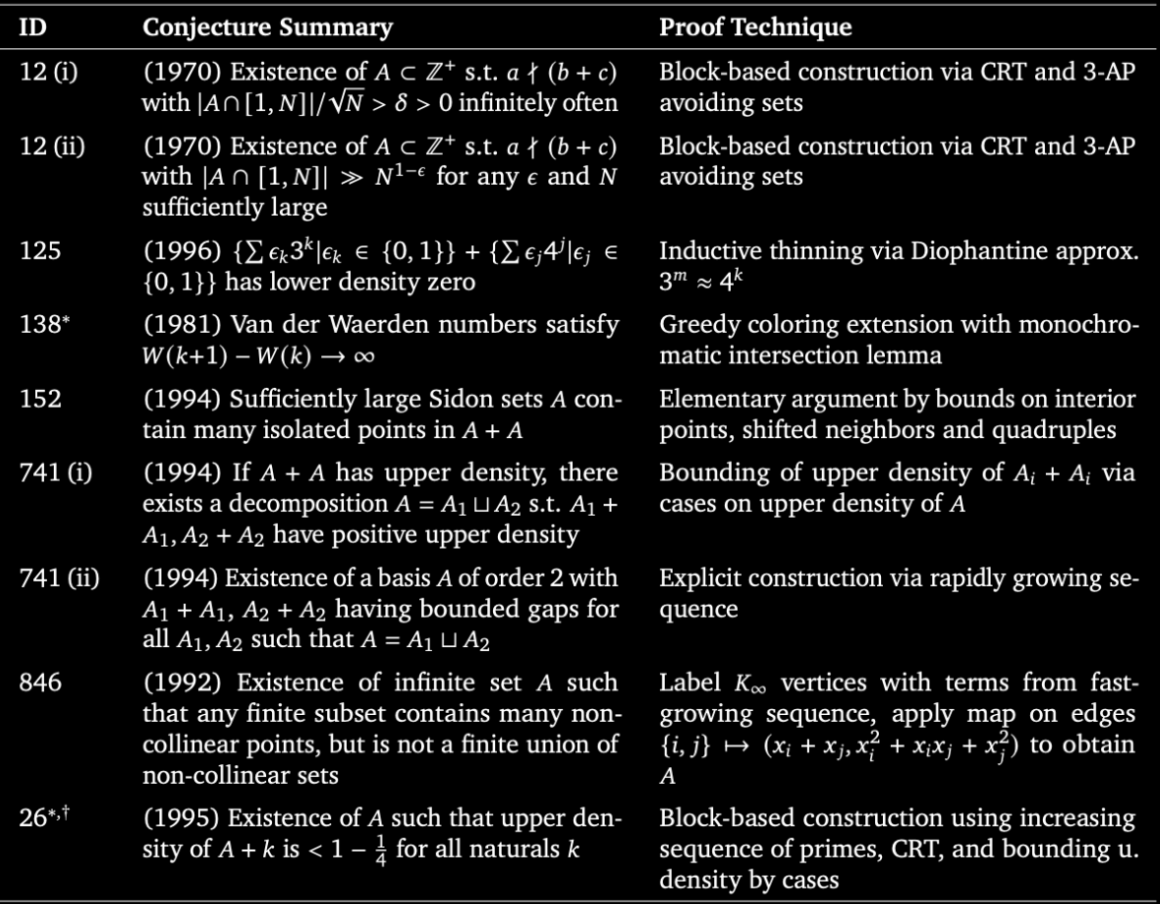
✅ 9 open Erdős problems (including two open for 56 years!)
✅ 44 Online Encyclopedia of Integer Sequences (OEIS) problems
✅ A 15-year-old open problem in algebraic geometry ✅ A 7-year-old open question in min-max optimization
We are collaborating with mathematicians across disciplines - from combinatorics and graph theory to quantum optics. Ultimately, these results show the massive potential of even simple agentic loops powered by Gemini.
Read the paper here: https://t.co/c5M9ZjRXU1
The results of the research happening in my team @GoogleDeepMind have convinced me that the next era of scientific discovery will be aided by AI agents acting as force multipliers for human ingenuity.
That’s why I’m proud to introduce Gemini for Science - a collection of experimental science tools designed to support researchers at every stage of the research process. The tools include:
1️⃣ Literature Insights, built with Google NotebookLM, searches millions of scientific papers to synthesize findings and generate artifacts including data tables, slides, reports, and more.
2️⃣ Hypothesis Generation, built with Co-Scientist, simulates the scientific method via a multi-agent "idea tournament" to generate, debate, and rigorously evaluate research hypotheses.
3️⃣Computational Discovery, built with AlphaEvolve and ERA, is an agentic engine that generates and scores thousands of code variations in parallel, allowing researchers to test modeling approaches in fields like epidemiology in a fraction of the usual time.
Read more: https://t.co/l8XIg8iXCN
Register for access here: https://t.co/V3YS15mRUS
The future of Math is mathematicians and AI agents working together.
Very pleased to introduce @GoogleDeepMind's AI co-mathematician: a multi-agent system designed to actively collaborate with human experts on open-ended research mathematics.
Mathematicians testing the agent across areas as diverse as group theory, Hamiltonian systems, and algebraic combinatorics have reported impressive results.
In autonomous mode evaluation on the rigorous FrontierMath Tier 4 problems, AI co-mathematician scored an unprecedented 48% — a new high score among all AI systems evaluated.
Over the last few months, our team @GoogleDeepMind and @googlecloud has been putting our Gemini-powered algorithm discovery agent AlphaEvolve to work across a wide variety of important applications. The results are amazing!
We're seeing major improvements in everything from chip design and genomics to logistics, electric grid optimization, and earth sciences. And this impact will only grow once it's used on more problems! 🚀 A perfect example of how AI agents will shape the world.
Read more here: https://t.co/JRYk7MOI8K
I’m hearing there’s renewed lobbying in DC and in state legislatures to ban or severely restrict open-source.
Like a few years ago, we’ll need everyone to help show policymakers why open-source matters: for startups, for competition, for economic growth, and for jobs.
If you build with open-source, now is the time to speak up!
Incredibly rewarding to see foundational AI research translate into tools that millions of people rely on.
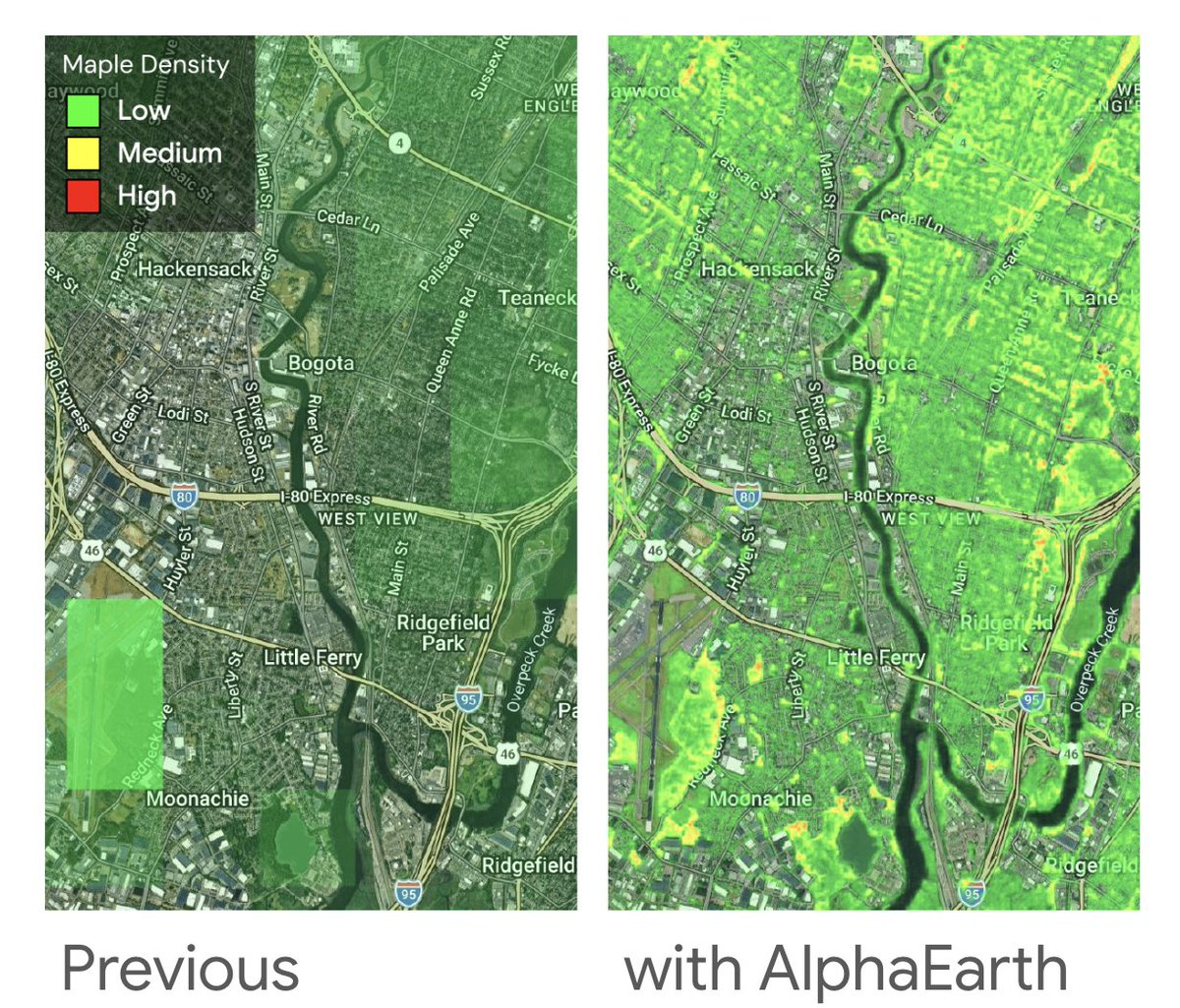
@GoogleDeepMind's AlphaEarth model is now powering high-resolution precise pollen maps for @googlemaps and Pixel Weather in the US - just in time for allergy season! 🌳🤧
Here’s an example showing pollen-producing Maple trees in New Jersey
Managed to tick the right boxes and opensource the core code for "delightful policy gradient".
egg 🥚
a minimal, CPU-friendly simulation environment for exploring RL on LLMs — before they hatch into full-scale distributed training.
https://t.co/0ocDk6vyKC
🚀 Muse Spark Safety & Preparedness Report for Meta AI is out.
We start with our pre-deployment assessment under Meta's Advanced AI Scaling Framework, covering chemical and biological, cybersecurity, and loss of control risks. Our assessment flagged potentially elevated chem/bio risk, so we implemented safeguards and validated mitigations before deployment - bringing residual risk to within acceptable levels.
Beyond the Framework, we also share findings and early explorations of model behavior (honesty, intent understanding, etc.), jailbreak robustness, eval awareness, and more.
We're sharing this report to give a closer look at how we evaluate advanced AI safety. Always more work to do, and we welcome feedback from the community.
https://t.co/azpKHwu7x9
Today we're releasing Gemma 4, our new family of open foundation models, built on the same research and technology as our Gemini 3 series. These models set a new standard for open intelligence, offering SOTA reasoning capabilities from edge-scale (2B and 4B w/ vision/audio) up to a 26B parameter MoE model and a 31B dense model. By releasing Gemma 4 under the Apache 2.0 license, we hope to enable more innovation across the research and developer communities. Our earlier Gemma 3 models were downloaded 400M times and over 100,000 variants of those models have been published, so we're excited to see what the community will do with the even better Gemma 4 models!
Learn more at https://t.co/BW6O3Gr8bc and https://t.co/8M0XSQSP4u
Great work by everyone involved!
#Gemma4 #AI #OpenSource #ML
Colab for "Delightful Distributed Policy Gradient"
A simple example of async actor:learner on MNIST:
- REINFORCE is useless without importance weights.
- PG with exact IW can just about manage
- DG with no IW at all beats *even fully sync PG*
Nothing hidden, run it yourself
https://t.co/zEeJ6hh1VN
With Emmanuel Dupoux https://t.co/hXpYcacDfs and Yann LeCun @ylecun, we consider a cognitive science inspired AI. We analyse how autonomous learning works in living organisms, and propose a roadmap for reproducing it in artificial systems.
https://t.co/fuqYmHZxSu
Calling robotics startups across Europe!
Applications are now open for the @GoogleDeepMind Accelerator: Robotics, a 3-month program designed to help early-stage robotics companies scale from prototype to production.
🤖Powered by Google AI technologies, including Google Gemini Robotics Models.
Apply today: https://t.co/OUvYOaV6IJ
Caught up with my ex-student Euan Ong at Anthropic, and I was embarrassed to reveal I haven't read his now legendary essay on CS career advice.
In case I'm not the last person who hasn't read it, it's a glimpse into an extraordinarily productive mind: https://t.co/yOzEeCFxzX
I think it's time I start speaking up a bit more on this platform. I lead engineering efforts for @geminicli and Gemini Code Assist at @googlecloud .
If I promise to post pithy thoughts and opinions a bit more, let's see if I can get a few followers...
Help me out @ntaylormullen , @JackWoth98 , @LyalinDotCom , @SriThreePO, @geminicli