Un fantasma de 2.000 millones de dólares volando invisible durante 36 horas seguidas.
Dos pilotos.
Un cubículo claustrofóbico.
Un inodoro químico.
Un microondas viejo.
Sin Red Bull.
Sin Monster.
Sin café a voluntad.
La cafeína solo llega como morfina en plena batalla:
cuando el cuerpo ya está al borde del colapso y la misión no puede esperar.
36 horas sin dormir.
Sin horizonte.
Sin que nadie en el mundo sepa que existes.
El vídeo generado por IA dura lo que tiene que durar…
y cada segundo te mete más adentro de la cabina.
Si te atreves a sentir lo que se siente volar lo invisible…
dale play.
¿Cuánto tiempo aguantarías tú?
The economics here are wilder than most people realize.
India produces 24-26 million metric tons of mangoes per year. About 45% of the entire planet's supply. And they export... 32,000 metric tons. That's 0.13%.
Mexico produces a fraction of what India does and exports 10x more by dollar value. India's mango export revenue is ~$60 million. Mexico's is $575 million.
Why would the world's largest producer barely sell to the outside world?
Because 1.4 billion people who consider mango a staple fruit create a domestic market so large that the marginal return on exporting is almost zero. The internal price clears. The logistics of cold-chain shipping a tropical fruit halfway around the world can't compete with selling it fresh at the market down the street.
India has over 1,000 mango varieties. The ones most Indians eat (Langra, Dasheri, Chausa) are so fragile they'd never survive export. The only variety that ships well, Alphonso, represents a tiny fraction of total production.
The "less than 1% exported" stat sounds like a failure. It's actually a demand curve so steep that the rest of the world barely gets a taste.
“First-innings dismissal was dodgy, there was no third umpire. The second-innings dismissal was absolutely plumb. Tendulkar set a trap for me, and I fell for it.”
~ Adam Gilchrist on his dismissals in the famous Kolkata Test, the match that featured VVS Laxman’s greatest innings of 281 and the best Test he was ever part of.
This is insane 😳
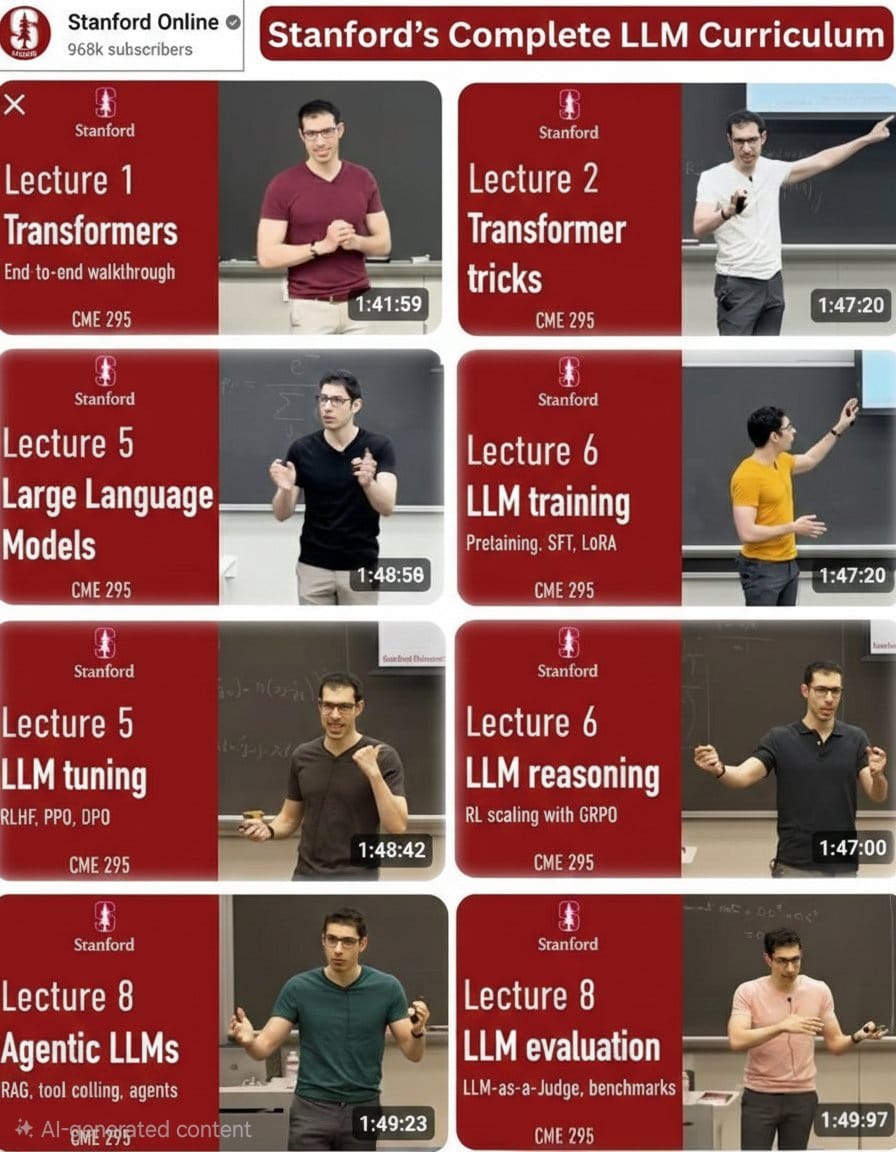
Most people are just using AI tools
Very few actually understand how they work
So I collected Stanford’s complete LLM curriculum
and turned it into a step-by-step learning path
Worth over $500
Giving it away free for the first 4,500 people
Transformers → Training → Alignment → Agents → Evaluation
Study this once and you’ll stop guessing with prompts
and start thinking like a real AI engineer
How to get it:
Follow must (so i can dm you)
Rt and comment 'LLM'
🇮🇳This is Shiva Keshavan, India's trailblazing Winter Olympian.
India may not have won a medal at the Winter Olympics... yet... but they have some pioneering athletes. Shiva is one of them. At just 16 years old, he became the youngest male Olympic athlete to compete in luge, a super fast-paced downhill race on a tiny sled, with no brakes. But, as the BBC's Ella Hubber has been finding out, his journey was far from easy. Without any luge infrastructure in India, Shiva decided to take up the sport using makeshift tracks and sleds built in his garage. His parents were able to scrape together the funds to send him to his first Winter Olympics at Nagano, Japan, in 1998, where he was India's only athlete. Shiva went on to compete at another five Olympics but never made it onto the podium. But it is his decades of determination, courage and incredible speed that make him stand out as a true Olympian.
The struggles of Indian athletes during Congress times!
They never supported Indian athletes!
Google is so powerful that it "hides" other search systems from us. We just don't know the existence of most of them.
Meanwhile, there are still a huge number of excellent searchers in the world who specialize in books, science, other smart information.
Here's a list of sites you may have never heard of!
https://t.co/hLHSvB1Joo - Academic Resource Search. More than a billion sources: encyclopedia, monographies, magazines.
https://t.co/tzsXqbrCJD - a search for the contents of 20 thousand worldwide libraries. Find out where lies the nearest rare book you need.
https://t.co/Fm78bG5hyH - access to more than 10 million scientific documents: books, articles, research protocols.
https://t.co/JvTczb6j6o is a library of scientific bioscience journals published in developing countries.
https://t.co/ZtsaKUl9Jy - volunteers from 102 countries have collected almost 4 million publications on economics and related science.
https://t.co/aBLUtUW6a8 is an American state search engine on 2200+ scientific sites. More than 200 million articles are indexed.
https://t.co/IAzkF2ErNt is one of the most powerful researches on academic studies texts. More than 100 million scientific documents, 70% of them are free
https://t.co/6ujFPDG4AQ
Ecosia is a not-for-profit tech company that plants and protects trees. By dedicating 100% of its profits to the planet, Ecosia has planted over 214,229,374 million trees since its founding in December 2009
https://t.co/ZrIBFqf207
Yandex is a technology company that builds intelligent products and services powered by machine learning. Our goal is to help consumers and businesses better navigate the online and offline world. Since 1997, we have delivered world-class, locally relevant search and information services.
https://t.co/Duwc39PTkx
Project Gutenberg is a library of over 75,000 free eBooks
https://t.co/hOuRZFcDao
“Protection. Privacy. Peace of mind. Get our browser on all your devices.
Search and browse with the DuckDuckGo browser for more protection. Unlike Chrome and other browsers, we don't track you.”
https://t.co/hIAOHavGYB
Presearch is a community-powered, decentralized search engine that provides better results while protecting your privacy and rewarding you when you search.
https://t.co/BoWNlciH7N
Reliable information for all kinds of research
https://t.co/tPY4FcMJDR
Startpage is a global privacy technology company built around the principle of always putting privacy first. Our suite of easy-to-use privacy products helps anyone around the world to protect their personal data online.
from Christopher Seymore