Excited to share a new preprint of my latest paper:
"The Social Psychology of the Living and the Dead"
In it, we set a research agenda for exploring the social psychology of the dead as a potential lens through which we can learn about the social psychology of the living 1/
📢 New Paper! 📢
Oscar Wilde famously said, “There is only one thing worse than being talked about, and that is not being talked about.”
But is that really the case?
1/4
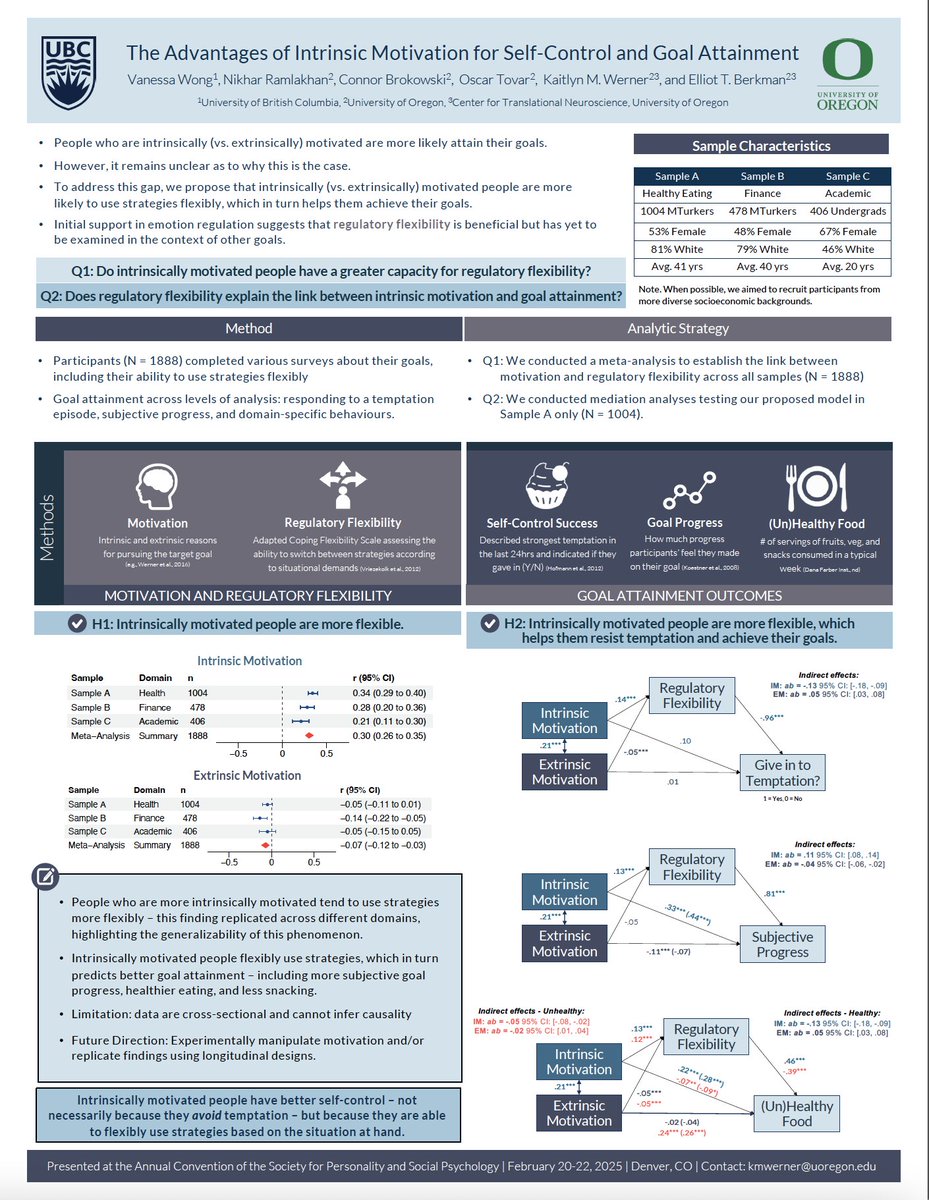
Our wonderful @SPSPnews SPUR scholar, Vanessa Wong, will be presenting her project as a poster on Saturday at #SPSP2025! Be sure to stop by and say hi!
Poster 236: Saturday, Feb 22, 11:30-12:30, Exhibit D
Celebrate submission day in addition to publication day.
Too many hours go into writing and submitting a manuscript to wait until its accepted to celebrate.
Ppl underestimate how proactive you need to be to make friends as an adult
For most of human history, adult friendship was a side effect of contexts where repeated casual interaction was ensured: neighborhoods, church, associations, etc
These contexts have largely disintegrated, but adults have not adapted. We’re still implicitly *waiting for friendship to happen to us* and it just doesn’t
Now the alternative to being lonely is to be weird: to be a proactive friender. This looks like being the one to initiate the first hangout, and also the second and the third. It looks like hosting your own dinners, game nights, etc, which create the repeated context that older generations would have counted on from, eg, church. It means following up on your last text message if they don’t respond (rather than automatically assuming that they’re rejecting you). It also means calibrating when you’re coming on too strong for certain people and friending them more gradually. It’s work!
In my experience, people are very confused by proactive friending behavior. The only social categories in which we proactively reach out are dating or evangelism. I can tell that, when I’m friending someone in this way, they’re like “what is this?” because they’re used to friendship just happening automagically (except it’s not anymore for them)
I used to feel bitter that I always needed to be the guy to make things happen (esp bc I’m a natural introvert), but that’s just the role that universe assigned me, as someone who’s seen the situation and who can do something about it. Maybe that can be true for you too
So you just gotta persevere – take one for the team as humanity goes through this painful transition from atomized loneliness to new types of togetherness 🚀
🚨‼️New pub alert from Journal of Health Psychology!
Evidence shows that though all groups report similar levels of perceived weight discrimination, White men report the worst psychological and behavioral outcomes. Emotional regulation plays a key role in these negative outcomes
OMG, I want to live in this article! Spiegehalter puts in words exactly how I approach probability: it doesn't exist as an objective measure, but it's still useful to pretend it does.
In a way, it feels like Calibrated Bayes, my favorite kind of Bayesian!
"research consistently suggests that friendships are as important as family ties in predicting wellbeing in adulthood and old age" https://t.co/KNM3J4AnUi via @BBC_Future
📢 Thrilled to share:
"Ostracism in Everyday Life: A Framework of Threat and Behavioral Responses"
published in JPSP @APAJournals on the day of my PhD defense - talk about timing!
🔗 https://t.co/EL8ikVon7T
@dongning_ren@OlgaStavrova@SelmaRudert Kip Williams & @R_Greifeneder
Pls RT: I am preparing a new undergrad course on the psych of social interactions, and I need your help! Do you have course materials on related topics (social perception, conversation science, communication, interpersonal processes) you can share w/ me? My DMs are open—many thx!
🚀 New paper out!
We've all been tempted to check our phones mid-conversation—but what if we could turn that into a positive social connection experience? Meet 'resisting phubbing'! 📱✨ https://t.co/BY5nWxs1KC
w/ Luca Pancani, Paolo Riva (@ConnectLab16), and Marco Perugini
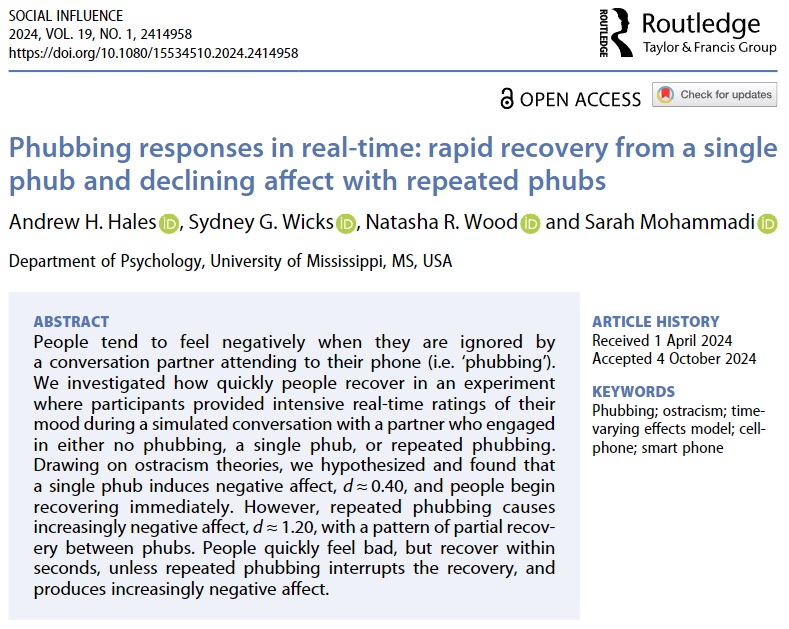
Thrilled to share our new paper that explores the real-time effect of being phubbed once or repeatedly. Check it out in Social Influence: https://t.co/m7wdBlEiaw
w/ Andy Hales, @sgwicks, and Sarah Mohammadi
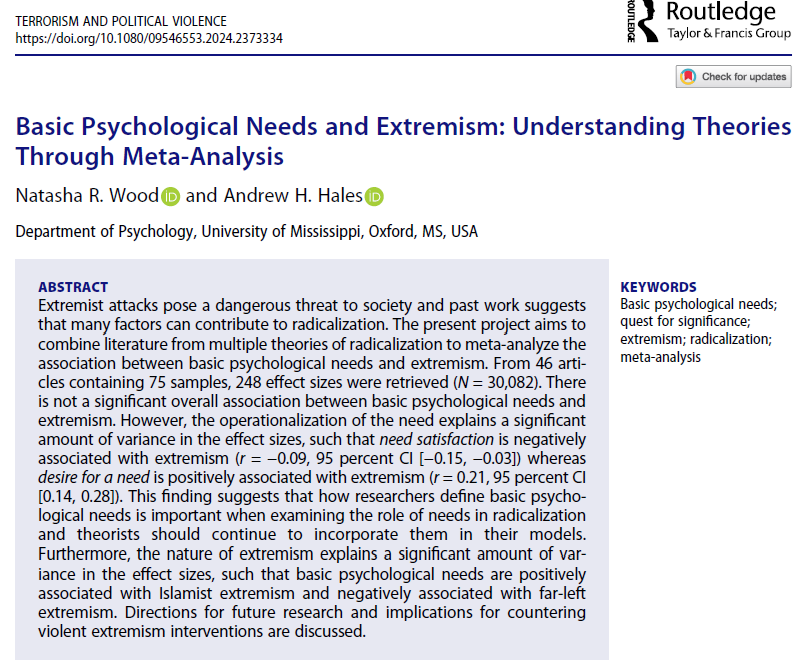
🚨New pub🚨 Excited to share our meta-analysis that explores the association between basic psychological needs and extremism. Check it out in Terrorism and Political Violence!
https://t.co/DifxPduzCs
Our lives don’t always follow a linear path. Turns out, neither do our data! Come to our #IARR2024 symposium w/ @YuthikaGirme, Keely Dugan, & Brian Don on nonlinear effects in relationship science, and see some data as beautiful as the Boston Public Library 😁