#Ossdsign $OSSD
Carnegie angående Ossdsign, de gissar Q4 med, så man var inte helt fel ute själv. Men minsta lilla tecken mellan Q3-Q4 så kanske det räcker för en rekyl modell större.
https://t.co/WnMZV3tReo
@MilkArthu Hade ett sidoprojekt som jag tjänade riktigt bra på ett tag. sen kom chatgpt och typ alla kunder försvann på några månader, de gör det själva nu gratis. lite surt måste jag säga...
och kan bara tänka mig vad som kommer hända med större bolag som har anställda...
A week ago, the market was asking two questions about $SHT:
1. Can they scale production?
2. Can they finance it?
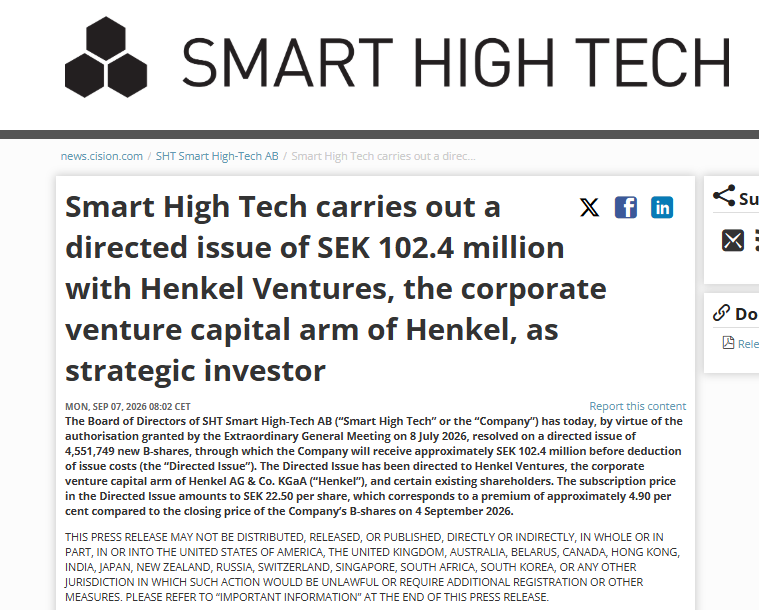
BTR answered the first. Today, Henkel answered the second.
SEK 102.4m raised at SEK 22.50, at a premium, with Henkel Ventures investing ~SEK 73m and becoming a 9% shareholder.
This is much more than financing. SHT’s closest commercial partner, the company already working with GT-TIM under the Loctite umbrella and across customer projects, is now putting its own capital behind the journey.
BTR provides the industrial platform. Henkel provides global commercialization, capital and now ownership.
The two largest short-term risks I highlighted in my recent article have changed dramatically within a week.
What an extraordinary development.
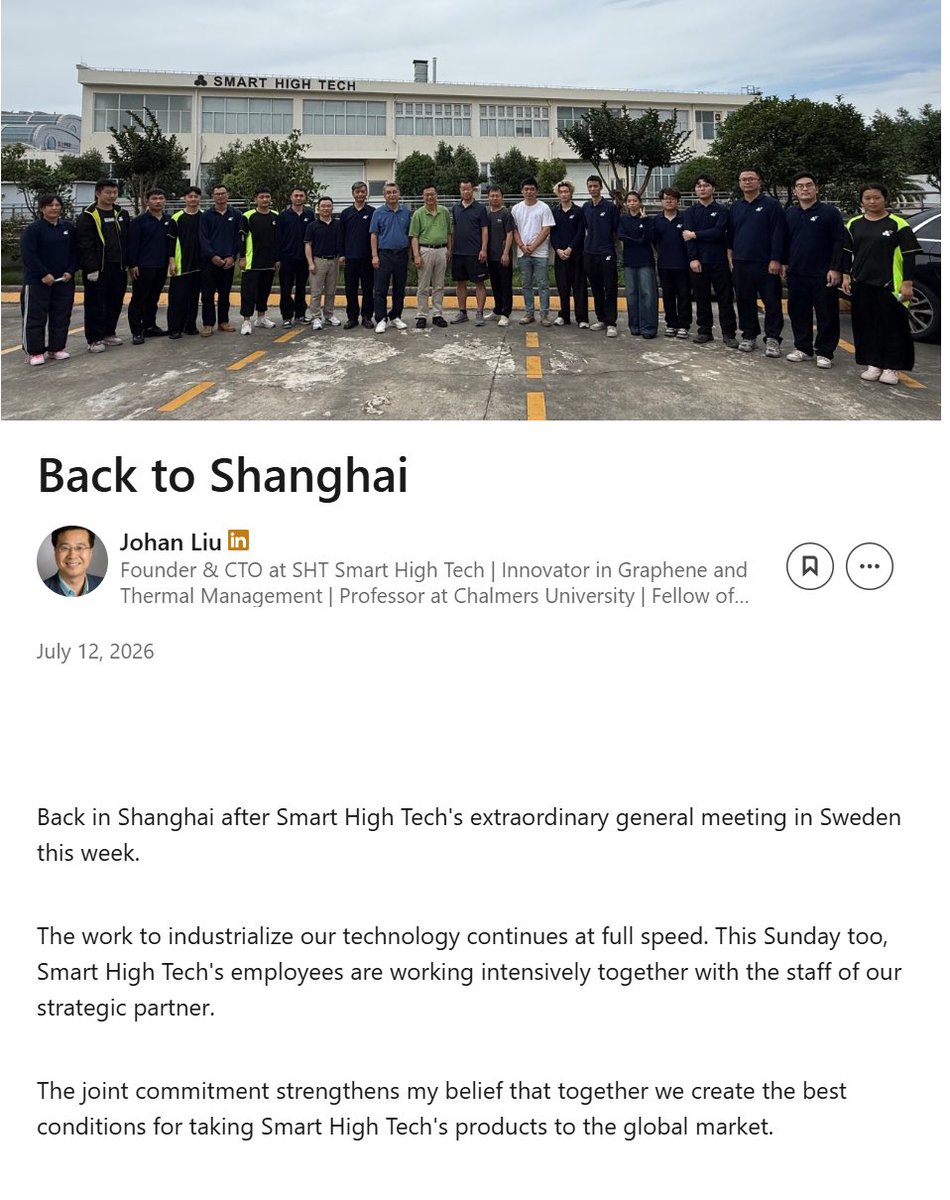
Johan Liu at $SHT just shared that Smart High Tech employees are working side by side with staff from their strategic partner Henkel in Shanghai to industrialize the production process (even on a Sunday).
Worth remembering that Henkel generated €20.5B in revenue in 2025. Seeing a global industrial leader actively allocating personnel to support SHT’s industrialization certainly says something about how they view the opportunity.
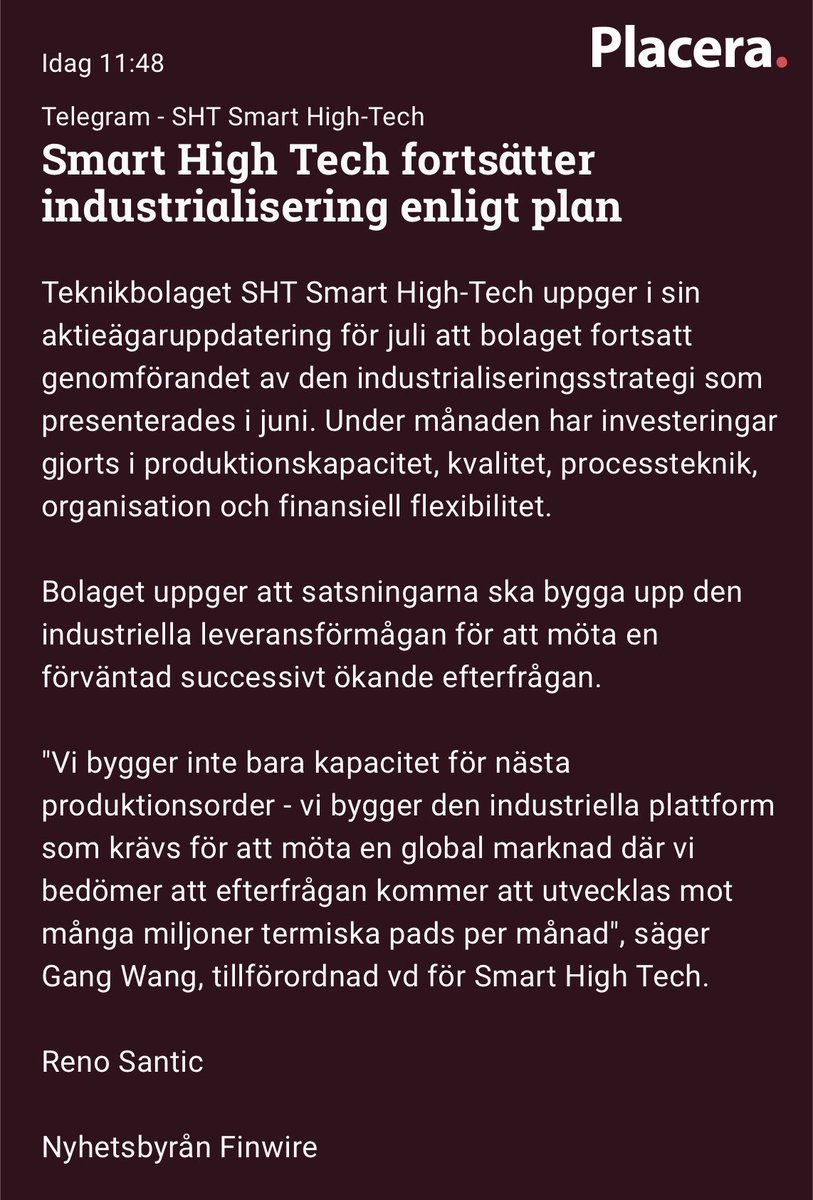
This also fits remarkably well with last week’s shareholder update, where SHT stated that discussions with customers and partners now point towards demand measured in millions of graphene pads per month, with a roadmap targeting 1 million pads/month by the end of 2027 as the first industrial milestone.
At the same time, recent industry reports suggest that NVIDIA’s Rubin platform is moving towards graphene thermal pads, which would further underline why manufacturing capacity is becoming the key competitive advantage.
At the EGM, Johan Liu also indicated pricing around $35–40 per pad for SHT’s high-performance products. If SHT eventually succeeds in scaling production anywhere near its long-term ambitions, the revenue potential becomes very significant.
There is still a lot to prove, especially around industrial scaling. But connecting the public pieces together, it’s hard not to feel that the coming years could be incredibly exciting for this company.👀
Another sign SHT is moving from technology validation toward industrial scale.
The planned BTR collaboration focuses on production capacity, quality, and supply chain readiness.
The opportunity is becoming increasingly an execution story.
Just so we are clear, BTR New Material Group is the worlds largest battery anode materials maker. And $SHT announced intent to partner with them.
Mr. Liu might be a genius.
Follow-up on $SHT – New Press Release today (2026-06-17) (Important!)
Today, Smart High Tech announced its intention to enter into an industrial collaboration with BTR New Material Group to evaluate expanded production capacity and scalable manufacturing of graphene technology for electronic cooling.
This targets my main concern about SHT that I have been writing about, whether the company can commercially scale and execute.
The PM specifically points to:
• industrial production capacity
• technical and operational industrialization
• graphene film optimized for electronic cooling
• process and quality validation
• scalable manufacturing
• regional supply chain structure
BTR New Material Group is listed on the Beijing Stock Exchange under ticker 920185. The company generated around 17 billion CNY in revenue in 2025, has more than 8,000 employees and is the world’s leading supplier of lithium-ion battery anode materials, at the forefront of next-generation silicon-based anodes, and has realized large-scale production of high-nickel NCA cathode material in China.
BTR also appears to be connected to supply chains involving some of the largest battery and EV-related players in the world, with public sources mentioning customers such as CATL, BYD, Sunwoda, Panasonic, Samsung, LG, SK On, EVE, Gotion and REPT.
This becomes even more interesting after SHT’s GT50R® launch yesterday. As I said in my previous post, GT50R® is aimed at applications such as:
• battery cooling
• battery pack encapsulation
• power electronics
• energy storage
• EVs
• power modules
So the potential BTR collaboration does not only relate to scaling graphene film for electronic cooling. It also creates a very logical industrial fit with the markets SHT is now targeting through GT50R®.
But it is still important to stay realistic. This is not yet a volume order. It is not a confirmed customer contract. It is not a final manufacturing agreement with guaranteed capacity. The wording is still “intends to enter into” and “framework for evaluation”. So the execution risk remains.
SHT still needs to prove customer qualification, validated production processes, scalable output, consistent quality, volume orders and recurring revenue.
But this is exactly the type of step I wanted to see.
SHT now has:
- Henkel as strategic partner,
- Thermal Grizzly as a commercial/B2C channel,
- $NVDA B2B qualification track for GT-TIM®,
- and now potentially BTR as an industrial scaling and production partner.
That is a very different setup from where the company was a few years ago.
SHT has built a strong technology platform in a market where the need for better heat management is obvious across AI infrastructure, semiconductors, EVs, batteries, energy storage and power electronics. Now the company needs to prove that the platform can become industrial reality.
The CEO of Novo Nordisk $NVO, Mike Doustdar, has revealed that the company is planning to seek regulatory approval for their oral Wegovy pill in China in the next few months.
It has already been approved in the US, the United Arab Emirates and the UK, and is expected to be approved in the EU soon, so this will be another huge market for them to tap into if they do get approval in China.
As always, the share price hasn't reacted much to this news, but it is at least trading a little higher pre-market at $44.21.
$MSFT --- $MSFT just delivered Q3 Microsoft Cloud revenue exceeding $54 billion, up a massive 29% YoY. Previously, Azure growth had been hit by capacity constraints due to Nvidia chip shortages and data center power supply bottlenecks. But as Microsoft ramped up Capex in 2026 and optimized its compute supply chain, those Azure capacity gaps are steadily closing. Management expects growth to remain red-hot at 37-38% in coming quarters.
The market had been sweating bullets that Microsoft's aggressive AI capital spending would crush margins — but in the latest quarter, Operating Margin didn't just hold steady, it actually EXPANDED to 46%. The efficiency gains from Azure and Microsoft 365 Copilot perfectly offset infrastructure depreciation costs.
$MSFT shares saw a notable technical pullback from highs back in April, driven by the tariff-induced tech sector rotation. But this selloff had NOTHING to do with deteriorating fundamentals — instead, it created an absolutely juicy "golden entry point" valuation for long-term capital in May and June.
1. The most certain AI monetization flywheel (absolute B2B king)
While most tech companies are still burning cash and telling AI fairy tales, Microsoft has already built the complete closed-loop ecosystem: compute power + foundation models (OpenAI) + cloud infrastructure (Azure) + application layer (M365 Copilot/GitHub).
Enterprises might skip buying flashy AI gimmicks — but they CANNOT live without Word, Excel, Outlook, and Teams.
Microsoft simply needs to raise prices (boost ARPU) via Copilot across its hundreds of millions of existing enterprise subscribers to print money nonstop. This B2B stickiness and per-customer monetization power is unmatched by any other internet company.
2. Decimating cloud competition from above
With generative AI exploding, enterprises increasingly prioritize LLM ecosystems when choosing cloud providers. By deeply integrating OpenAI's cutting-edge models (including the GPT-5 era tech stack), Microsoft has turned Azure into the default choice for deploying enterprise AI applications. This is allowing $MSFT to consistently capture the largest slice of incremental market share vs. AWS and Google Cloud.
3. Bulletproof balance sheet and shareholder returns
Microsoft sports a near-AAA rated balance sheet with hundreds of billions in cash on hand, and Free Cash Flow hitting all-time highs every single year.
In this macro environment of economic volatility and uncertain interest rates, this mega-cap stock — boasting massive cash generation, a 0.93% dividend yield, and ongoing share repurchase programs — is the natural "safe haven" for global institutional capital.
Spent some time reading through all 7 open positions at $SHT today.
What stood out wasn't the individual roles.
It was how consistent the message was across every single job ad.
They keep talking about:
• industrial-scale production 📊
• factory expansion 🏭
• global sourcing 🔍
• international growth 🌍
• multi-site operations 🇸🇪🇨🇳(🇺🇸?)(🇩🇪?)
• production qualification ✅
• yield improvement ⬆️
• automation 🤖
• supply chain resilience 🛡️
Interestingly, they're not hiring a bunch of researchers.
They're hiring the people you'd expect if your biggest challenge is scaling manufacturing rather than proving the technology.
A few quotes that caught my attention:
→ "moving from R&D to industrial-scale production"
→ "support production scale-up initiatives and future factory expansion projects"
→ "expanding our international footprint"
→ "help build the supply chain behind the next generation of AI technology"
Combined with:
• NVIDIA qualification
• Henkel partnership
• AMD relationship
• 50+ prototype orders from 25+ global industry leaders
...it feels like management is spending very little time talking about whether the technology works and a lot of time talking about how to produce more of it.
The upcoming EGM is also interesting in that context.
If it ultimately enables the company to raise the capital required for a major production expansion, potentially with support from Henkel, SHT may finally get the resources needed to pursue the opportunity in front of them at scale.
According to management, current output does not even cover 10% of NVIDIA's indicated demand.
And that's before considering the 25+ other global industry leaders currently evaluating the technology.
The gap between current capacity and potential demand is enormous.
Companies valued at ~€120M rarely find themselves in a position where they are already supplying NVIDIA while simultaneously trying to scale capacity to meet future demand.
Just an observation.
Link: https://t.co/jcqml7FaRq