Forbes Crowns Armenia “The Birthplace Of Wine” 🇦🇲👑
➖➖➖
Forbes has dedicated a feature to Armenian winemaking, calling the country “the new crown holder in the debate over the birthplace of wine,” writes Forbes journalist Layne Randolph.
The article traces Armenia’s 6,000-year wine story from the Areni-1 cave — the world’s oldest known winery, dating back 6,100 years — to today’s revival of indigenous grapes like Areni, Voskehat, and Khatouni. Randolph emphasizes how Armenia’s ancient legacy is now being reshaped into a global future, with exports more than doubling over the past decade and bottles reaching shelves from Paris to Los Angeles.
For much of the 20th century, however, Armenia’s vineyards were redirected toward brandy production under Soviet rule, creating a spirit so iconic that Winston Churchill famously received 400 bottles of ARARAT Brandy annually from Joseph Stalin after the 1945 Yalta Conference. That reputation stuck, branding Armenia as “brandy country.” But as Forbes notes, Armenia’s true legacy lies in wine — and it is reclaiming that crown today.
Unearthing the World’s Oldest Winery
The Areni-1 cave complex in Vayots Dzor, discovered in 2007, offered archaeologists the earliest complete winemaking setup ever found. Excavations revealed a clay press draining into a fermentation vat, storage jars half-buried for temperature control, grape seeds, skins, and even pottery shards stained with the red pigment malvidin.
“For the first time, we have a complete archaeological picture of wine production dating back 6,100 years,” said archaeologist Gregory Areshian, co-director of the dig. The site even yielded the world’s oldest leather shoe, underscoring its time-capsule significance.
Forbes noted that unlike its neighbors Georgia & Turkey, Armenia can point to a single excavated site, the Areni-1 cave in its Vayots Dzor province, with a press, a vat & grape DNA, neatly tying its 6,100-year-old winemaking past to the present. The fact that those seeds were Areni — still cultivated today — gives Armenia’s claim unusual continuity.
From the Bible to the Silk Road
Scripture itself links Armenia to wine: Noah’s Ark is said to have landed on the Mountains of Ararat, where he planted grape seeds. By the 4th century, Armenia became the first nation to adopt Christianity as a state religion, and monastic winemaking thrived.
Armenian wine traveled the Silk Road, where merchants were known for cultivating and blending vintages carried in amphorae and wineskins, making Armenia a gateway for wine’s spread across Europe and Asia.
Armenia’s Winemakers Today
Forbes highlights the new generation of Armenian winemakers who are reviving old methods and pushing new boundaries:
- Trinity Canyon Vineyards: Near Areni-1, leaning into terracotta vessels and indigenous grapes.
- Zorah Wines: Aging Areni in buried karases, winning international acclaim.
- InVino (Mariam Saghatelyan): Opened Armenia’s first wine bar in 2012, building Yerevan’s wine culture.
- Gevorkian Winery: Pioneering pét-nats, pomegranate wines, and reviving ancient kakhani techniques.
- Krya: Restoring neglected old vines in Vayots Dzor, preserving heritage fruit.
- Yacoubian-Hobbs (Paul Hobbs & Viken Yacoubian): Combining international expertise with Armenian terroir, exporting wines directly to U.S. markets.
These players, Randolph writes, are ensuring Armenia’s comeback has not just a headline, but a marketplace and a future.
A Future Written in Ancient Vines
The past may have given Armenia the world’s oldest winery, but its modern producers are making sure the story continues. Exports have surged, Armenian wines are now sold in more than 30 countries, and international acclaim continues to grow.
“Armenia will always be proud of the brandy that once charmed Churchill,” Randolph concludes. “But its wine story—anchored in a cave older than the pyramids—is what it wants the world to remember now.”
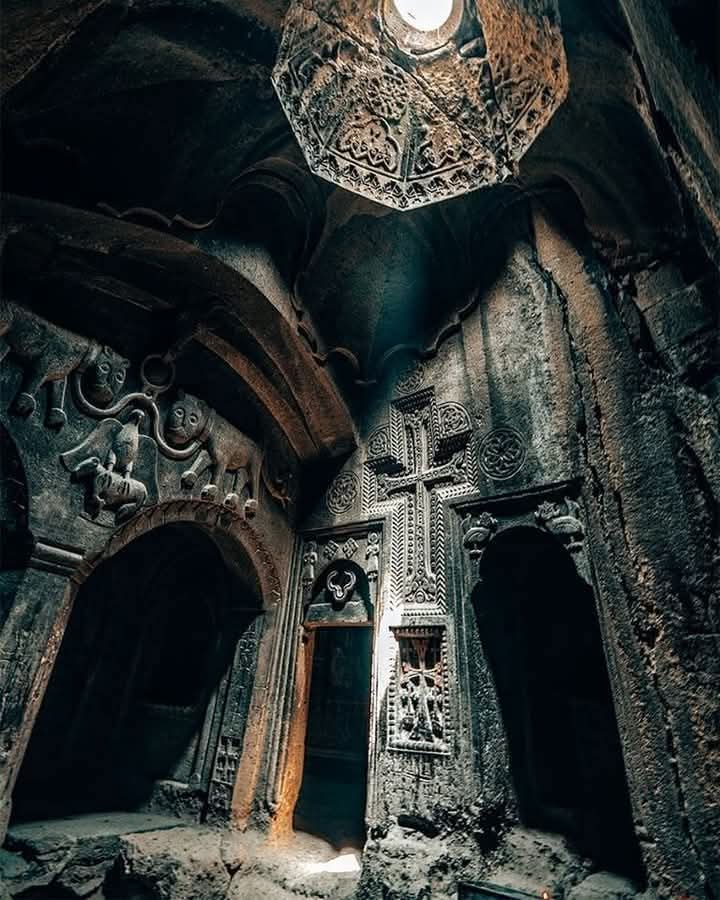
The monastery of Geghard and the Upper Azat Valley contains a number of churches and tombs, most of them cut into the living rock, which illustrate Armenian medieval architecture at its highest point. The complex of medieval buildings is set into a landscape of great natural beauty, at the entrance to the Azat Valley. High cliffs from the northern side surround the complex while the defensive wall encircles the rest.
The monuments included in the property are dated from 4th-13th Century AD. At early period, the Monastery was called Ayrivank (Monastery in the Cave) because of its rock-cut construction. The monastery was founded, according to tradition by St. Gregory the Illuminator, and was built following the adoption of Christianity as a state religion in Armenia (beginning of 4th Century AD). The main architectural complex was completed in 13th Century AD and consists of the cathedral, the adjacent narthex, eastern and western rock-cut churches, the family tomb of Proshyan princes, Papak’s and Ruzukan’s tomb-chapel, as well as various cells and numerous rock-cut cross-stones (khachkars). The Kathoghikè (main church) is in the classic Armenian form, an equal-armed cross inscribed in a square in plan and covered with a dome on a square base, linked with the base by vaulting. The east arm of the cross terminates in an apse, the remainder being square. In the corners are small barrel-vaulted two-storey chapels. On the internal walls there are many inscriptions recording donations. The masonry of the external walls is particularly finely finished and fitted. A gavit (entrance hall) links it with the first rock-cut church.
The first rock-cut church was built before 1250, entirely dug into the rock and on an equal-armed cruciform plan. To the east, a roughly square chamber cut into the rock was one of the princely tombs (zhamatoun) of Proshyan Dynasty. This gives access to the second rock-cut church built in 1283. The second zhamatoun, reached by an external staircase, contains tombs of princes Merik and Grigor. A defensive wall encircled the monastery complex in 12th-13th Centuries. Most of the monks lived in cells excavated into the rock-face outside the main defensive wall, which have been preserved, along with some simple oratories.
St. Astvatsatsin (Holy Mother of God) chapel is the most ancient preserved monument outside the ramparts and is located on the western side. It is partially hewed in the rock. There are engraved inscriptions on the walls, earliest of which date back to 1177-1181 AD. Residential and economic constructions were built later, in 17th Century.
The monastery of Geghard is a renowned ecclesiastical and cultural centre of medieval Armenia, where a school, scriptorium, library and many rock-cut dwelling cells for clergymen could be found in addition to religious constructions. Historians Mkhitar Ayrivanetsi, Simeon Ayrivanetsi, who lived and worked there in the 13th century, contributed to the development of the Armenian manuscript art. It was also renowned for the relics housed there. The most celebrated of these was the spear, which had wounded Christ on the Cross and was allegedly brought there by the Apostle Thaddeus, from which comes its present name, Geghardavank (Monastery of the Spear). The spear was kept in the Monastery for 500 years. Relics of the Apostles Andrew and John were donated in the 12th century and pious visitors made numerous grants of land, money, and manuscripts over the succeeding centuries.
#archaeohistories
🚨ELON MUSK: "It's pretty wild that a tiny tax on tea started the revolution and now we get the living daylights taxed out of us and theres no revolution. You get taxed on what you earned, you get taxed on what you buy, and you get taxed on what you own. Taxes, taxes, taxes, and what does it get spent on? That's why we need to reduce the size of government."