Sr. AI Architect @Adobe | Prev. Director (Distinguished) AI Eng for AI Search and Discovery @BestBuy | @Stanford AI Lab, @oneconcerninc ML, @datmoAI Co-Founder
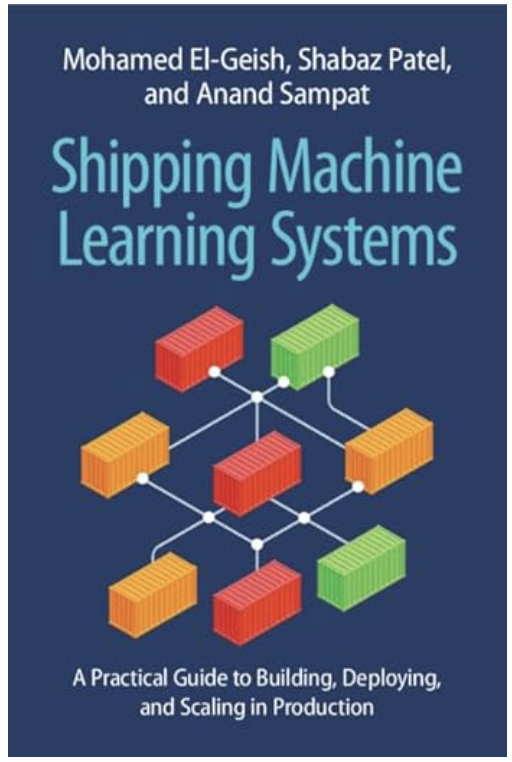
Very excited that our book, Shipping Machine Learning Systems: A Practical Guide to Building, Deploying, and Scaling in Production, is now available.
Early in my career, Martin Kleppmann’s Designing Data-Intensive Applications gave me a framework for thinking in systems. It stuck with me not because of flashy techniques, but because it was clear, opinionated, and grounded in real-world constraints.
When I was shipping ML systems at my startup, Datmo, and later at One Concern and Best Buy, I kept running into challenges no book had fully prepared me for. My co-authors, Anand and Mohamed, saw the same patterns in their own work.
- Systems, models, and agents that silently decayed in production
- Debugging pipelines with logs, traces, and version control
- Evaluation setups misaligned with actual product outcomes
- CI frameworks using LLM-as-a-judge to catch regressions
- Architectures that didn’t survive first contact with users
- Constantly shifting constraints: latency, cost, throughput, org structure
These are the kinds of issues that led to this book.
We structured it around the crawl → walk → run progression most teams follow (or should). The goal was to document what we wish we’d known at each stage, and the tradeoffs that matter in practice.
Whether you’re working with traditional ML models or AI agents, building infra or running models in prod, I hope this book helps.
Thanks to many who have reviewed or contributed to the book! @chipro@Hassan_Sawaf, Riham S., @emadelwany, @_moelgendy, Ritesh Bajaj, @anders_ai, Sahil Khanna, @qasimmunye, @LawLM@qasim31wani@melissapan and others.
Cambridge: https://t.co/g5S588Gkqt
Amazon: https://t.co/3zi3Xub8vG
Congratulations to the @hqfabi team on the launch! Step change for data analytics. Connect to different data sources, ask questions in plain english, and get clear, reliable answers. One can turn the analysis into dashboards/workflows in minutes. This is how AI should speed up decision-making.
Today we’re introducing @hqfabi 2.0 - Your AI analyst for ALL your data
Connect to *any* data source.
Analyze it using an AI agent that understands (and learns!) your business.
Turn your insights into dashboards or workflows in minutes.
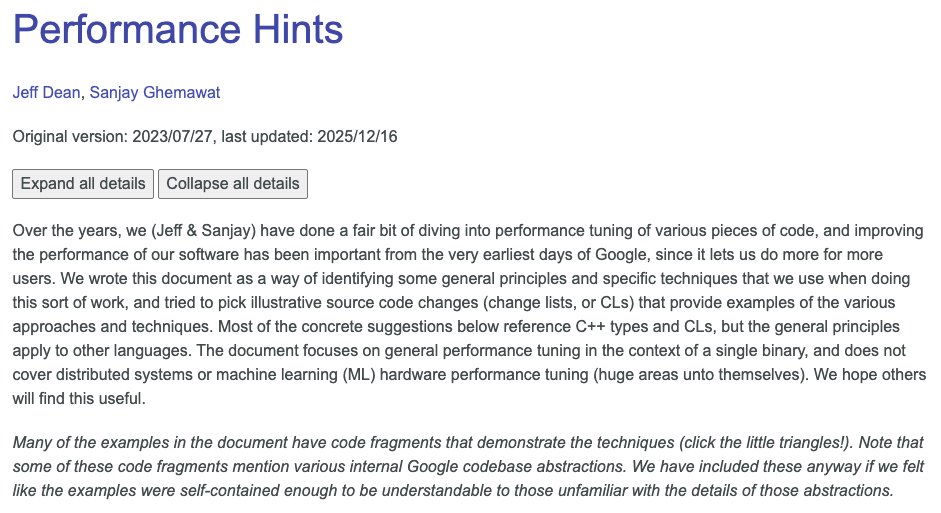
Performance Hints
Over the years, my colleague Sanjay Ghemawat and I have done a fair bit of diving into performance tuning of various pieces of code. We wrote an internal Performance Hints document a couple of years ago as a way of identifying some general principles and we've recently published a version of it externally.
We'd love any feedback you might have!
Read the full doc at: https://t.co/jej95g236P
📣 Today we’re officially announcing our launch of @hqfabi Workflows!
For those of your who follow us, you know that we believe in two things:
1️⃣ Finding insights from your data should be dead simple regardless of where your data lives. Some teams have everything flowing to awesome data warehouse ( @Snowflake, @Databricks, @MotherDuck, @ClickHouseDB to name a few), others live in Google Sheets or @Airtable. They each have their purpose, insights shouldn’t be limited to teams that just use one or the other.
2️⃣ Insights should be delivered where the team works. Dashboards are great - especially when they have AI natively embedded like ours do ;) - but rely on you remembering where to find said dashboard to use it. More impactful: Bring the insights to your users in email, @SlackHQ, or Google Sheets.
We’re bringing all these pieces together with Workflows.
→ Low-code Integration Cells: Using Python, the lingua franca of data analysis, you can push dataframes, images and variables to Google Sheets, Slack, or email in just a few clicks.
→ AI Analysis Cells: Want to have AI generate a summary to send to Slack? Or need the AI to process a dataframe column using a prompt? No problem! Our AI enrichment and summarization cells make that so simple even I can do it!
→ Workflow Canvas View: Get a birds eye view of your entire workflow to see how all the pieces work together. Tip: this is a GREAT way to quickly understand what one of your coworkers built when they share their work with you.
Much more to come on this front. I believe data teams will spend less time doing one-off analysis in the future and more time building “insight pipelines”. We’re building the foundation for this.
Read all about why we built Workflows, what features are in it, and what you can do with them in our latest blog 👉: https://t.co/mYyOrjEMyg
PS: We’d love your support on ProductHunt as well! https://t.co/8AKpNlusxh
Introducing Willow, our new state-of-the-art quantum computing chip with a breakthrough that can reduce errors exponentially as we scale up using more qubits, cracking a 30-year challenge in the field. In benchmark tests, Willow solved a standard computation in <5 mins that would take a leading supercomputer over 10^25 years, far beyond the age of the universe(!).
GenAI is set to revolutionize many industries including e-commerce search. It will be smarter, faster, and more intuitive. Finding the right product will become much easier.
I am looking for AI/ML Engineers to build impactful models and AI agents for the e-commerce sector, serving millions of users. If this sounds interesting to you, please reach out!
https://t.co/17n20DxE21
@RichardSocher@databricks @YouSearchEngine Great! How do you currently deploy your models? Are you using vLLM, Nvidia Triton, or a custom inference engine?