When China figures out how to manufacture a product, their ability to scale is often greater than the rest of the world combined. We saw this with lithium batteries and solar, for example.
SpaceX is a rare counter-example, where its mass to orbit is roughly an order of magnitude greater than the rest of the world, BUT China now does a majority of non-SpaceX mass to orbit. SpaceX is an anomaly in the matrix.
Maybe RAM will be different, but RAM was a low margin commodity only ~3 years ago. LP5 and LP6 are designed to a common standard that China seems to be solving fast.
Newer HBM architectures and things like an SRAM layer below logic and 3D stacking RAM on top of logic while finding a way to keep the logic cooled will be harder to solve.
NO WAY: Metas Fable-Class Model outperforms Fable 5.1 on AA Intelligence Index! Just short behind Opus 5.5!
This is insane, the whole game changed again! OpenAI under huge pressure! More to come!
this is the most DANGEROUS thing on internet today
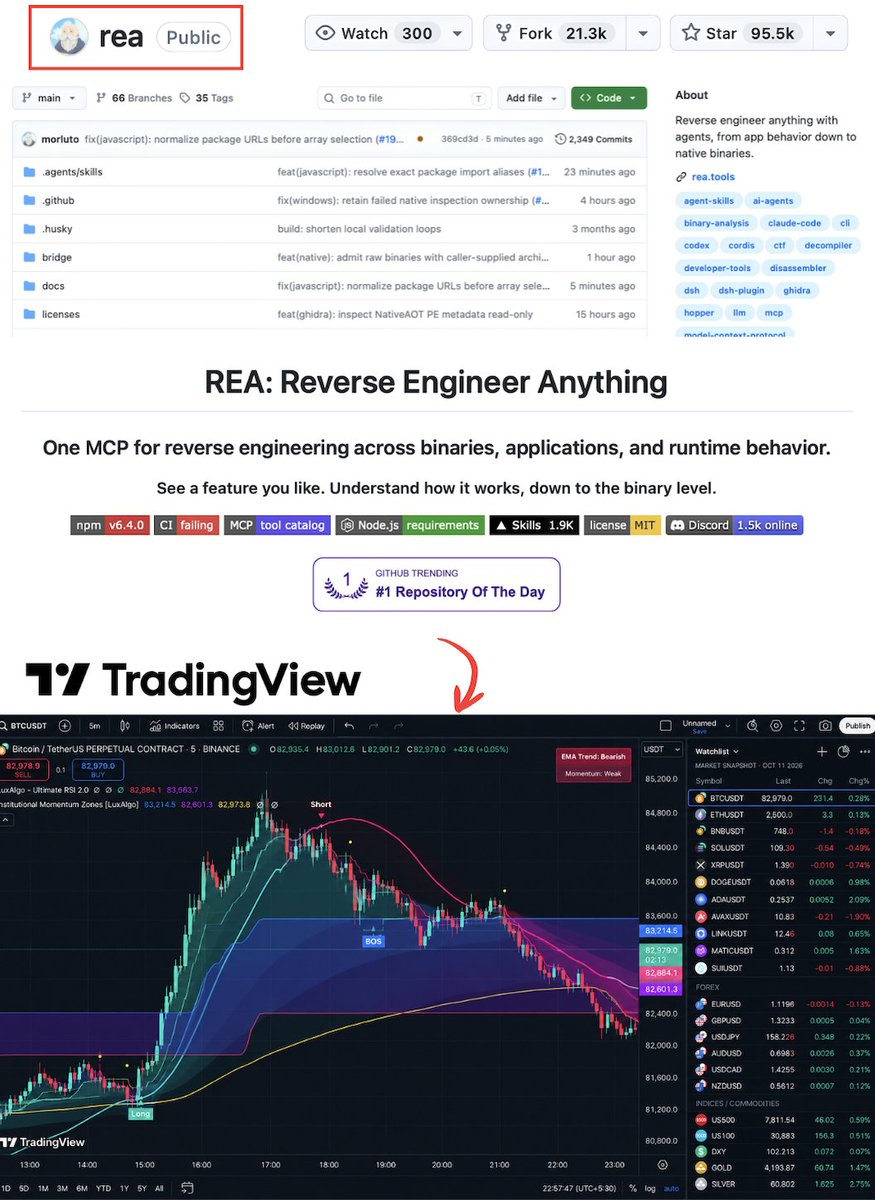
REA (Reverse Engineer Anything) - this open source MCP lets your AI agent reverse engineer any app, down to the binary
i just reverse engineered TradingView, now I am using their premium indicators for FREE - software is cooked
here is how to use REA to reverse engineer TradingView:
1. point REA at TradingView's publicly observable interface and map every major feature, from chart interactions to indicators and alerts
2. trace how the interface behaves when you switch symbols, change timeframes, add indicators, draw levels, and update chart layouts
3. use REA's available MCP tools to investigate authorized software artifacts and trace application logic wherever the evidence allows
4. feed those findings into Claude Opus 5.5, which turns the investigation into a technical specification and an implementation plan
5. rebuild the charting engine independently, with real market data, candlesticks, technical indicators, drawing tools, and persistent watchlists
6. add a quant backtesting engine that tests strategies against historical data, accounting for fees, slippage, and drawdowns
7. test every component, compare its behavior against documented and observable results, fix failures, and keep iterating until the system actually works
8. you end up building your own TradingView-style quant research terminal from scratch, with source code you control and features you can keep extending
i won’t say anything more:
We built an autonomous multi-agent pipeline specifically for e-commerce video creation 🔥
Instead of a single AI prompt, Klaivo delegates tasks to specialized AI agents (script, visuals, voice, sound).
Here’s what happens when you feed it a simple product URL ⬇️