I love that if you listen closely, you can actually HEAR Starship falling! And I also love that Starhopper was still there to witness this amazing milestone!
The rapid disassembly of Booster 22 in high definition, captured from my perch at Rocket Ranch several miles away. Each frame hand aligned, stabilized and interpolated for maximum gory detail.
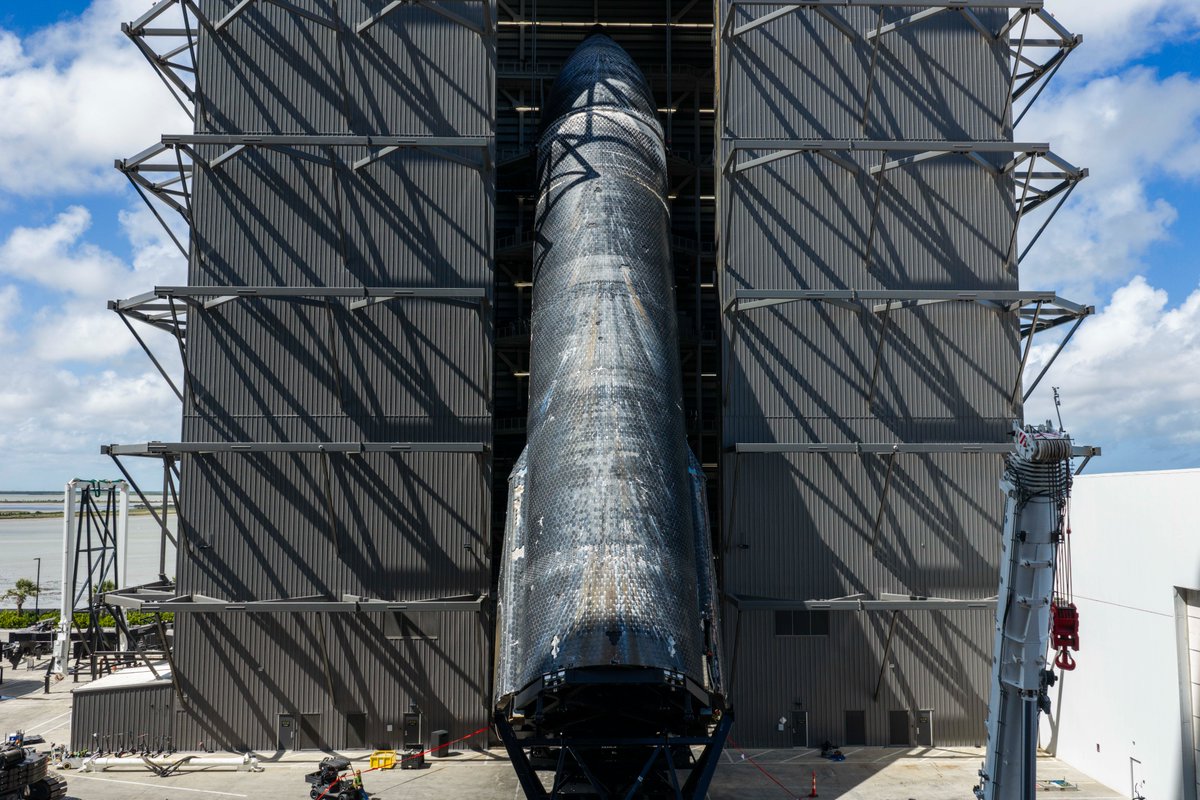
After the successful catch of ship 42, many people commented on the damage to the ablative sheets on the sides of the ship due to the chopsticks. @elonmusk said a new material, a stainless steel wool material, would be used to solve this issue.
Upon further review (now confirmed by some SpaceX thermal systems engineers), a version of this material was tested during flight 15, w/ 2 patches of this material on the left aft flap. I did not pay much attention to this flap at the time, but I did capture a few images of it before the launch.
This material appears to be a stainless steel wool matting material similar (visually) to what we saw with the Space Shuttle, but different in many important ways.
The Space Shuttle used Advanced Flexible Reusable Surface Insulation (AFRSI) blankets (also called Flexible Insulation Blankets or FIB). These quilted, flexible blankets covered large areas of the upper (leeward) surfaces … fuselage, upper wings, & vertical tail, where peak reentry temps stayed below ~1,200 °F (649 °C).
This replaced most of the white low-temperature reusable surface insulation (LRSI) tiles on later orbiters (& on Columbia after its early flights) because they were lighter, more durable, and easier & cheaper to make & install.
This used a core/batting material consisting of a low-density fibrous high-purity silica (99.8% amorphous silica fibers, often called Q-felt or quartz fiber batting; individual fibers ~1–2 mils thick).
It had an outer fabric of woven high-temperature silica/quartz fabric, an inner woven lower-temperature glass fabric, a silica/quartz thread called Astroquartz (a glass thread was sometimes used on the inner side) & a ceramic coating of colloidal silica plus high-purity silica fibers on the outer surface for durability, abrasion resistance, & required emissivity/optical properties. Waterproofing agents were also applied.
On Starship, based on the test sections we saw on Flight 15, it seems a similar flexible, quilted-style thermal blanket will be made with stainless steel wool. This idea has both commercial precedent & a direct NASA history tied to Shuttle-era concepts.
The principle is the same as the silica batting in AFRSI: fine filaments create a high-void-volume structure, heat conduction is limited by the trapped gas (air or low-pressure atmosphere) & the long, tortuous path through the fibers rather than solid conduction.
Stainless steel wool (& needle-punched mats made from it) is already used commercially for high-temp insulation & acoustic packing:
• Continuous service temps of ~700–850 °C (up to ~1,100–1,200 °C for higher-grade alloys such as certain 400- or high-Cr/Ni series).
• Applications include automotive/motorcycle exhaust mufflers (as both a thermal barrier & blow-out protection for other packing), industrial high-temp filtration, & insulation around pipes, turbines, or hot gas systems.
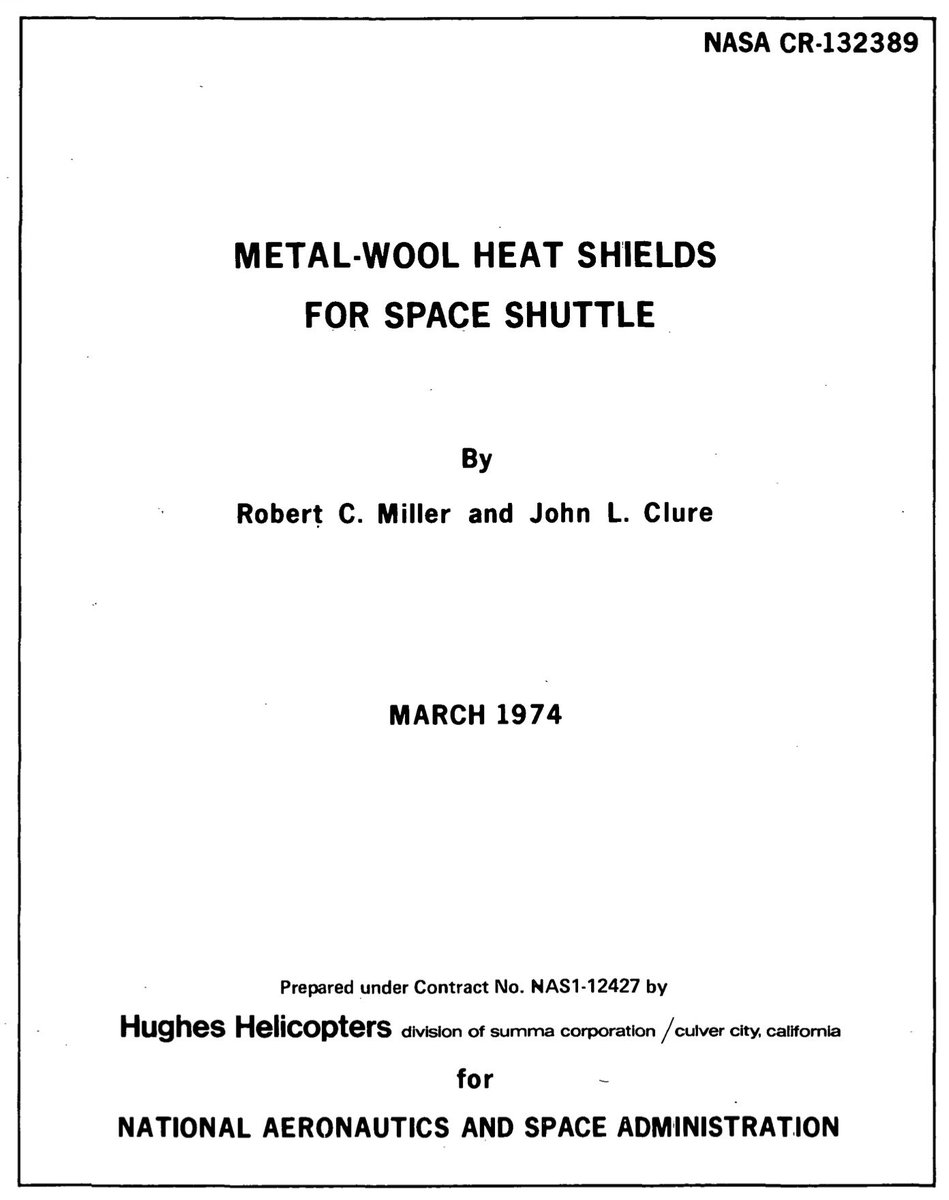
In 1974, NASA funded a contractor study (NASA-CR-132389, “Metal-wool heat shields for space shuttle”) that specifically evaluated packaging metal wool as a reusable thermal protection system for aerodynamic surfaces on Shuttle-like vehicles.
Key findings included:
• Thermally competitive with the best available insulations, with conductivity dropping further under vacuum/low-pressure conditions.
• Inherently impact- and erosion-resistant, chemically stable, & producible as an all-metal system.
• 300-series stainless steel considered practical to ~1,250 K (~1,790 °F / 977 °C) under flight profiles w/ modest aerodynamic loads & limited oxygen exposure. Structural stainless sheet could handle still higher temps for expansion management.
• Designs used thin corrugated stainless skins, internal supports (beams or columns), & the wool itself, w/ attention to thermal expansion, venting, & minimizing thermal shorts.
It will be interesting to see how @SpaceX employs this material & how it performs on an upcoming Ship iteration! @esherifftv
@thejackbeyer Great pictures Jack! Hope you're having a blast at your new job. Miss you on streams. Was good to see you along with Max after the catch.
WHAT DID I JUST WITNESS?!?!? I just watched a Starship reenter after over 22 hours in orbit AND GOT CAUGHT BY THE TOWER!!!!! UNBELIEVABLE!!!! Huge congrats @SpaceX@elonmusk
A good time to remind you of this amazing clip of an Energia rocket (serial 5S) performing a dry gimbal test of the core stage's four RD-0120 engines in the assembly facility.
Here’s a story for you. We started filming without owning the title and had to do alternates.
Taft Broadcasting owned the title Ghostbusters as part of their half-hour sitcom starring Larry Storch and Forrest Tucker (F-Troop) and a gorilla chasing ghosts. I had never heard of it. They didn’t have proton packs or Bill Murray. Columbia paid $500,000 to buy the name, but they really should have paid Dean Martin, from whom I first heard the term.
In the film Scared Stiff (1953), he and Jerry Lewis (check out his acrobatic stair descent) are in an old haunted castle, and Lizabeth Scott asks Dean: “Who are you guys?” And Dean answers: “You’ve heard of Trustbusters and Gangbusters, we’re Ghostbusters!”
For my research writing the first movie, I watched every single ‘ghost’ comedy ever made. Bowery Boys, Hope and Crosby, Abbot and Costello, Martin and Lewis all did such films.
Happy Halloween 2026.
In Memory of Randolph “Randy” Mantooth
Randy Goes on one last run with his lifelong friend and co-star Kevin Tighe inside Squad 51.
On October 17th, a Flag Ceremony was held at Station 127 (Station 51) as Randy left the station for the last time.
Rest easy, Johnny.
📷:Los Angeles County Fire Museum
The first Starship to return to its launch site, Ship 40's journey took it across air, space, and sea. Now that it is vertical alongside three other Starships in a Megabay at Starbase, it will provide first-of-its-kind data on a flown Starship heatshield, Raptor engines, avionics, and more.