Yes it is indeed the case that the art and entertainment industries depend on an audience, though i'm also pretty confident that a lot of people dislike or even hate the jobs they do, and not getting the expected compensations or feeling undervalued are also a potential trigger for burnout, which could very well kill creativity (https://t.co/PkboDeJuM8). Whether the artist is getting clients or not does not define their authenticity as an artist. Me for example, I was/am a Software Engineer while being employed, but also while i was unemployed I was STILL a software engineer by identity, and unemployment didn't automatically discredit me from the title.
@mouseMSPDraws@KitsuneMizuki For a lot of artists it's the only way to get anything close to western wages especially in south east asia, where earling 150-200$/month can be common so these 15-30$ commissions genuinely help pay rent and stuff especially students or unstudied people or similar
@splitbycomma@BiigNick There was a recent change that @nikitabier announced ~3 months ago, in which they mentioned they'd integrate Grok completely into the X algorithm https://t.co/BuA1UTFBx9
Yes the character is your intellectual property, but you are sub licensing it as part of a work agreement for an artist to create a derivative work of art. The artist's depiction of your character is derivative work, and the artist is the rightful owner by default in that case, unless an IP/copyright transfer was explicitly done. Otherwise, the artist is the rightful owner of that art, and it's simply sublicensed to you.
It's obvious that they meant "samples" as in "the images it was trained on".
For artists/non-technical people: Since I keep seeing a lot of confusion around how AI image models exactly learn, I have composed an explaination in simple terms of the different parts that compose the "AI learning" process, since I work in a data science adjacent job and have studied how these things exactly work.
In both cases, the AI model can literally only rely on the images it was trained on, and is actively trying to replicate the input images precisely. There is literally no creativity, just interpolation between everything that was learned, and blatant copying.
For AI bros/"erm actually" people: I have omitted confusing specifics (e.g. KL Divergence, DIT, the exact denoising process, RVQ losses, etc...) for simplicity purposes, which are mostly irrelevant anyways for understanding the concept for non-technical people.
Example (very) technical AI research papers as proof:
Qwen Image https://t.co/8k2OUZL1ZY
Stable Diffusion https://t.co/ASJZJOnhKp
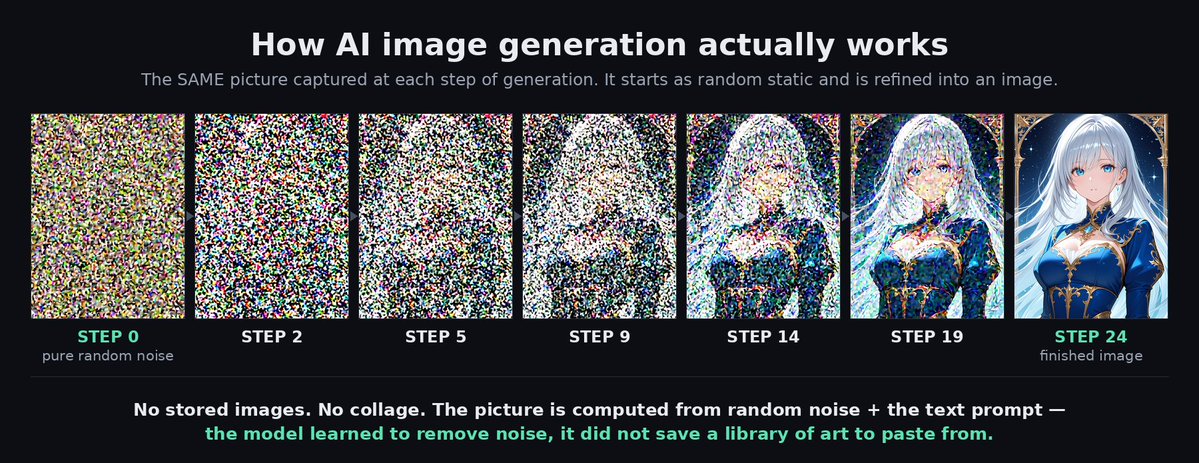
Not quite, diffusion models don't use "samples". You're thinking of older models that would use actual images to composite an image.
I created this graphic here to show how an image is formed.
@AoiTheUsagi@DraleZero@TwitchSupport Well doesn't OBS usually flatten all audio into the stereo channel? unless this thing were to listen to only a specific extra channel like how people do on karaokes to not have their vod muted completely
@Cyan_with_a_bh Actually yes LLM inference is very ram intensive due to how tiered kv cache Management works in the datacenter. To fit so many customers while wasting the least amount of compute possible, GPUs constantly swap to the host's ram, which is also the whole point of GB200/GH200
I can't wait to see twitch polluted with endless fully ai generated + controlled low effort "vtubers", or even better, slap that shit on top of already automated reddit stories video spam on tiktok 😍😍 finally vtubing was "democratized"! (ignore nvidia being fed even more $$$!!)
@Grxit The AI itself is for example just cheap cause it's amortized insanely over tons of users and time since pretraining a frontier video generator/llm costs +50-100 million lol. If you do the math fairly 1:1, having someone pretrain a bespoke video generator for you would cost +100M$
To be fair you are paying someone salary for work with commercial value, which is btw already underpriced heavily, just like you'd pay someone to do construction on your property or fix a phone screen. There's no economics of scale like how a multi billion dollar CPU building machine is amortized across millions of chips to make the chips affordable, so this stuff is most often built from scratch, and you'd probably get mad if you don't get paid at your job with a dismissal like e.g. for a Programmer "write a bunch of text on the PC". Stuff like this can require +100-150 hours to design, draw and rig and even at shitty underpaid 7$/hr that's already 700-1050$ in human labor, for which the artist often depends on to survive
Today I made a prototype of a system that turns a single AI-generated portrait into a living VTuber. No rigging, no Live2D, nobody spending 80 hours in an editor.
The character was generated locally with SDXL using the same model and custom LoRA I use for the art bot in my Discord server.
A video model (Grok) then animated her into a chain of idle clips, each one starting on the exact frame where the previous one ended, so she loops forever and rarely cuts.
Her mouth is the interesting part: a tracker follows the drawn lines of her lips through every frame, measuring position, angle, and width, and a composited mouth rides along, rotating and foreshortening as her head moves. The mouth shapes themselves were inpainted onto her own face by SDXL, so every viseme is in her exact art style. Real phoneme detection drives which shape shows.
Because the mouth is composited rather than baked in, it stops the instant the voice stops. The body animation never even knows speech exists.
Animating her ate about half of my SuperGrok credits, which works out to $14.32 if you paid for the same experimentation directly. I used 5 of the 12 generated clips in this demo. Narrated this demo using the Kokoro TTS model for free.
Next step would be webcam emotion detection so she can swap between animation sets when the streamer smiles or gasps, more mouth shapes