In a major international effort to evaluate potential treatments for #Ebola disease due to Bundibugyo virus (BVD), the PARTNERS (Platform Adaptive Randomised Trial for New and Repurposed Filovirus TreatmentS) clinical trial has opened enrolment today for patients in the #DRC.
What does the trial do?
This trial will assess whether two therapies –
➡️ a monoclonal antibody (MBP134)
➡️ an antiviral medicine (remdesivir)
can improve survival among people diagnosed with BVD.
It will also evaluate whether combining the two provides additional benefits.
Who is behind it?
The trial, sponsored by the WHO, has been coordinated by the Institut National pour la Recherche Biomédicale (INRB) in the DRC, the @ITMantwerp Institute of Tropical Medicine in Belgium, and the @UniofOxford in the United Kingdom, in collaboration with international research, clinical and humanitarian partners, and supported by @AfricaCDC.
What can the trials help determine?
The PARTNERS trial is expected to assess whether these therapies can improve outcomes for patients with BVD and reduce deaths in affected communities.
🔗 https://t.co/NIAEPl5zUF
The PARTNERS clinical trial to evaluate potential treatments for Bundibugyo virus has opened enrolment today for #Ebola patients in the #DRC: https://t.co/GzWRkdQ9Vl
Even without approved therapeutics, many people are recovering from this disease, but of course, we could save more lives with safe and effective therapeutics in our toolkit.
The PARTNERS trial, established with national authorities and scientific partners in record time, offers real hope that we can deliver concrete results for – and with – the communities at the heart of the outbreak.
All patients who enroll in the trial will receive comprehensive supportive care and close follow-up, whether they are randomized to the treatments or not.
My thanks to @inrb_kinshasa, the Institute of Tropical Medicine in Belgium, and the @UniofOxford, @AfricaCDC and all the partners who have been part of this lifesaving effort.
Once again, the Democratic Republic of the Congo is demonstrating its commitment to science, research and innovation in the face of a health emergency. My gratitude to them.
For 100 years, the Weekly Epidemiological Record (WER) has documented the evolving story of global public health, one week at a time.
On its 100th anniversary, the WER is adopting a new digital format.
First published in April 1926 by the Health Office of the League of Nations, the WER began as a simple bulletin: telegraphed reports tracking the spread of five notifiable diseases – cholera, plague, smallpox, yellow fever and typhus.
The publication was entrusted to the World Health Organization (WHO) when the Organization was established in 1948.
Today, the global health landscape is increasingly complex. Climate change, demographic shifts, technological advances and persistent inequities are shaping how diseases emerge and spread.
The WER - now a digital publication - continues to provide timely epidemiological information, while chronicling major vaccine policy decisions, progress towards disease elimination, and other content for which the WER has come to be known: https://t.co/u7q508Ps22
Emotional moment inaugurating the refurbished JW Lee Strategic Situation Room with generous support from the Republic of #Korea 🇰🇷
Launched by Dr Lee in 2003, it’s at the centre of @WHO's emergency response. We gather here daily at 9 am to go over signals & plan our work.
Press Conference by the International Health Regulations Emergency Committee on #Ebola caused by Bundibugyo virus in #DRC and #Uganda
TODAY, 11.00 (GMT+2)
Livestream on WHO X, Facebook, LinkedIn, YouTube
The Prime Minister @sanchezcastejon rightly so stressed that history will judge us: "And it will say whether we were capable of protecting life when we knew how to do so".
We are one humanity. We share the same DNA.
We must work together, for #HealthForAll.
#WHA79
The International Health Regulations Emergency Committee on #Ebola caused by Bundibugyo virus in #DRC and #Uganda will meet today, 19 May 2026 from 17h30 CEST (GMT+2) https://t.co/UdtqVMGkAu
@DrTedros determined the event constitutes a public health emergency of international concern on 17 May 2026
From COVID‑19 lessons to action.
Join us for a #WHA79 strategic roundtable on how experience has shaped reforms to strengthen @WHO’s Health Emergencies Programme.
🗓️ Today, 1 pm CEST
📍WHO EB room or online
Advancing together, to protect health 🤝
https://t.co/lfnzJdI8an
Today's #WHA79 Strategic Roundtable will discuss the evolution of WHO health emergencies programme.
Follow LIVE from 13h00 CEST on our website https://t.co/VxXIzO0i0O
The world remains vulnerable to pandemics. A new @TheGPMB report shows risks are rising while investments and reforms fall behind.
We cannot lose momentum on the Pandemic Agreement.
We cannot afford another pandemic like COVID‑19 -- or worse.
https://t.co/3fjto15Qpq
One of the clear lessons of the hantavirus outbreak is that *chance* makes a huge difference to how a disease can spread.
The Andes strain of the virus causes 100s of human infections every year, but most burn out almost immediately.
Occasionally, there is a bigger outbreak fueled by human-to-human transmission but these are rare.
The pattern is a feature of almost all zoonotic spillover events, millions of which happen each year involving thousands of different pathogens.
Mercifully, most go nowhere. They flare then vanish.
Now enter *chance* – a series of unforeseen but often predictable environmental circumstances or events.
A wet market, a trunk road, a game of beer-pong … or in this case, a hop-on-hop-off international cruise with connecting flights.
The map below shows the 12 countries that passengers flew to after disembarking one leg of the cruise in St Helena in late April.
30 passengers disembarked there, one dead, but no one knew then about the disease to which they had been exposed.
The outbreak has been serious, with three dead and at least five suspected cases so far.
About 150 remain on the ship, while hundreds of potential secondary contacts are being traced and asked to isolate around the world.
Nevertheless, the chances are that *this* outbreak will die out too.
The virus does not appear to spread efficiently enough to sustain itself, even with the circumstances it has been handed.
But here’s the thing: it’s a numbers game.
Look again at that map and consider where we would be if the virus was more infectious, or had mutated to become so.
It is why the World Health Organization and pandemic planning is so important.
.@WHO is working with national authorities to respond to the #Ebola outbreak caused by the Bundibugyo virus in DRC and Uganda. @DrTedros has determined this event to be a global health emergency, requiring urgent, coordinated action.
WHO update: https://t.co/sdMKLARFZ0
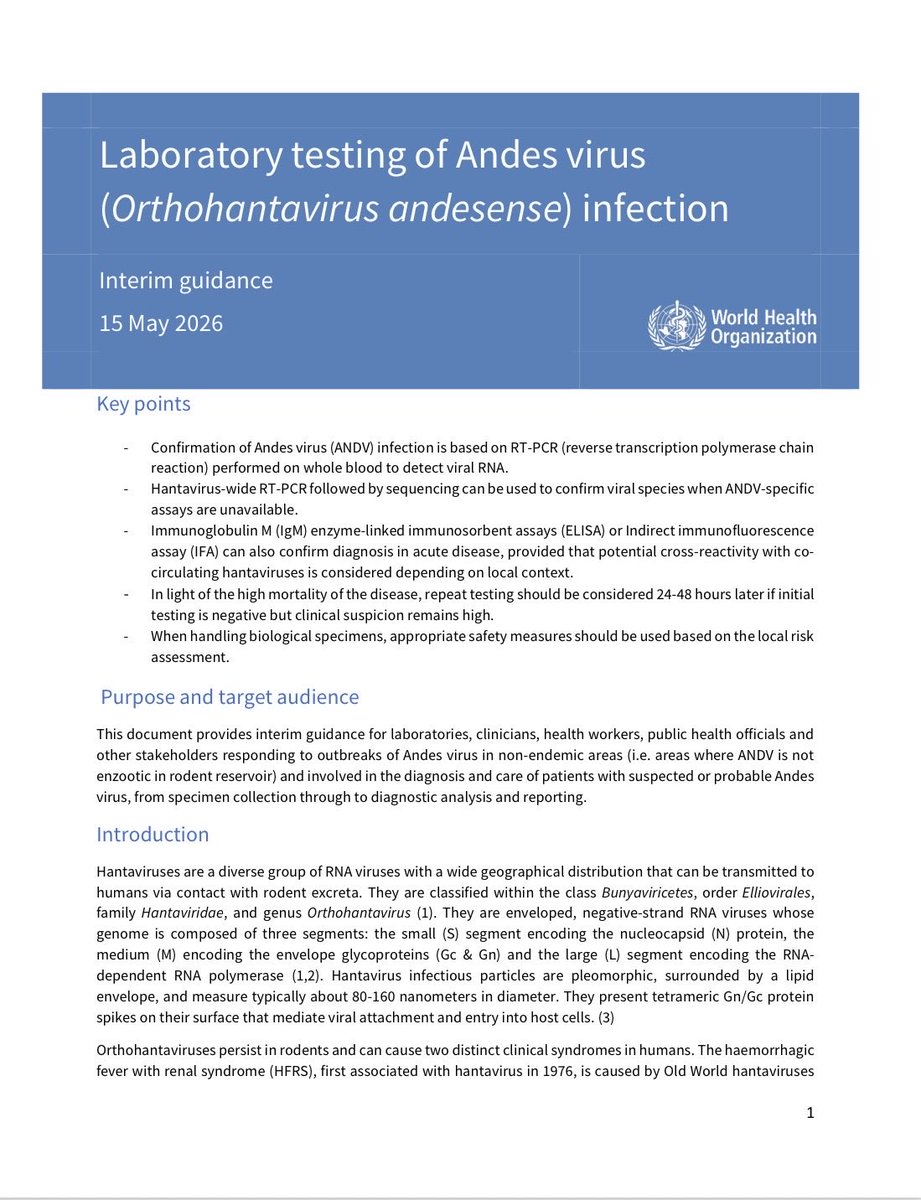
🆕📢 @WHO interim guidance for laboratory testing of Andes virus infection
Critical guidance issued to help countries test & diagnose #hantavirus.
https://t.co/36Pu2Xh4pe
Join our live update on #hantavirus with WHO Technical Officer Anaïs Legand TODAY at 16.30 CEST [GMT+2]
It will be livestreamed on WHO's X, Facebook, LinkedIn and YouTube.
Complex at clinical, technical, and political levels, but grateful for the frameworks, expertise, and critically the dedicated colleagues that @WHO relies on every day. Our work continues...
🗞️ Ein Patient mit einer Hantavirus-Infektion ist in Spitalbehandlung. Das @Unispital_USZ ist auf solche Fälle vorbereitet. Die Sicherheit des Personals und aller Patienten ist gewährleistet. Für die 🇨🇭 Bevölkerung besteht derzeit keine Gefahr.
👇
https://t.co/AmVlHu6sYe
Swiss authorities have confirmed a case of #hantavirus identified in a passenger from the MV Hondius cruise ship.
He had responded to an email from the ship’s operator informing the passengers of the health event, and presented himself to a hospital in Zurich, Switzerland, and is receiving care.
In line with the International Health Regulations (IHR), WHO is working with relevant countries to support international contact tracing, to ensure that those potentially exposed are monitored and that any further disease spread is limited.
The type of virus in this outbreak has been confirmed as Andes hantavirus by the National Institute for Communicable Diseases @nicd_sa, South Africa and the Geneva University Hospitals @hug_ge, Switzerland
The support of the Institut Pasteur de Dakar @PasteurDakar, Senegal and the Administración Nacional de Laboratorios e Institutos de Salud @ANLIS_Malbran, Argentina has also been critical in responding to this event.
As of 6 May, there are 8 cases, 3 of whom are confirmed as hantavirus by laboratory testing.
WHO will continue to work with countries to ensure that the patients, contacts, passengers and crew have the information and support they need to stay safe and prevent spread.
I thank @WHO’s Member States for the progress they have made on the Pathogen Access and Benefit Sharing system annex of the WHO Pandemic Agreement.
With urgency and continued commitment, remaining differences will be resolved and the world will be better prepared for the next pandemic.
https://t.co/7j8c5JXK8F


![WHO's tweet photo. Join our live update on #hantavirus with WHO Technical Officer Anaïs Legand TODAY at 16.30 CEST [GMT+2]
It will be livestreamed on WHO's X, Facebook, LinkedIn and YouTube. https://t.co/XV5Z8zZOBc](https://pbs.twimg.com/media/HHzV55vWcAUmxGW.jpg)


