I can't say I like the debate about "engagement" with Chinese intelligence. My rules are (1) prepare professionally; (2) don't assist in the exploitation of others; and (3) treat the Chinese side as what they are and ask.
If you don't want to do these three things, then, really, why are you meeting with them?
The basic rule should be to approach any engagement with the PRC/CCP apparatus with the same professionalism with which they approach these engagements.
At minimum, that means all U.S. participants should know with whom they are meeting. We often approach the Contemporary Institutes of Contemporary International Relations (CICIR) as though they were not a bureau of the Ministry of State Security (MSS). They are, in fact, intelligence professionals. We would not use CIA-affiliated to describe a serving CIA analyst, so we shouldn't use MSS-affiliated to describe CICIR. That analyst is CIA (or, in my case, was), just as a CICIR analyst is MSS.
I have heard from many participants in Track 1.5 and Track 2 dialogues with the Chinese that they were unaware who the Chinese participants really were. Nor were they aware of the history of the engagement, past transcripts, etc. All things that the Chinese side brings to the table. The Chinese side approaches these engagements as opportunities to shape outsiders' thinking much more than opportunities to explore ideas or potential initiatives.
A second rule would be to prepare people for what should or should not be within the bounds of the conversation. This is not about classified information, but rather what gossip should off limits, what personal details to keep discrete, etc. Do not aid in the exploitation of others.
There are a lot more, but I will finish with a third: if you're going to engage the MSS, PLA intelligence and political warfare, and united front organizations, then ask them about their system, what they do, why they do it, and how it works. Don't pretend like they are something other than what they are. Ask and you might be surprised by what you learn.
There is more to be gained by treating Chinese intelligence interlocutors as what they are than pretending that they have special insights into high-level policymaking. If someone in DC said a GS-13/14 intelligence analyst was an amazing source of insight into U.S. foreign policymaking, then they would be laughed out of the room. Maybe this is changing as the MSS becomes more important, but, for much of the last 43 years, that has not been the case.
If you are not willing to do these basic things, then you really should not be meeting with this part of the party-state and just stick to the diplomats.
P.S. Make sure you know who to call at your local FBI field office or equivalent in case something bad happens, like a recruitment pitch.
Step 1: say the opponent presents a challenge for the Knicks.
Step 2: choose the opponent to win vs Knicks in 6 games.
Step 3: when series isn’t going the way they thought it would, complain about how the team they picked to beat the Knicks isnt very good.
Step 4: after Knicks curb stomp opponent, say “Knicks wont win championship, they haven’t beaten anybody!” as the tears come down their faces.
Step 5: repeat the process next round
#alwaysknicks
@ScottGoldstein Hey Scott, the curfew isn't group punishment for bad behavior. It is a boundary given to children who don't have full legal autonomy and shouldn't be held to the same standards applied to adults. A curfew is a guardrail to keep them on track. Teens deserve grace AND guidance.
DC is facing a defining moment: job losses, empty buildings, pressure on small businesses, and families feeling the strain.
I’m running for mayor to meet that moment and revive our economy, make neighborhoods safer, lower costs and stretch opportunity to touch every part of our city.
Grateful to @FukuyamaFrancis and @AmericanPurpose for publishing this. Gaddafi gave up his weapons. Saddam never finished his. Ukraine surrendered its arsenal. Kim held on. One of these stories ended differently. That's the most dangerous lesson the 21st century has produced.
I write for @CarnegieEndow on how too many Western strategists expect China to behave like the United States—and then when China does not behave like the United States, they conclude that it is a strategic failure rather than a deliberate choice, and that a “chastened” China has been put back on its heels. It’s important not to mirror-image U.S. foreign policy, refracting Chinese policy through the lens of what American strategists would do if they were Chinese Communists. Beijing doesn’t think like Washington—and the Iran conflict shows why. https://t.co/ja3M33m2ii
Both superpowers have now fired their top general, their service chiefs, and theater commanders. If that's catastrophic for the PLA, and the consensus says it is, what exactly do we think it's doing to us?
https://t.co/yvGMJeJMS6
My grandpa came here from Syria when he was 19 years old to attend college. He came with nothing, lived in a small apartment with his family, and spent his life building a business that now employs dozens of people and helps thousands of clients.
My mom had me at 15 years old. It wasn't an easy journey for my parents, but my mom went on to get a PhD in I/O Psychology, studying discrimination against mothers and caregivers, commuting long hours while raising me. She now owns her own leadership consulting business.
The only reason I am where I am today is because of the beauty of America. My family was able to immigrate, create a community, and build something from nothing.
My uncle was diagnosed with a rare disease at 22 years old and was told he didn’t have much time left. The Affordable Care Act saved his life by allowing him to have an incredibly expensive experimental treatment and his impact on me shows in my content everyday. He's 35 now.
My mom went from being a teenage mom to having a PhD. My grandpa went from being intimidated by the country to making it better through work ethic and dedication. My uncle was able to get a life-saving treatment because of access to healthcare. And this is only the half of it.
This is the American dream. I am so sickened and infuriated by the constant erasure of what makes America great; opting for villianization of immigrants, demonization of social safety nets, constant hatred and belittling and stereotyping of everyone who looks different.
Thousands of workers are protesting in Jakarta, a major flashpoint for long-standing socio-economic issues. This isn't a one-off event; it's a signal of persistent risk.
What does this mean for your supply chains there? Our latest brief breaks it down.
https://t.co/wWkhMPLcWz
From friendly calls to vindictive tariffs. The US-India trade relationship is at its most tumultuous point in decades, marked by a 50% tariff on Indian imports.
What does this mean for your supply chain? We assessed the state of play in our latest brief.
https://t.co/DoZkGib99q
New from China's MIIT: the "Steel Industry Stable Growth Work Plan (2025-2026)" targets 4% annual growth. This plan aims to rebalance oversupply & demand by focusing on five key areas.
What does this mean for your business? Let us break it down for you!
https://t.co/rMPniFB5qJ
New analysis from Anansi Strategic Intelligence: Our latest report breaks down Indonesia's supply chain risk post-protest. Key vulnerabilities found in "last mile" logistics and workforce mobility, not major ports. Read the full insights here:
https://t.co/DM1p4PgBwq
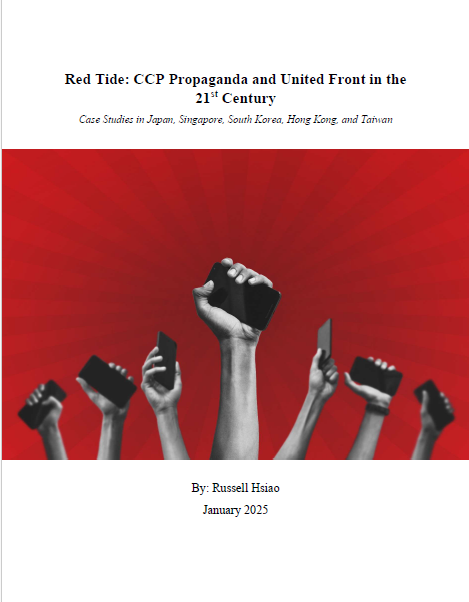
After nearly six years of research and fieldwork (delayed by the COVID pandemic), my study “Red Tide: CCP Propaganda and United Front in the 21st Century Case Studies in Japan, Singapore, South Korea, Hong Kong, and Taiwan” is finally ready for release in January 2025. The full report runs over 100 pages and 35,000 words—a soft release of the executive summary is forthcoming shortly.
The study provides a detailed examination of how the Chinese Communist Party’s strict ideological controls that it exerted internally through propaganda and united front to maintain political control are now being projected outward by political warfare aimed at both protecting CCP rule and undermining its political adversaries. Contrary to the perception that the CCP’s united front is singularly focused on Taiwan, CCP propaganda and united front activities in the five case studies in this study demonstrate an expansive remit that underscores the Party-state’s global ambitions.
Prior understanding of the Central Propaganda Department and the United Front Work Department were often too compartmentalized, and treated the two organs as siloed systems, leading to their net effects being underappreciated. While functionally different bureaucracies, CPD and UFWD are increasingly operationally integrated—together with intelligence functions. General Secretary Xi Jinping has institutionalized the convergence of the propaganda and united front systems through multiple central leading small groups into a system of systems approach for political warfare in the 21st century.
This study provides case studies of how the CCP uses these tools for political warfare in Hong Kong, Japan, Singapore, South Korea, and Taiwan.
Check out the new piece David Lin and I wrote examining how the US and China diverge on deploying emerging commercial space technologies👇🏻
#Hyperbola2#newspace#emergingtech
Generative AI isn’t just a buzzword — it’s a game changer. In our latest SCSP report, we delve into the profound implications and prospects GenAI offers the U.S. Government.
#SCSPTech#GenAI#NationalSecurity