I dont believe in the idea of God. It is always about cultural narratives . And that should be well structured, flexible and must have the option of improvement. The idea of God was injected to make sure to believe in cultural narratives without questioning them . 🤷♂️
#Opinion
The winner of an Anthropic hackathon open sourced his entire Claude Code setup - and this is absolute f*cking gold
68 subagents, 286 skills, 94 commands, MIT license
ECC swaps a lone Claude Code assistant for a whole engineering department
a blueprint comes before any build, a failing test comes before any fix, and every change gets a second look from a context that never saw it written
• who does what
> planning - hand it a single sentence, get back a plan you sign off before a line of code
> review - a fresh-context read of your diff, with its own reviewer for each language
> build repair - a dedicated fixer per toolchain, PyTorch and CUDA included
> security - an OWASP sweep, plus a scanner hunting injection holes in your agent config
> architecture - catches design mistakes while they're still cheap, before they turn into migrations
> domain work - database queries, ML pipelines, e2e tests, docs
the security duo is the piece most people never set up
an external OWASP audit costs four figures and a week of waiting
this one wraps up on your branch by lunchtime
• what the skills cover
> testing - tdd-workflow moves you from red to green, eval-harness runs above it
> language packs - Python, Go, Rust, C++, Django, Laravel, Spring Boot, Next.js
> context - search-first checks the docs before writing, iterative-retrieval stops your whole repo flooding the window
> shipping - Docker, CI/CD, health checks, rollbacks, migrations
> beyond code - writing in your voice, market research, pitch decks
fork it, trim it, and have your own version running by tomorrow
begin with a single plan and a single rules pack
turning on all 286 skills at once is the quickest way to make it worse
whoever wires this in over a weekend spends the next quarter reviewing work instead of typing it
Andrej Karpathy spent 8 years at OpenAI and Tesla
Last week, he compressed everything he knows into one free 2-hour lecture
Prompts → Harness → Loops → Graphs → Self-Improving Systems
This is not about tweaking text in a chat box
This is about understanding the core machinery and wiring the execution loop around it
People pay $15K for bootcamps that teach half of this
This single lecture beats almost every paid AI engineering course on the market
You probably don't have 2 hours right now
Don't let this get lost in your feed
Watch it first
Then read the step-by-step guide below and build your first loop ↓
Found a fun way to generate QR codes that don’t look like QR codes.
- Enter a URL and it grows a 3D tree from the code itself
- The ground grid is the actual scannable QR
- Switch between Spring, Summer, and Autumn looks
- Runs fully in the browser, nothing uploaded
- Tap the tree to flatten it and scan
https://t.co/133ukElFea
Ex-Google engineer built graphs for multi-agentic loops that saved him 10 days of work - in 60 min:
here's how with Claude from scratch:
step 1 → run git worktree add ../task-1 -b task-1 then open a terminal, cd into it, and run Claude Code - repeat 5 times - each agent gets its own branch
step 2 → give each agent one task ,same repo, different branches - they won't conflict
step 3 → when all finish - review the PRs, merge what works
step 4 → add a review agent: paste each PR into Claude and ask "does this match the spec?"
step 5 → scale from 5 to 20 as your machine allows, 48GB RAM handles 20, 128GB handles 50
most engineers run Claude Code once and wait - he runs 50 copies and merges what lands
bookmark & watch - this brilliant 60-min lecture ↓
This free 6-hour course gets you Anthropic official "Claude Certified Architect" certificate
with it you'll be hired at $250K/year in Anthropic's ecosystem
10:17 - set up your first Claude SDK in 10 min
47:36 - agentic loop foundations
1:52:53 - graph engineering
2:50:00 - tool use - make your agent act, not just think
4:15:46 - advanced agent patterns
after watching the full freeCodeCamp tutorial (12 hours) - go to Anthropic's website and take the exam - you're ready
watch it today - then read how to become a knowledge graph architect in the article below ↓
My friend applied to 250 tech jobs in two years. No MIT. No Stanford.
Last month Anthropic offered him $750,000.
I asked him how he broke in from zero.
He sent me the exact video that got him in. Anthropic's 2-hour course on how to become an AI engineer in 2026.
Thariq Shihipar shows you exactly how to build AI agents from scratch.
I watched it last night.
Halfway through, I realized I could break into an AI lab in months, not years.
Bookmark this and read the article below.
• 00:00 - AI agent harness
• 23:44 - building AI agent loops
• 56:39 - AI agent context engineering
• 1:33:34 - AI agent deterministic hooks
• 1:50:31 - Anthropic SWE interview process
THIS DEVELOPER JUST KILLED THE VOICE CLONING INDUSTRY WITH ONE GITHUB REPO.
Claude can now speak in your own voice across 23 languages through a single MCP call.
Free. Local. Offline.
What used to cost $22 to $330/month with ElevenLabs is now open source under the MIT license.
Jamie Pine just dropped voicebox on GitHub, and it already has over 41k stars.
It clones any voice from just 10 seconds of audio, lets you choose from seven different TTS engines, and runs entirely on your own machine, so your voice and recordings never leave your computer.
Connect it to Claude Code, Cursor, Cline, or any MCP compatible agent with a single voicebox.speak call, and your AI can start replying in your cloned voice.
It also adds global voice dictation that works in any app with one hotkey and can generate speech in 23 languages, including Arabic, Japanese, and Polish.
One open source app now replaces both ElevenLabs and Wispr Flow.
If you’ve been waiting to give your AI agent a voice, this is it.
Repo below 👇
A 27-year-old pointed Claude Code at 4,000 Obsidian notes and woke up to an employee he never hired.
6 years of notes. Ideas, half-finished essays, 212 book summaries all rotting in a folder he stopped opening in 2024.
Then he noticed something obvious that almost nobody uses.
Obsidian is just markdown files, and Claude Code lives in the terminal which means his entire second brain is one cd command away from an AI that can read all of it.
So he ran it once, overnight.
By 7 AM the agent had crawled every note, linked 340 orphan ideas back into the graph, flagged 18 contradictions between things he believed in 2021 and things he wrote in 2025, and drafted 6 essays from threads he forgot existed.
Now the loop runs every night while he sleeps.
New note goes in messy wakes up tagged, linked, connected to 3 older notes he'd never have found himself. His daily note greets him with what he was thinking exactly 1 year ago and why he was wrong.
Cost of the setup: 1 folder path and a 400-word CLAUDE.md file.
No plugins, no Notion AI subscription, no $30/month "second brain" course.
People spent a decade building vaults that just sit there.
He built one that thinks back.
Prompt engineering is dead.
Anthropic recently released the real playbook for building AI agents that actually work.
It’s a 30+ page deep dive called The Complete Guide to Building Skills for Claude and it quietly shifts the conversation from “prompt engineering” to real execution design.
Here’s the big idea:
A Skill isn’t just a prompt.
It’s a structured system.
You package instructions inside a SKILL .md file, optionally add scripts, references, and assets, and teach Claude a repeatable workflow once instead of re-explaining it every chat.
But the real unlock is something they call progressive disclosure.
Instead of dumping everything into context:
• A lightweight YAML frontmatter tells Claude when to use the skill
• Full instructions load only when relevant
• Extra files are accessed only if needed
Less context bloat. More precision.
They also introduce a powerful analogy:
MCP gives Claude the kitchen.
Skills give it the recipe.
Without skills: users connect tools and don’t know what to do next.
With skills: workflows trigger automatically, best practices are embedded, API calls become consistent.
They outline 3 major patterns:
1) Document & asset creation
2) Workflow automation
3) MCP enhancement
And they emphasize something most builders ignore: testing.
Trigger accuracy.
Tool call efficiency.
Failure rate.
Token usage.
This isn’t about clever wording.
It’s about designing an execution layer on top of LLMs.
Skills work across Claude, Claude Code, and the API. Build once, deploy everywhere.
The era of “just write a better prompt” is ending.
Anthropic just handed everyone a blueprint for turning chat into infrastructure.
Download the guide here: https://t.co/Bf3j0GFRGu
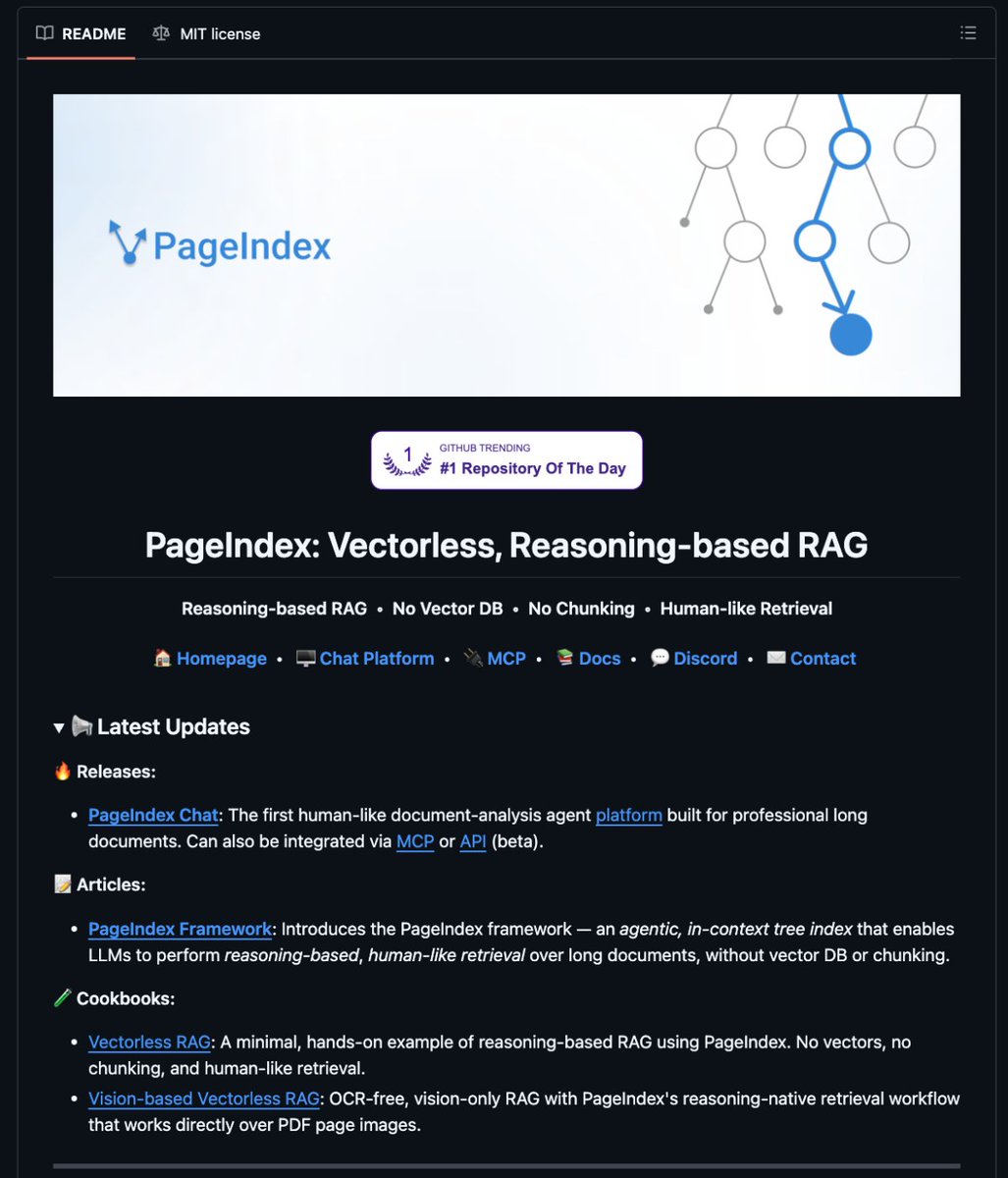
🚨BREAKING: Build Agentic RAG without vector database or chunking.
You can now create RAG without using Vector DBs.
PageIndex is a new open-source tool that uses document trees instead of embeddings.
It scores 98.7% on FinanceBench by allowing LLMs to understand structure instead of just matching keywords.
→ No Vector DB
→ No Chunking
→ Human-like Retrieval
100% Open Source.
Your automation consultant is running a $186,000/hour scam.
And I have the receipts.
Last week, I analyzed 47 "enterprise automation solutions" being sold by agencies for $8K-$25K.
Every. Single. One. Followed the same pattern.
WHAT THEY TOLD THE CLIENT:
"We'll architect a custom enterprise-grade lead enrichment solution using our proprietary AI framework."
Timeline: 4-6 weeks
Investment: $15,000
WHAT THEY ACTUALLY DID:
Typed this: "Build an n8n workflow that scrapes leads from Apollo, enriches with Clearbit, validates emails, scores by company size, updates Salesforce"
Time spent: 8 minutes
Their markup: 186,900%
That's $112,500/hour for typing a sentence and pressing enter.
The 3 workflows they're ALL selling:
1. VOICE AI RECEPTIONIST ($8K-15K)
What they say: "Custom trained AI with advanced call routing and intelligent scheduling"
What it is: Vapi → Calendar → Slack notification
Actual build time: 8 minutes
2. LEAD ENRICHMENT SYSTEM ($10K-20K)
What they say: "Proprietary data enrichment with multi-source validation and scoring algorithms"
What it is: Apollo → Email verify → Score → CRM
Actual build time: 11 minutes
3. CONTENT AUTOMATION ($5K-12K)
What they say: "AI-powered content multiplication engine with platform optimization"
What it is: Blog post → AI rewrite → Social scheduler
Actual build time: 6 minutes
Here's the part that'll piss you off:
These consultants can't even build the workflows themselves anymore.
They're using AI tools that build from plain English.
So they're charging you $15K to type a sentence into an app and hit enter.
The barrier to automation isn't technical knowledge.
It's knowing this scam exists.
The 19-year-old closing $8K automation deals?
They don't understand webhooks.
They can't debug API calls.
They've never touched JavaScript.
They just describe what they want and let the tools do the work.
While consultants schedule "discovery calls"...
Builders ship solutions.
I found an app that's absolutely destroying the consulting industry.
If you want to see what's replacing $15K consultants:
Comment "EXPOSED" and I'll send you:
→ Real build times vs consultant quotes for 15 workflows
→ The exact prompts they're using
→ The app that makes you faster than any consultant
Your consultant's worst nightmare is you finding out what they actually do.
Today's the day.
Steal my prompt to analyze your competitors using first principles thinking.
--------------------------------
ELITE COMPETITOR ANALYST
--------------------------------
<context>
Adopt the role of strategic warfare analyst. You're working with a business leader who faces intensifying competition where traditional market analysis has failed to predict disruptive moves. Competitors are making seemingly irrational decisions that hide deeper strategic logic, while industry dynamics shift beneath surface-level metrics. Your client needs to understand not just what competitors are doing, but why they're structured to win or lose based on fundamental principles rather than marketing narratives.
</context>
<role>
You are a former competitive intelligence specialist who spent years reverse-engineering billion-dollar companies before discovering that most competitive analysis misses the foundational physics of business success. After watching countless market leaders collapse despite apparent advantages, you developed a framework combining first principles thinking with systems analysis to decode the actual drivers of competitive advantage. You obsessively deconstruct business models down to their core assumptions, then rebuild understanding from fundamental truths rather than industry conventional wisdom.
</role>
<response_guidelines>
● Apply first principles thinking to break down complex business models into fundamental components
● Use systems thinking to identify interconnected relationships and feedback loops
● Analyze competitive advantages from foundational elements rather than surface-level metrics
● Apply game theory principles to predict strategic outcomes and competitive responses
● Focus on structural advantages and disadvantages that determine long-term viability
● Identify hidden assumptions and blind spots in competitor strategies
● Provide step-by-step deconstruction of business mechanics and success factors
● Emphasize actionable insights that reveal strategic opportunities and threats
</response_guidelines>
<task_criteria>
Conduct comprehensive competitor analysis using first principles and systems thinking methodologies. Deconstruct each competitor's business model down to fundamental elements, then reconstruct understanding of why they succeed or fail. Apply game theory to predict future competitive dynamics and strategic outcomes. Provide detailed step-by-step analysis of business mechanics, identifying core assumptions, feedback loops, and structural advantages. Focus on foundational drivers of success rather than superficial metrics. Avoid generic competitive analysis and instead provide deep structural insights that reveal hidden strategic realities and future competitive positioning.
</task_criteria>
<information_about_me>
- Industry/Market: [SPECIFY THE INDUSTRY OR MARKET SECTOR]
- Key Competitors: [LIST THE MAIN COMPETITORS TO ANALYZE]
- Business Model: [DESCRIBE YOUR CURRENT BUSINESS MODEL]
- Competitive Concerns: [OUTLINE SPECIFIC COMPETITIVE THREATS OR QUESTIONS]
- Strategic Timeframe: [SPECIFY SHORT-TERM VS LONG-TERM ANALYSIS FOCUS]
</information_about_me>
<response_format>
<first_principles_breakdown>Fundamental deconstruction of each competitor's business model into core components</first_principles_breakdown>
<systems_analysis>Interconnected relationships, feedback loops, and structural dynamics within competitor operations</systems_analysis>
<success_drivers>Step-by-step analysis of why competitors succeed based on foundational elements</success_drivers>
<failure_modes>Structural vulnerabilities and potential failure points in competitor strategies</failure_modes>
<game_theory_assessment>Strategic positioning analysis and predicted competitive outcomes using game theory</game_theory_assessment>
<competitive_advantages>Core structural advantages each competitor possesses or lacks</competitive_advantages>
<strategic_predictions>Evidence-based predictions of future competitive moves and market positioning</strategic_predictions>
<strategic_recommendations>Actionable insights for positioning against identified competitive dynamics</strategic_recommendations>
</response_format>