Don't think of LLMs as entities but as simulators. For example, when exploring a topic, don't ask:
"What do you think about xyz"?
There is no "you". Next time try:
"What would be a good group of people to explore xyz? What would they say?"
The LLM can channel/simulate many perspectives but it hasn't "thought about" xyz for a while and over time and formed its own opinions in the way we're used to. If you force it via the use of "you", it will give you something by adopting a personality embedding vector implied by the statistics of its finetuning data and then simulate that. It's fine to do, but there is a lot less mystique to it than I find people naively attribute to "asking an AI".
End of the workshop "Artificial Intelligence and Discrete Optimization"
https://t.co/PQEW4OnvyC
Thanks again to @ipam_ucla, the speakers and the participants for an exceptional workshop!
All talks will be available at
https://t.co/EH2BuKVUgC
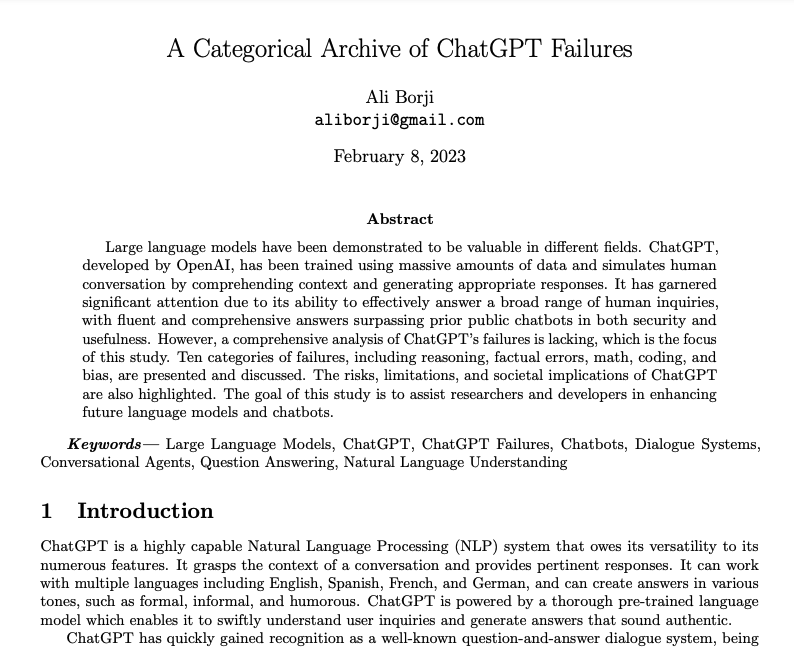
A Categorical Archive of ChatGPT Failures
Comprehensive analysis of ChatGPT failures for categories like reasoning, factual errors, maths, and coding.
If you are developing with LLMs it's important to know these failures. Good to see them documented.
https://t.co/lSrIrfuWcz
It is sad to lose the DeepMind office in Edmonton to the Tech layoffs and looming recession. But AI is not going away, and I am more focused than ever on the Alberta Plan for AI research.
https://t.co/DQBl7vmGaO