$17M to build two single window systems??
The Lanka Software Foundation is currently building the Trade National Single Window and the first part is hopefully going to go live in the next month or so. Total cost: $0.
$17M is crazy - most of it will go to stupid consultants to write dumbass reports.
@shakyasinhayo02 The people who bankrupted the only Theravada Buddhist national in the world are the real rodiyas.....your caliber or cast is defined by your actions
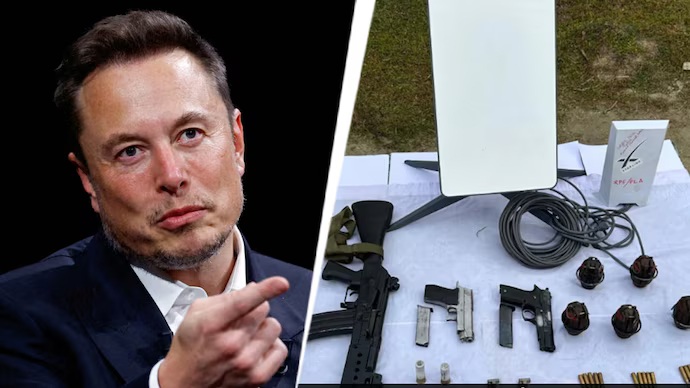
Elon Musk says oligarchs are blocking Starlink in India. Let me tell you what is really stopping it, and why India is right.
Starlink already has its Indian licence. It got the telecom licence in June 2025, space regulator approval in July 2025, and trial spectrum in September 2025.
What is pending is security clearance and FDI approval. Jio and OneWeb are waiting on the same rules. Nobody gets a shortcut.
And India has good reasons to be careful.
In November 2024, Indian agencies caught a boat near the Andaman Islands carrying around 6,000 kg of meth, the biggest drug haul in our history. The smugglers reportedly used a Starlink device to navigate. Police had to write to Starlink asking who bought it.
In December 2024, the Army seized a Starlink-like device along with weapons during a raid in Manipur. Musk said Starlink beams were turned off over India. A few weeks later, The Guardian reported that Starlink was working in parts of Manipur during internet shutdowns, with devices smuggled in from Myanmar.
In 2022 Ukraine, a country at war, asked Musk to extend Starlink coverage to Crimea for an attack on Russia's navy. He said no. One private businessman decided what a nation at war could do.
That is exactly why India is asking for three things. Indian data stays in India. Our agencies can legally monitor traffic, like with every telecom company. And the government can switch off service in a specific area during an emergency.
China doesn't allow Starlink at all and is building its own satellite networks. South Africa asked for local ownership like every other operator there, and Musk called it racism.
Even in America, the standard Starlink plan costs around 120 dollars a month, while normal fiber is 55 to 80 dollars and much faster. It works best where cable doesn't reach.
India needs satellite internet in its villages. Starlink is welcome. On India's terms, like everyone else.
This is not about oligarchs. It is about who holds the off switch to our internet.
To the Colombo elite (the boardroom class, conglomerate chairmen, old-money families, developers, hoteliers, bankers, and industrialists moving between Cinnamon Gardens cocktail parties and World Economic Forum panels), this message is for you.
You have spent two years watching this government dismantle the opposition, capture the judiciary, weaponize anti-corruption institutions, suppress media freedom, and harass critics. And you have said nothing. You calculated, as always, that silence is the safest investment: keep your head down, attend state economic forums, praise the "reform agenda," and quietly align with new power. You watched politicians arrested, journalists questioned, an airline CEO found dead, a retired intelligence chief tortured in custody, and a constitutional amendment rammed through to subordinate the bench. You assumed none of this was your problem. You believe you are above politics, and immune.
You are not immune. If you understood the history of the party governing this country, you would know the Colombo business class has always been among the JVP’s primary targets.
The last time the JVP held power through terror, it came for you. During the 1987 to 1989 insurrection, it enforced general strikes through violence. Every business, factory, and market was ordered to shut. Those who defied orders to keep workers employed were attacked; bus drivers and entrepreneurs were murdered simply for working. Documented assassinations included businesspeople alongside politicians and officials. Anyone sustaining the economic order when the party demanded it stop was deemed a legitimate target. Sixty thousand died, supply chains collapsed, and generations of enterprise were brought to a standstill.
That is the party in office today. Its methods have changed and its rhetoric has softened, but its ideological DNA remains intact. Founded on Marxist-Leninist doctrine, the JVP views the business class not as job creators, but as class enemies. Private wealth remains suspect, enterprise is tolerated only when serving party objectives, and commerce is treated as a resource to be managed through taxation, regulation, or intimidation.
Today, the JVP does not enforce compliance with machetes; it uses CIABOC investigations.
The amended Anti-Corruption Act expanded CIABOC’s remit to cover private-sector bribery and influence peddling. In 2025, CIABOC arrested 154 suspects and filed 115 cases, taking prominent business leaders into custody. Transactions once considered ordinary commercial dealings now fall within the state’s crosshairs.
Anti-corruption laws are necessary, but only when enforcement is independent. When the CIABOC Director General is a former member of the JVP legal division, when inquiries into opposition figures are shelved while rivals face prosecution, and when critics face contempt charges, compliance ceases to be about the law. It becomes about avoiding the displeasure of the party. Colombo executives know their "measured praise" is not voluntary; it is an insurance policy.
The business elite has met this administration with its customary sycophancy. Figures who once lauded Ranil Wickremesinghe now praise Anura Kumara Dissanayake. But the JVP is different. It does not share your assumptions regarding the primacy of capital or property rights. Commanding 159 parliamentary seats, it needs neither your campaign contributions nor your commercial counsel. The private sector possesses nothing the state cannot extract through regulation or decree.
Your greatest failing is not refusing to oppose this administration, but failing to realize that your core interests (secure property rights, judicial independence, and due process) are the very principles being dismantled. When the judiciary loses autonomy, contract enforcement turns political. A state that manipulates judicial tenures and abuses detainees leaves every commercial transaction subject to political favor.
When CIABOC’s mandate broadened, the elite claimed those with nothing to hide had nothing to fear. But in an environment of compromised oversight and selective prosecution, clean hands offer zero protection. Safety derives solely from the uniform application of the law; without it, innocence is no shield.
Venezuela’s private sector made the identical calculation. Under Hugo Chávez, executives attended state summits, issued supportive statements, and assumed compliance would preserve their wealth. Instead, over a thousand enterprises were expropriated as independent courts vanished. By the time commerce realized accommodation yielded no immunity, the institutional buffers were gone.
Sri Lanka has not begun nationalizing assets, but the pattern is unmistakable: expanded investigatory powers, eroded judicial oversight, selective enforcement, and a business sector trading silence for survival.
The JVP targeted commerce in 1989 through violence; today, it employs statutory machinery. Acquiescence will not protect you, and sycophancy will not buy favor. Your only lasting safeguard lies in what you refuse to demand: an uncompromised judiciary, non-partisan investigatory agencies, and the rule of law. These are the basic preconditions for a market economy, and they are being dismantled while boardrooms offer applause.
#SriLanka #LKA #JVP
@colomboinsights The so called harassment is equal application of law among all citizens, if you became someone by breaking the law then you're not elite, you're a criminal
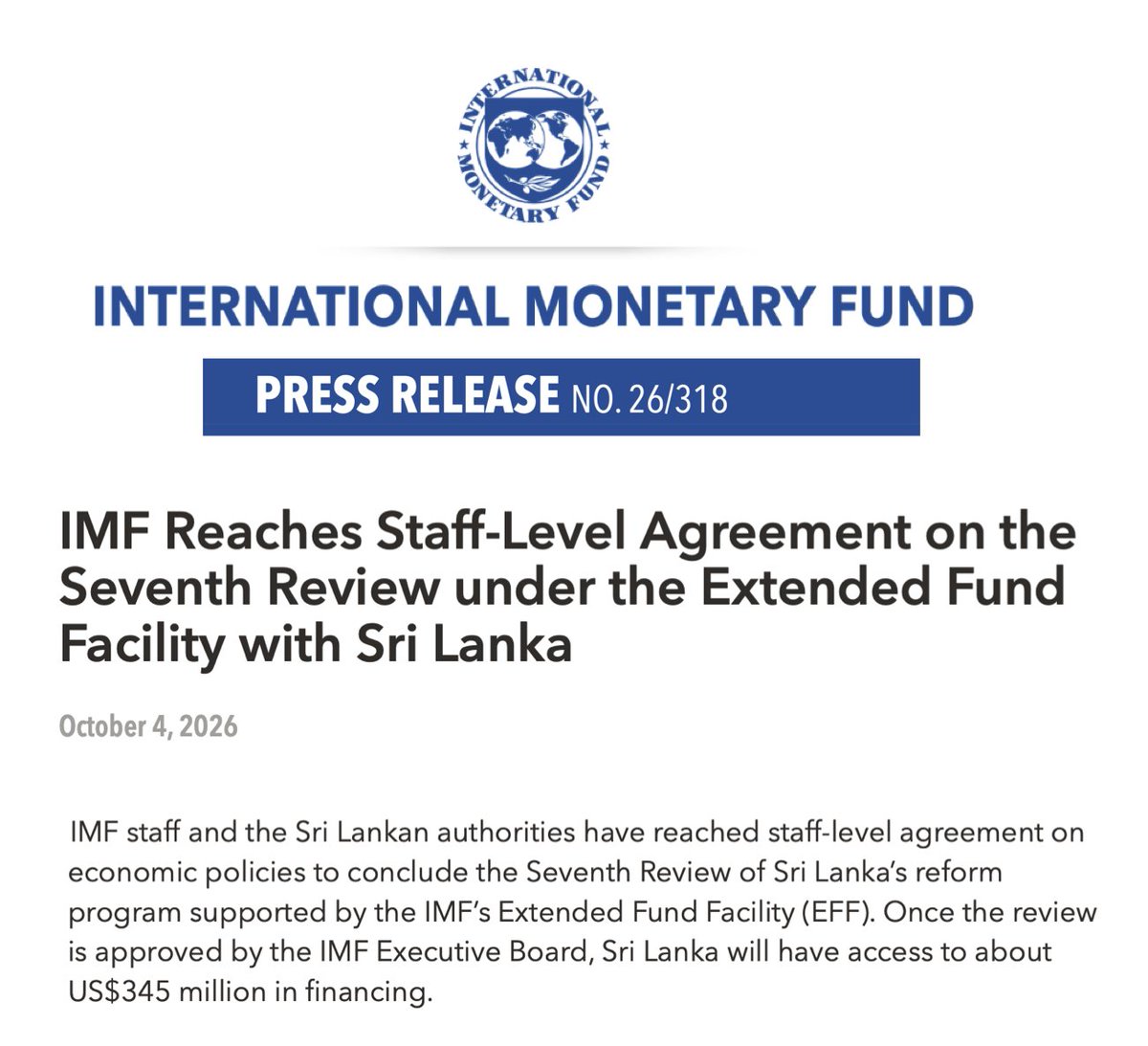
IMF and Sri Lanka reached a staff-level agreement on the 7th review of the Extended Fund Facility.
@IMFNews Board approval is subject to:
• presentation of the 2027 budget, in line with program parameters
• completion of the financing assurances review
- to confirm multilateral partners’ contributions
- to assess progress with debt restructuring
Once approved, we will have access to ~USD 345 Mn.
IMF emphasised:
• amidst a protracted Middle East (ME) war, Govt. should allow domestic fuel prices to adjust in line with international price movements, while protecting the vulnerable.
• in case of a stronger second-round inflationary effects from the ME war, @CBSL should stand ready to tighten monetary policy.
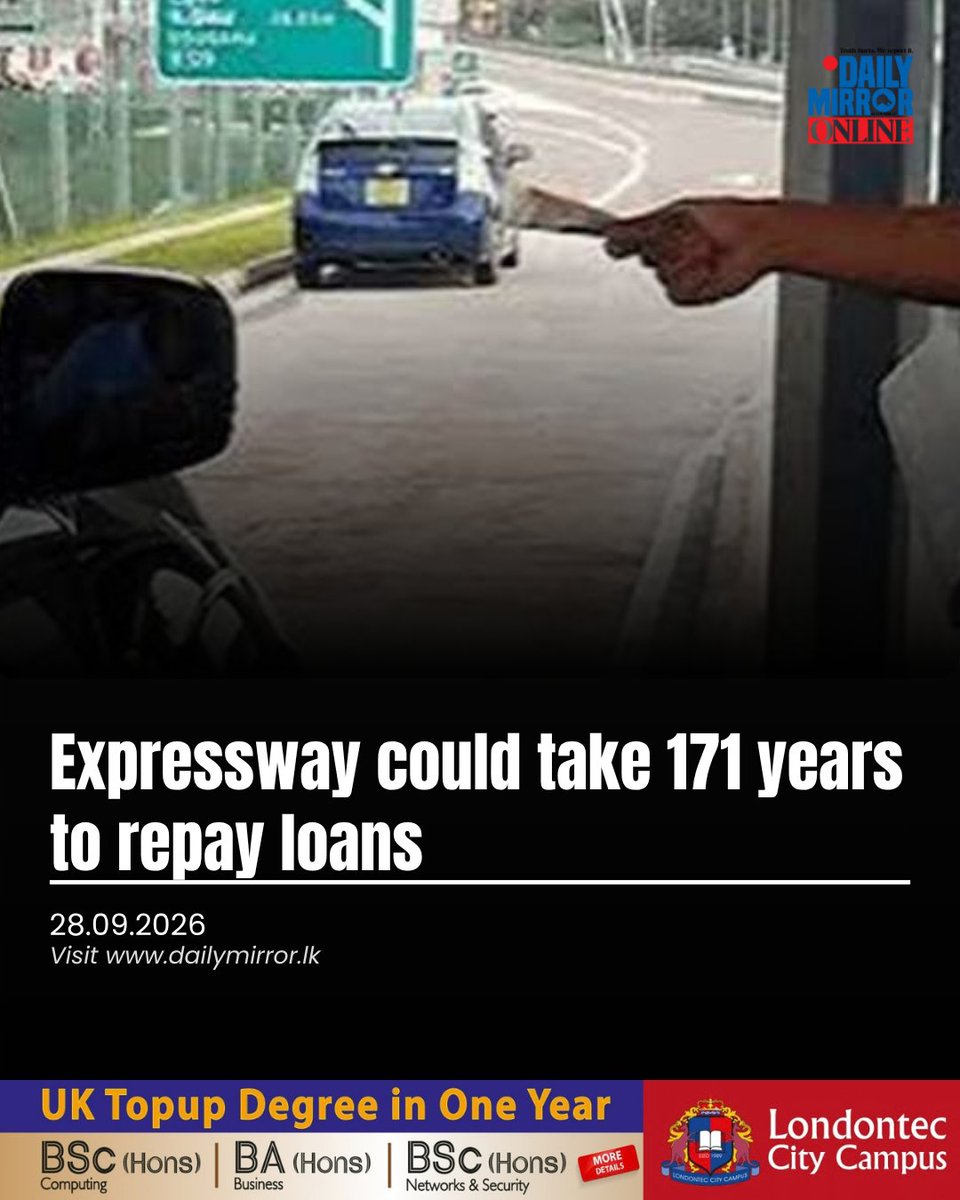
@Dailymirror_SL 611B LKR is roughly 1.8B USD. However, the wider economic benefits such as mainly tourism, fuel and time saving, new investments in the south, more than makes up for it.
Just in 2025 tourism revenue was 3.2B USD, while Galle fort became top visited destination over Sigiriya
611B LKR is roughly 1.8B USD. However, the wider economic benefits such as mainly tourism, fuel and time saving, new investments in the south, more than makes up for it.
Just in 2025 tourism revenue was 3.2B USD, while Galle fort became top visited destination over Sigiriya