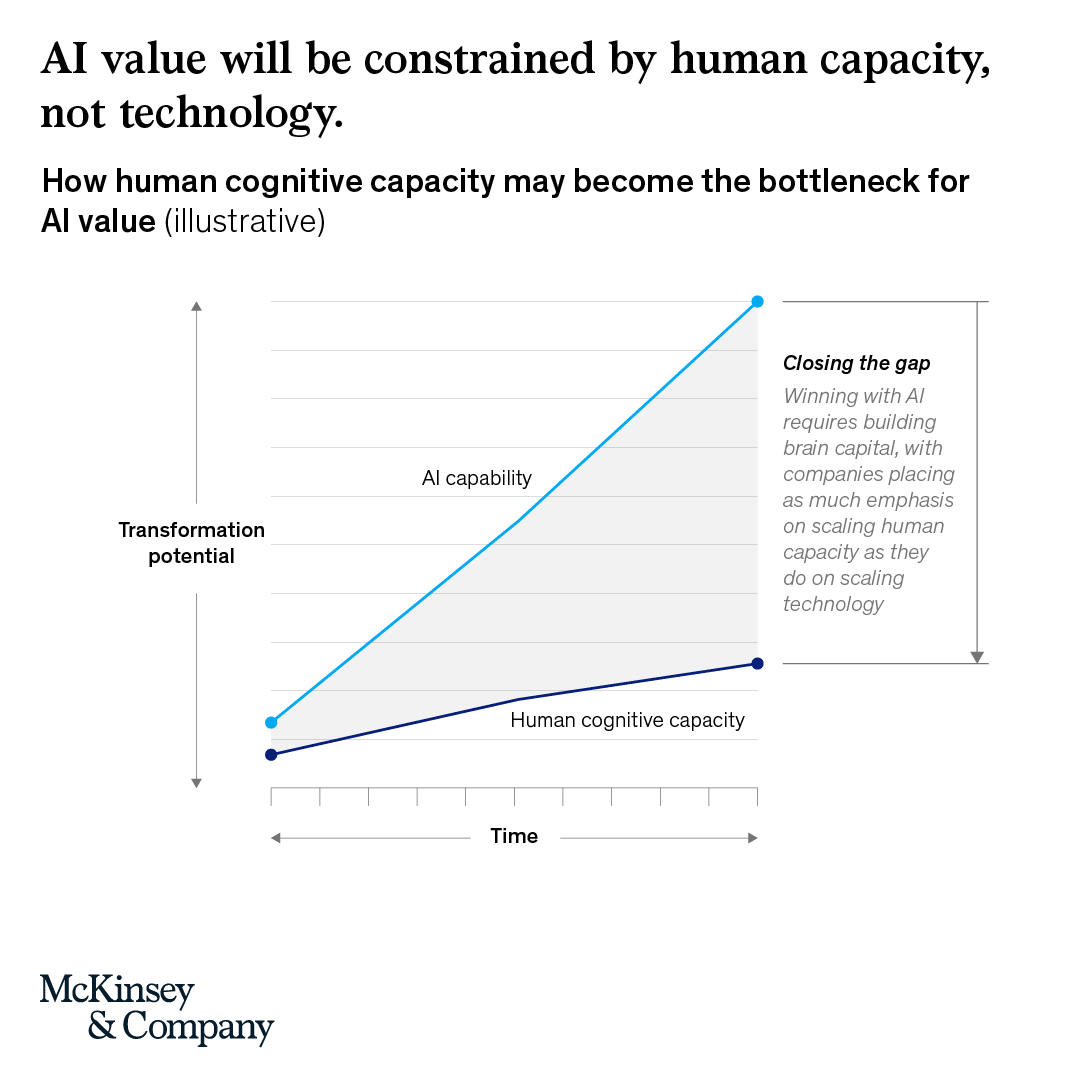
AI is moving fast. Human cognitive capacity isn't moving at the same speed.
Building brain capital is becoming just as important as building AI—giving people the skills, focus, and decision-making capacity to keep pace. https://t.co/Cv0SspivZ4
"A cyber attack, when it happens, has nothing to do with technology. It's all about humans."
To empower your teams and lead with impact, discover our cyber security culture principles:
https://t.co/4KBgefk8lz
After decades of working with leaders at companies like Apple, Salesforce, and Cisco, we've identified 4 storytelling techniques that consistently work to deliver important messages in high-stakes settings:
1. Start with the unexpected
Don’t begin your presentation with context. Instead, begin with the moment that makes people think, “Wait…what?”
Instead of something like:
“Here’s an update on our September campaign…”
Try starting with the most interesting detail:
“I broke our biggest marketing rule last month, and it worked.”
Lead with the surprise. You can add context later.
2. Let people feel the tension
After the surprise, don’t rewind to the beginning. Take your audience to the moment where things weren’t working.
Flat numbers.
Missed goals.
Stalled progress.
Instead of:
“The campaign was underperforming, and our team went back to the drawing board.”
Try:
"We were two weeks out from the end of the quarter. The campaign wasn’t producing results, and the team was out of ideas. That’s when I decided to take a risk...”
You don’t need to explain the problem. You need to make people feel it.
3. Use real dialogue
When your audience hears what was actually said, they stop listening to you and start visualizing the moment. This helps them connect emotionally with what you’re saying.
Instead of:
“The campaign manager said team morale was low and they were struggling to find a solution.”
Try:
“My campaign manager pulled me aside in the hallway and said, ‘We’ve tried everything. The team has been working overtime, and we don’t know what else to do.’”
Dialogue brings listeners into the moment with you. It makes the story real.
4. Share the lesson
Never assume people will infer the meaning you intended.
End your story by answering:
- What does this mean?
- How should someone act differently now?
Example:
“Breaking our biggest marketing rule helped us turn this campaign around and hit our numbers. I strongly suggest we revisit our marketing guidelines. We could be leaving a ton of revenue on the table.”
Without the lesson being clear, even a good story feels unfinished.
These are the same techniques we teach to our clients at Duarte. Try them out during your next presentation and watch how people lean forward and tune in to your message
A CALL FOR RESEARCHERS!
The National Information Technology Development Agency (NITDA) is calling on top researchers and experts to lead a groundbreaking national study on how digital technologies are transforming our economy.
This is your chance to influence policy, drive innovation, and leave a lasting impact on Nigeria’s growth story.
Application should be sent to: [email protected]
Deadline: 19th April 2026
The CEO of one of the world's biggest banks just said something no banker was supposed to say out loud.
His name is Georges Elhedery. He runs HSBC — $3 trillion in assets, the world's 4th largest bank.
He didn't talk about digital transformation. He talked about "ruthlessly killing complexity."
"Things don't become complex by design. They end up becoming complex by lack of focus."
HSBC now has 100+ AI use cases deployed, half already in production. 85% of employees use generative AI tools. The $1.5 billion cost-savings target was hit six months early.
20,000 jobs — 10% of the global workforce — are on the table.
Here's what nobody says out loud.
Complexity isn't a mistake. It's the natural output of a system that hired people to coordinate other people.
AI doesn't just replace the work. It exposes what the work actually was.
Most of those 20,000 jobs weren't creating value. They were managing friction created by the previous 20,000 jobs.
AI is the first technology ruthless enough to say: "that entire category of work is overhead, not output."
The first-order story is AI cutting jobs. The second-order story is AI revealing which jobs were always phantom overhead.
Understanding that difference is what separates clear analysis from headlines.
I made a free toolkit breaking down 100+ mental models used by history's greatest thinkers — the same frameworks that help you see patterns like this before everyone else.
5,000+ downloads. 113 five-star reviews.
Comment "MODELS" and I'll send it to you.
If you're new here, @GeniusGTX is a gallery for the greatest minds in economics, psychology, and history. Follow along for more similar content.
@NigeriaRevenue@taiwoyedele My understanding is that basic food items like bread are VAT-exempt under Nigeria’s VAT framework.
However, I was charged ₦450 VAT today when buying bread at City Bakery.
Can someone clarify, is this an incorrect application of VAT?
@NigeriaRevenue@taiwoyedele still waiting for clarity on this ₦450 VAT slapped on bread (basic food, supposed to be exempt/zero-rated).
This feels like unfair overcharging by the bakery,consumers getting shortchanged on essentials!
@fccpcnigeria has my right been breached?
@satyanadella Great to see @Microsoft commit to partnering with U.S. communities as AI infrastructure expands.
For Africa, the next frontier is data sovereignty & trust. Hosting data locally is vital to close the Digital Divide and bridge the Infrastructure Gap, ensuring inclusive growth.
@BradSmi@Microsoft Thank you @BradSmi & @Microsoft for tackling AI’s environmental & economic risks.
For Africa, the next step is building trust in hosting data locally. Without data sovereignty, fears around AI adoption deepen, widening the Digital Divide & Infrastructure Gap.
#AI#DataSovereignty