Yes, mitigating Hormuz-like chokepoint risks is a major driver for countries to expand local renewables and electrification, but I’m wondering will energy security also be a driver for a hydrogen H2 economy?; some very initial thoughts... https://t.co/SzLvnv1Opl
@JEBistline It looks to me that they only consider local government policies so that demand side subsidies don’t really matter. They do not include massive national solar feed in tariffs in their analysis.
@RobertD11359976@AukeHoekstra No they are all overnight costs. Your $8/W data are from a 2020 MIT report, https://t.co/vab3ug9T4P. They have a updated estimate then at https://t.co/PalOzFmxwf which increase the estimate to about $15/W.
@AukeHoekstra We’ve submitted a longer archived paper documenting all methods and data. As you know, the publication process can take ages... but all original data/code are available on my GitHub: https://t.co/uKxgqMEAOs.
@AukeHoekstra Auke, yes these are overnight costs. And as the author, I do think direct cross-country cost comparisons on costs should be made with caution (as we noted in our paper).
@duncancampbell@xiaowang1984 My hypothesis is that for nuclear power the “learning” is more about an indigenization process… for solar the “learning “ is improved cell efficiency & scale of economy
So cool to see a front (digital) page story at NYT on nuclear, and interactive too. I think this mostly gets the story right of why China is beating the US on nuclear energy, but will add a few nuances...
https://t.co/wQsDxayHib
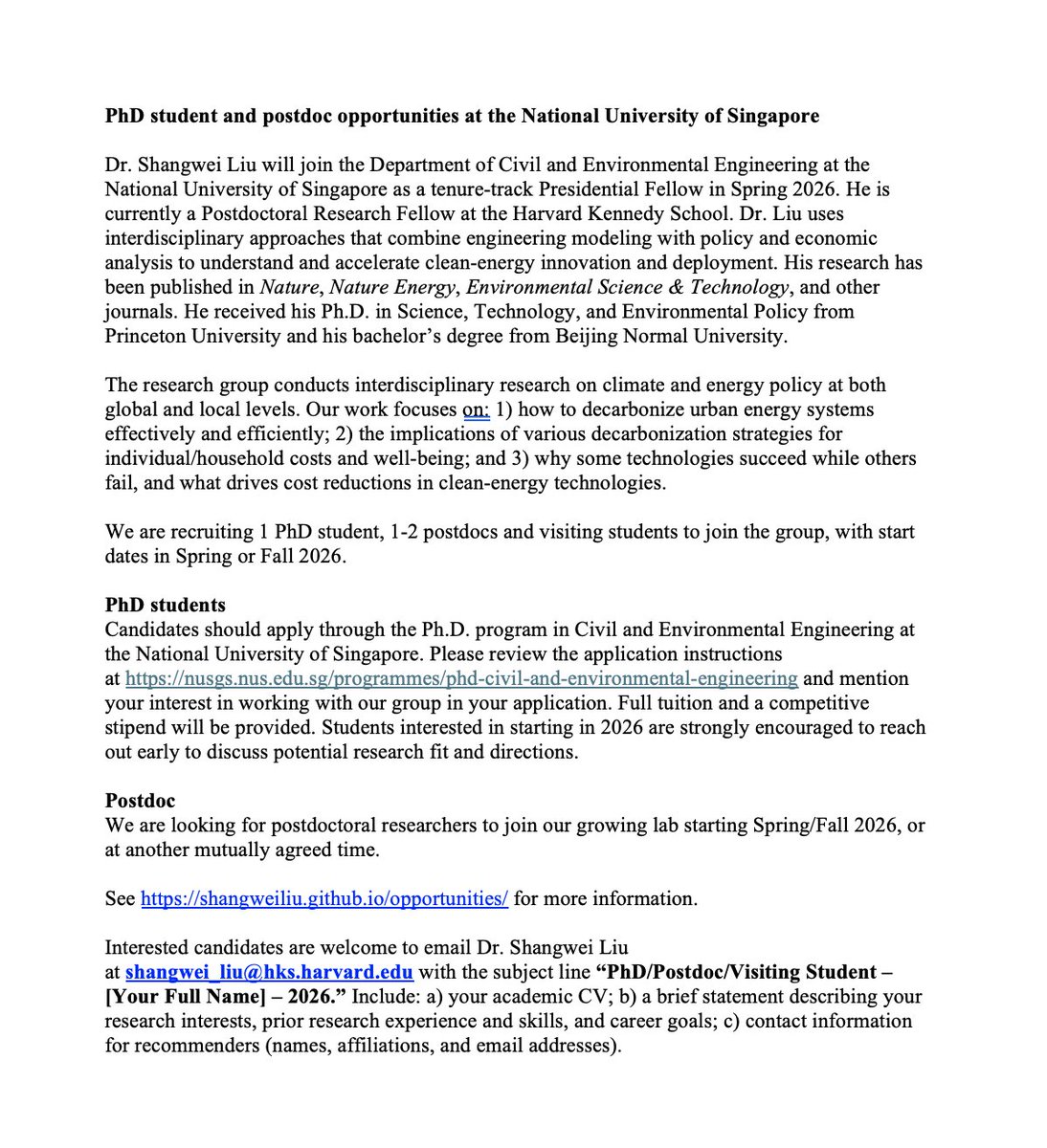
My new group will focus on energy and climate policy at local, regional, and global levels. I aim to build an inclusive and productive research environment, and we are recruiting Ph.D. students and postdocs.
More details: https://t.co/amsODA9vyJ
Thrilled to share a career update: I will join the Department of Civil and Environmental Engineering @NUSingapore as a tenure-track Presidential Fellow in Spring 2026. Extremely grateful to my mentors and colleagues who have supported me throughout my career.
Excited to share my new blog with the Roosevelt Institute: “Can China Break Nuclear Power’s Cost Curse—And What Can the US Learn?” Grateful to @toddntucker for the invitation and to the Roosevelt Institute editorial team for their terrific support.
We’re launching a new blog series on how countries + industries are navigating the clean energy transition.
First up, @shangwei_ digs into why nuclear costs keep rising in the US but falling in China—and what this means for industrial policy. ⬇️ https://t.co/oF1fbEGvTd
While most countries have seen nuclear costs spiral upward, China has shown that stable regulation and domestic supply chains can keep costs under control, offering lessons but also cautions for other countries.
🚨 Climate Week NYC 2025🚨
Can nuclear power help us reach net-zero and power the AI era?
Join us Sept 23 (10–11:30 AM ET, online) with
Dr. @dan_kammen
Dr. @shangwei_
Dr. Jessica Lovering
Dr. Nicolas Zweibaum
👉 Register: https://t.co/d0LPxvcbjz
#ClimateWeekNYC#Nuclear
The past 20 years have not been happy ones for nuclear energy. Is a long nuclear winter showing the first shoots of spring? Growing optimism reflects three developments https://t.co/c0F2R0evCh
@DavidLiaoCH That’s a great question… we don’t look at the operational details. But I suspect that the Chinese case will be similar to the French one as China actually learned nuclear power operations from France?
Nuclear energy is now trying to make a global comeback. The U.S., France, and many emerging economies are eyeing a nuclear renaissance. But there’s a problem: historically, building more reactors has led to higher costs, especially in the U.S. and France.
The 2025 French Court of Auditors’ review later placed the overnight cost at over $10/W (see: https://t.co/2uXC5YLffc). We apologize that the “>” symbol was inadvertently dropped from the final published figure, and regret any confusion this may have caused.
Also clarification on Flamanville 3 costs: At the time of our data collection, Flamanville 3 was still under construction, with overnight cost estimates ranging from $4/W to $10/W (see Rothwell, 2022, Energy Policy, 164, 112905).
In our original figure (now included as Supplementary Figure S1), we used the lower bound of $4/W and marked it as “> $4/W”, as even this very low estimate illustrates the substantial cost escalation in France’s recent nuclear construction.