🚨 #Breaking In a landmark 6-3 ruling today, the U.S. Supreme Court held in Chatrie v. United States that law enforcement’s use of a geofence warrant to obtain cellphone location data constitutes a “search” under the Fourth Amendment.
Justice Elena Kagan, writing for the majority, concluded that individuals have a reasonable expectation of privacy in their historical cellphone location information — even when it is shared with companies like Google.
The Court vacated the lower court’s decision and remanded the case for further proceedings to determine whether the specific geofence warrant in this case satisfied the Fourth Amendment’s requirements of probable cause and particularity.
This decision builds on the Court’s 2018 ruling in Carpenter v. United States and represents a significant victory for digital privacy, limiting broad “dragnet” surveillance techniques that sweep up location data from potentially thousands of innocent users.
The ruling does not ban geofence warrants outright — it simply requires them to meet constitutional standards.
Privacy advocates are hailing it as an important check on government overreach in the digital age.
NEW EXHIBIT: “Jeff Gordon” opens this Wednesday, July 1–just in time for fans visiting for the Brickyard 400!
Spanning both Lower-Level rotating galleries, this exhibition explores Gordon’s racing timeline from quarter midgets, sprint cars, to his unparalleled stock car career.
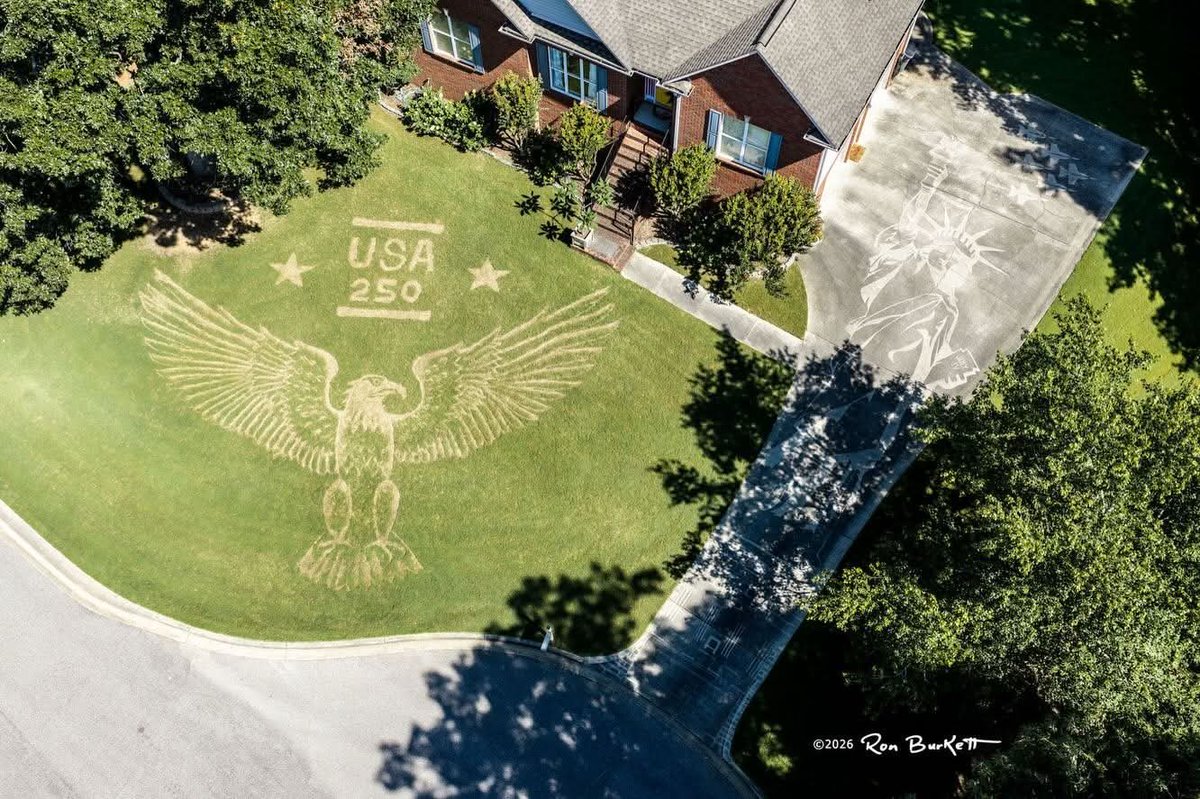
Ron Burkett in Trussville decided to do an art project with his grass in celebration of America’s 250th anniversary.
How freaking cool is that?!? Bad ass. 🇺🇸
1950 World Cup: The Miracle on Grass | HISTORY
At the 1950 World Cup, the United States pulled off one of the greatest upsets in the history of sports, beating all odds to defeat the polished English team.
It might have been the greatest soccer upset of all time, a World Cup match so astonishing it was retroactively dubbed the “Miracle on Grass.” On June 29, 1950, a ragtag bunch of American amateurs defeated England in Belo Horizonte, Brazil, a mining city surrounded by hills.
Were we colluding with the Russians in 1995?
Bill Clinton was the President of the United States in 1995.
On June 29, 1995, the American space shuttle docks with the Russian space station to form the largest man-made satellite ever to orbit the Earth.
This historic moment of cooperation between former rival space programs was also the 100th human space mission in American history. At the time, Daniel Goldin, chief of the National Aeronautics and Space Administration (NASA), called it the beginning of “a new era of friendship and cooperation” between the U.S. and Russia.
https://t.co/GWfUBk7rku