India's biggest development challenge was never a lack of ambition. It was the politics of delay, disruption, and opposition.
▶️ The 𝐒𝐭𝐞𝐫𝐥𝐢𝐭𝐞 𝐂𝐨𝐩𝐩𝐞𝐫 𝐏𝐥𝐚𝐧𝐭, which once produced nearly 40% of India's refined copper, was shut down after sustained protests, turning India from a net exporter into a net importer of copper.
▶️ The 𝐒𝐚𝐫𝐝𝐚𝐫 𝐒𝐚𝐫𝐨𝐯𝐚𝐫 𝐃𝐚𝐦 faced decades of resistance before finally delivering water security, irrigation, electricity, and economic transformation across large parts of western India.
▶️ Today, the 𝐆𝐫𝐞𝐚𝐭 𝐍𝐢𝐜𝐨𝐛𝐚𝐫 𝐏𝐫𝐨𝐣𝐞𝐜𝐭 faces similar opposition, despite its potential to strengthen trade, connectivity, and India's strategic presence near the Malacca Strait.
Watch how the stories of Sterlite, Narmada, and Great Nicobar reveal a recurring pattern: when critical infrastructure projects are stalled, the cost is borne by India's growth, self-reliance, and strategic interests. The real question is whether transformational projects will move forward — or remain trapped in a cycle of politics and obstruction. 👉
THIS GUY LIVES UNDER SFO'S TAKEOFF PATH SO HE BUILT A CEILING PROJECTOR THAT TRACKS EVERY PLANE FLYING OVER HIS HOUSE IN REAL TIME
he uses a cheap $30 radio receiver to pick up the signals that planes broadcast while flying.
then projects them onto his ceiling in real time
when a jet flies over his house you hear it outside and at the exact same moment a plane glides across his ceiling labeled with the airline, aircraft type, and destination
pure black background so the projector's rectangle disappears and only the aircraft are visible
but he didn't stop at planes
it also draws the real sky behind them. sun, moon, bright stars, constellations, and live satellites including the ISS. all at their true positions for his exact location and time in real time
so he's lying in bed watching the actual night sky projected onto his ceiling with real planes crossing through it as they take off from SFO
there is a huge market for every man alive that runs outside to see the helicopter
vibe coded the whole thing himself with a cheap radio, a projector, and some clever software
@aslicheen The most ignorant, bigoted racist-supremacists on the planet right now. Everything is going to come crashing down one day sooner than later. Then they will know. Still Indians won't do to them what they have been doing to India for the last two decades.
As security priorities evolve globally, stronger strategic partnerships matter more than ever. 🇮🇳🇮🇱
India–Israel cooperation in defense, technology, AI and cyber capabilities can play a vital role in strengthening long-term national security and resilience.
A timely conversation on innovation, strategy and the future of partnership.
#IndiaIsrael #NationalSecurity #StrategicPartnership #DefenseInnovation #Geopolitics @Gen_RajShukla@MDigitalBharat
Supreme Court upholds the decision of Election Commission of India’s (ECI) to undertake Special Intensive Revision (SIR) of voter rolls that started in Bihar.
A bench led by CJI Surya Kant has held that the SIR exercise cannot be struck down as ultra vires (illegal) just because it’s a process different from ordinary exercise of revision of voter rolls.
The Court has termed SIR as legitimate and constitutional exercise. “The exercise is legally tenable”, it added.
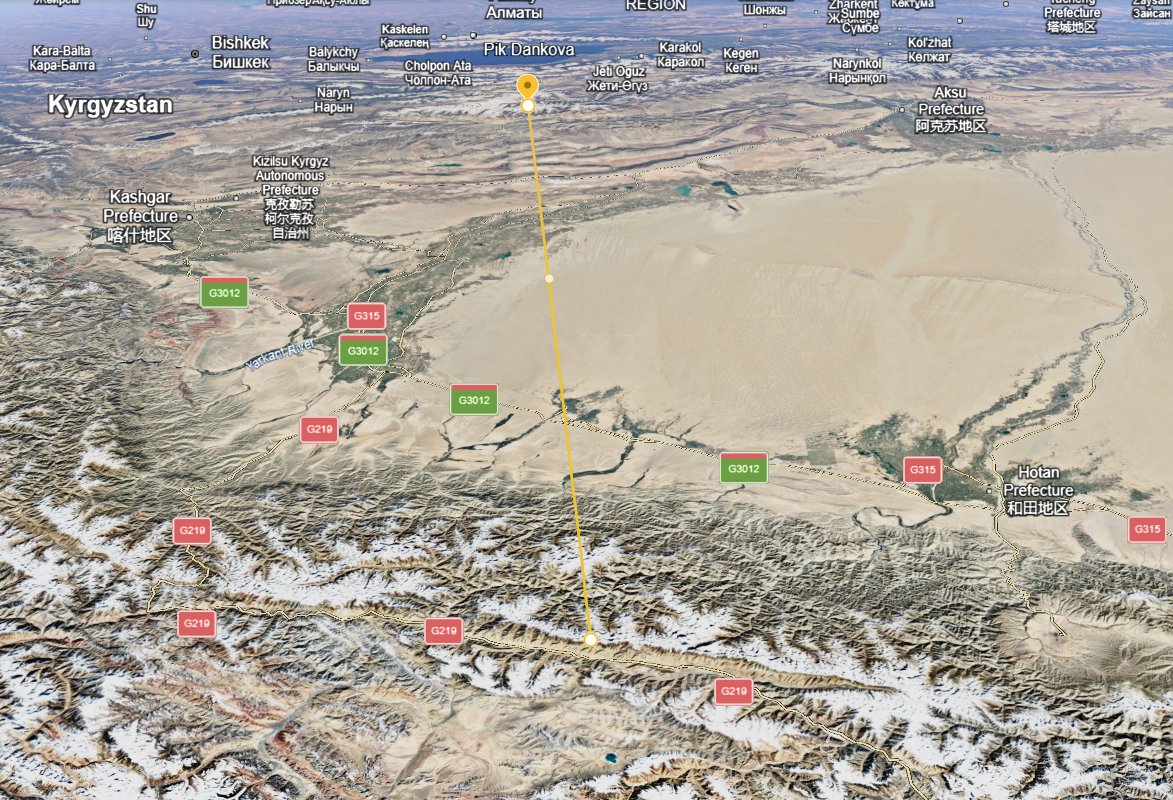
The longest theoretical line of sight in the world is from Pik Dankova in Kyrgyzstan to an unnamed ridge near the India-China border. To see such a view would require perfect conditions. The result would be a span of a jaw-dropping 531km (330 miles).
https://t.co/Qn8Pd4OELo
Just to refresh our memory and let the younger lot know, there was a similar situation at Timber Trail (HP) in 1992. The height, distance and terrain were much more challenging. And it was almost sunset when the incident happened. 10 tourists, including a 4-YO kid, had got stranded when, having reached the drop off point at the hilltop resort, they suddenly saw one of the cables breaking and the trolley beginning to slide backwards.
One passenger was thrown out since he was in the process of deboarding and landed close to the docking station, while the trolley attendant panicked and jumped to his death when his head hit a rock below.
The trolley reached a speed of more than 200 kmph while sliding back, with sparks sparking on the cable. A twist of luck, wherein the broken cable got entangled, stopped the trolley that was now suspended 1500 ft above the valley floor below.
An SF officer, who had lost one of his parents a couple of days back (I think his mom had left him for heaven), took it on himself to rescue the stranded tourists. Two brave pilots of the IAF flew him onto the stranded trolley. It was by the late afternoon the next day that the young officer winched himself down and stood on top of the trolley.
That was one messy situation wherein they had been stuck for a long time, with one of the passengers suffering from diarrhoea. Needless to say, they had survived the longest night of their life with no water or food and no radio communications.
The officer, having briefed the tourists about the drill of winching by a Mi-17 heptr (there was no possibility of getting them down to the valley floor because of such a height), started securing them one by one as the pilots hovered above the trolley, with the wind draft from the rotors shaking the cabin violently.
Soon, it was dark, and rescue had to be paused with five people still in the trolley. Fearing that the officer would now leave them to return the next morning, as the stranded tourists looked up to the officer with despair in their eyes, he spoke those immortal words: 'I have two kids at home and the fact that I am staying on means there is nothing to worry." And he volunteered to stay with them for the night.
The operation ended the next morning, with the officer winching himself up in the end.
Let's now have the names of those heroes:
Maj Ivan Joseph Crasto (awarded Kirti Chakra); later Colonel.
Group Captain Fali Homi Major (awarded Shaurya Chakra); later IAF Chief.
Flt Lt P Upadhyay (awarded Vayu Sena Medal); later Group Captain.
I don't know if that kid later joined forces, or if two honeymoon couples who would later become parents did send their kid(s) to forces, but such stories need to be told and retold, for no civilisation can have a future if its past is forgotten.
@adgpi@IAF_MCC
Can we all give a salute to Sidhant? His question caught Marco off-guard and forced him to reply. And his reply suddenly made his boss and many of the MAGA who call India and Indians sick things stupid.
Like the US state dept declared "officially stupid." And it is true, no matter they take down the post. Marco himself is being targeted racially by these stupid racists now.
This was the first time I saw an Indian journo ask some uncomfortable questions to these visiting dignitaries who are generally treated very reverently in India.
Sidhant didn't back down too when Marco tried to get confrontational after getting caught off-guard by this question. Only Dr. J seemed to try intervene. That's OK, it was a diplomatic thing to do.
So kudos to Sidhant. He has now made the US officially address the racism issue and officially call the people who do it stupid. I hope now the Trump admin acts on this issue destroying India-US relationship.
Because this racism and hate for Indians and Hindus in the last two years of Trump admin did not start organically. I didn't see the same last term. So what changed this term?
This time it was seeded with an operation by adversaries infiltrating American social media as MAGA accounts to incite normal Americans against India, Indians, and specifically Hindus.
It is weak the US, under Trump admin, will allow its own social media companies to be used by Islamists and Communists to wreck India-US relations or dictate American foreign and immigration policies influencing MAGA.
My thoughts on the whole Norwegian journalist thing
Europeans, especially northern Europeans, are rude (by our standards)
We Indians are taught to be humble.
Stuck in the concept of "atithi devo bhava." We cannot imagine being rude to a guest like that.
Europeans know this, and they shamelessly exploit this cultural advantage over us.
This reminds me of something Harsha Bhogle said about the famous 2002 Natwest final at Lords in England
"We have always harbored notions of telling people ... get stuffed yourself, but we never did it. We were a great talking nation. We weren't a great doing nation. And when Saurav came along and he actually took that shirt off, people said ah...someone's actually done it."
It's the same situation with foreign media and India today. Like it was with cricket in 2002.
We get angry and seethe online, but face to face, Europeans know we would never talk to them like that.
Someone in Indian media has to do to them what they do to us. Someone has to do the equivalent of what Saurav Ganguly did at the Lords balcony in 2002.
This rudeness cannot be taught. It cannot be scripted. It cannot be planned. It has to come spontaneously.
Go make a cartoon of the Norwegian PM serving drinks on Epstein's island. But be sure to put it in the middle page of the newspaper. Because you know, it's tiny Norway, not worth being on our front pages.
The legendary Concorde thundering down the infamous Kai Tak Runway 13 approach—swooping low across Kowloon before carving that razor-sharp visual turn at the checkerboard.
Blistering speed, a steep bank, and absolutely no margin for error. British Airways crews owned this high-stakes maneuver, blending pinpoint precision with pure piloting instinct—treating every passenger to a front-row view of one of aviation’s most iconic landings.
This wasn’t flying. This was controlled chaos at its absolute finest.
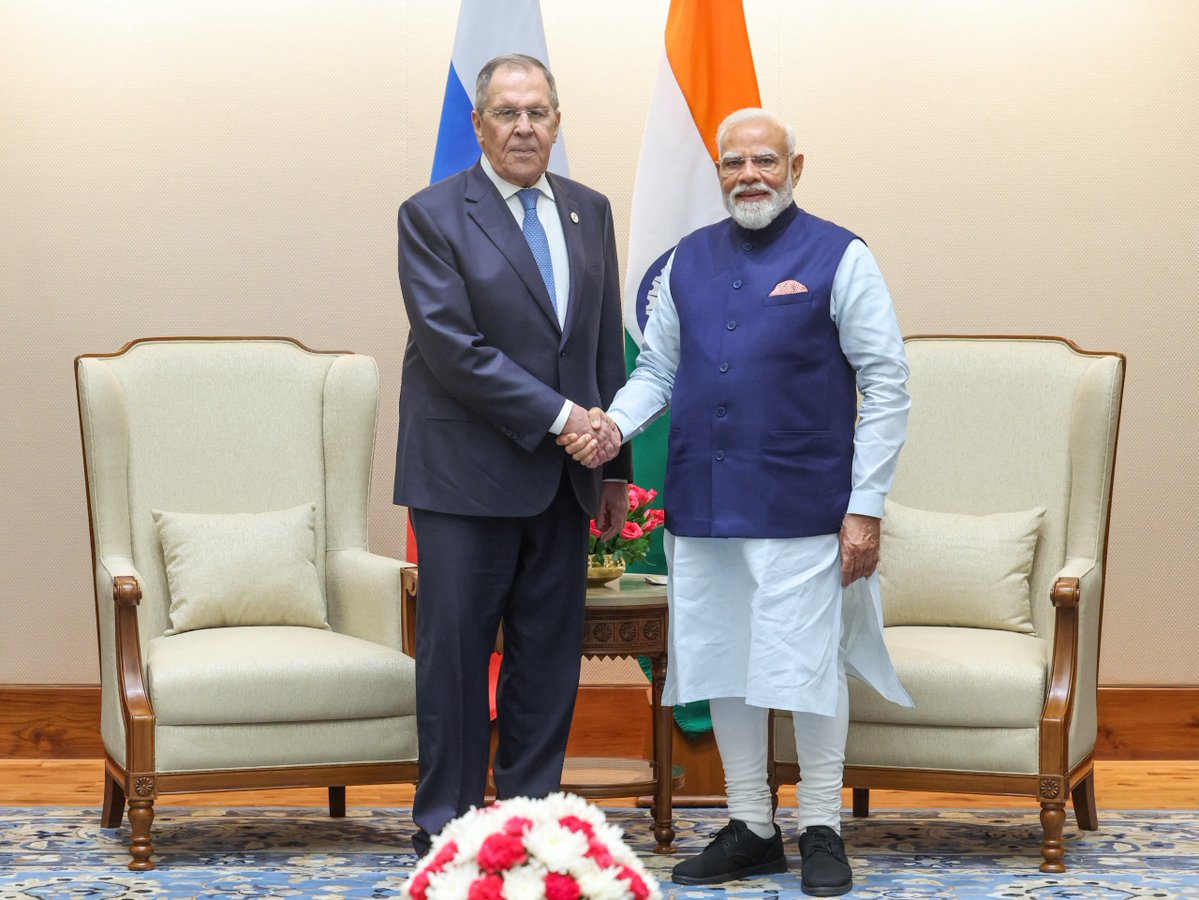
Pleased to receive Russia’s Foreign Minister Sergei Lavrov. Thanked him for an update on the progress on various facets of our Special & Privileged Strategic Partnership.
We also exchanged views on various regional and global issues, including situation in Ukraine and West Asia. Reiterated our consistent support for efforts aimed at peaceful resolution of conflicts.
@mfa_russia
In 1907, the summer sun over Ahmedabad was a brutal reminder of colonial hierarchy. While the British elite cooled themselves with imported ice & expensive English custards, a man named Vadilal Gandhi stood in a dusty corner of the city with a wooden barrel & a heavy iron handle. He was not just churning milk; he was hand-cranking a revolution that would eventually feed a billion people.
Vadilal did not start with a factory; he started with a Kothi: a primitive, hand-operated ice cream churner. In the early 1900s, ice was a rare commodity, often brought by train from the mountains/manufactured in tiny quantities for the British.
Imagine Vadilal in the pre-dawn heat, packing a metal canister with milk, sugar, & hand-picked fruits. He would surround the canister with a mixture of coarse salt & crushed ice. The salt lowered the freezing point of the ice, allowing the cream to solidify. For 4-6 hrs, Vadilal’s arms would move in a rhythmic, agonizing circle, churning the mixture until it became the smooth, frozen silk we know today.
In those days, European ice cream recipes almost always used eggs as a stabilizer. Vadilal knew his audience. He realized that for ice cream to become a true Indian staple, it had to be 100% vegetarian.
He experimented with natural thickeners & high-quality dairy to replicate the English texture w/o violating Indian sentiments. He turned a foreign dessert into a pure Indian celebration. By the 1920s, Vadilal’s fame had grown. He opened a small soda fountain in Ahmedabad.
Picture a bustling street in the 1930s. Amidst the cries for Swaraj, people from all walks of life, from laborers to local leaders would gather at Vadilal’s. It became a neutral ground. For the price of a few annas, an Indian could sit in a clean, modern shop & enjoy a luxury that was previously reserved for the Gymkhana Clubs he was not allowed to enter.
When he scaled, Vadilal faced a massive problem: how do you deliver ice cream in a country with no electricity & 40°C heat? He pioneered the use of insulated wooden boxes & specialized thermocol-lined containers.
He created a human relay system. Young men on bicycles would race from the central shop to distant weddings, the containers packed with extra salt-ice to buy them precious minutes. If the bicycle chain broke, the profit vanished. Every delivery was a high-speed battle against thermodynamics.
Vadilal eventually passed the handle to his son, Ranchodlal Gandhi. While the father used his hands, the son brought in the 1st electric churners in the late 1920s. They expanded from 1 shop to a fleet of carts, ensuring that the brand Vadilal became synonymous with the very concept of ice cream in Western India.
Vadilal Gandhi never saw the giant automated factories that today bear his name. He did not need to. He knew that the secret to a great nation & a great ice cream was the same: it required a steady hand, a pure heart, & the refusal to let the heat of oppression melt your resolve. He started with a wooden barrel; he ended by freezing a piece of the Indian summer for eternity.
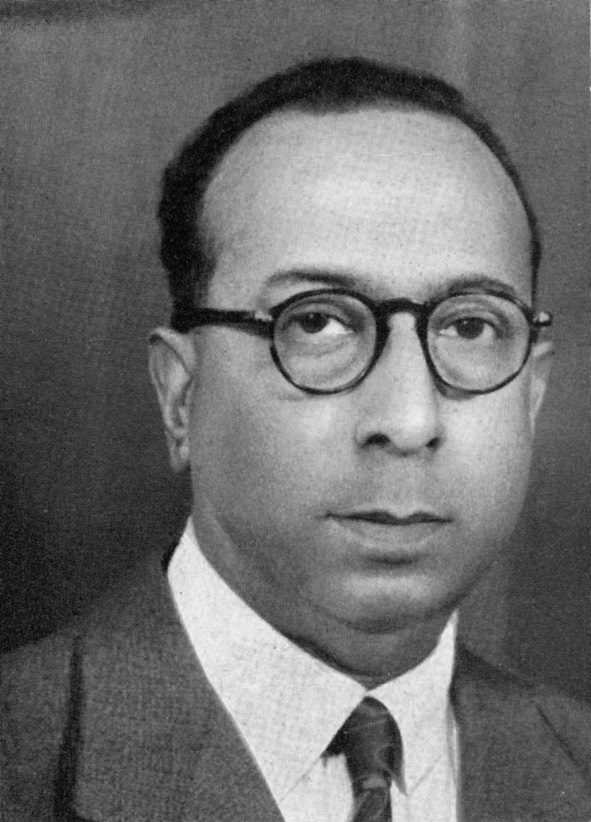
Imagine a man standing on a rooftop in Calcutta at midnight. The city is asleep, but he is awake, watching an invisible pulse of energy bounce off the edge of the world & come back home. He was the 1st Indian to realize that the Void above us is actually a bridge. In 1935, while the British Raj dismissed Indian science as theoretical & primitive, a man in a quiet corner of Calcutta was aiming a radio beam at the heavens like a silver spear. He was not looking for God; he was looking for a mirror in the sky that everyone said did not exist & when he found it, he realized he had discovered the secret Electric Skin of the planet.
Before Sisir Kumar Mitra, the world knew of the Ionosphere, but they thought it was a simple, single layer. Mitra was the 1st to prove the existence of the E-Layer & the complexity of the F-Layer specifically over the tropics. Using a primitive, hand-built radio transmitter, he sent signals upward & timed their return. He discovered that the air 100km above Calcutta was ringing like a bell.
He proved that the Sun does not just give us light; it strips the air of its electrons, creating a celestial mirror. This is why we can hear a radio station from a 1000 KMs away at night. Mitra was the 1st man to map the Radio-Geography of the Indian sky.
In the 1920s, the British were very protective of Broadcasting. They did not want Indians having the power to transmit information wirelessly. Sisir Kumar Mitra did not care. He set up the 1st amateur radio station in India at the University College of Science in Calcutta.
He was essentially a pirate for science. He began broadcasting a call-sign that could be heard across the city, proving that an Indian could master the most advanced tech of the era. The British were furious but could not stop him because he was doing research. He paved the way for All India Radio using a rebel transmitter.
In 1947, he published his magnum opus, The Upper Atmosphere. When the book arrived in the United States & the USSR, the scientists there were stunned. They thought a colonial scientist would only have outdated data. Instead, Mitra’s book was so advanced that it became the "Holy Book of Space Science" for the 1st decade of the Space Age.
When the Soviets launched Sputnik in 1957, the engineers tracking its signal were using the atmospheric models created by a man in a humid room in Calcutta. The 1st satellite in space was talking through a sky that Sisir Kumar Mitra had already mapped.
Near the end of his life, Mitra turned his eyes toward the Moon. He was one of the 1st to mathematically suggest that the Moon might have a plasma envelope/a very thin atmosphere of ions. For decades, this was dismissed. It was not until the Chandrayaan-1 mission & modern probes that the Lunar Ionosphere was confirmed. Mitra was right about the Moon half a century before India actually went there.
Sisir Kumar Mitra was the man who turned the sky into a lab, proving that even under the weight of an Empire, an Indian mind could reach 300 kilometers straight up & touch the edge of space with nothing but a radio wave & a dream.
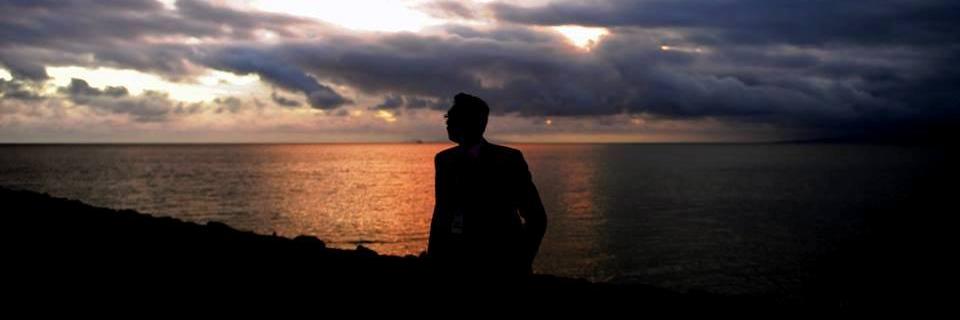
Took this photo while on the way from Somnath to Vadodara…
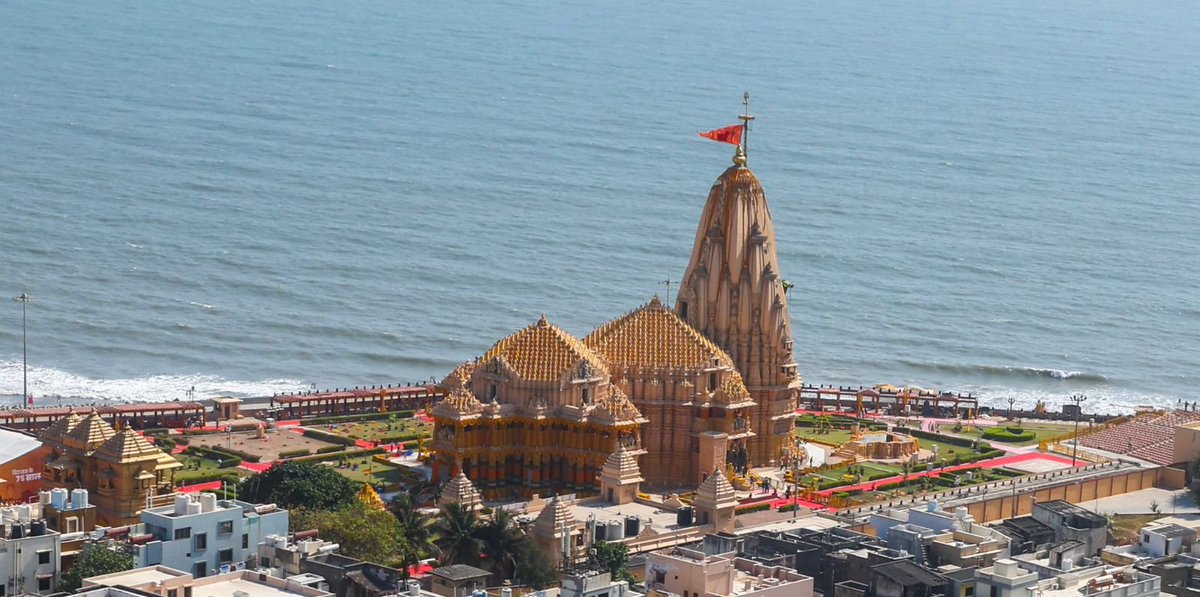
On the shores of Prabhas Patan, the Somnath Temple stands tall as a radiant symbol of devotion, history and civilisational spirit. It has outlasted barbaric attacks, invasions and the passage of centuries. It is eternal. Somnath gives every Indian strength, courage and hope.
Har Har Mahadev!
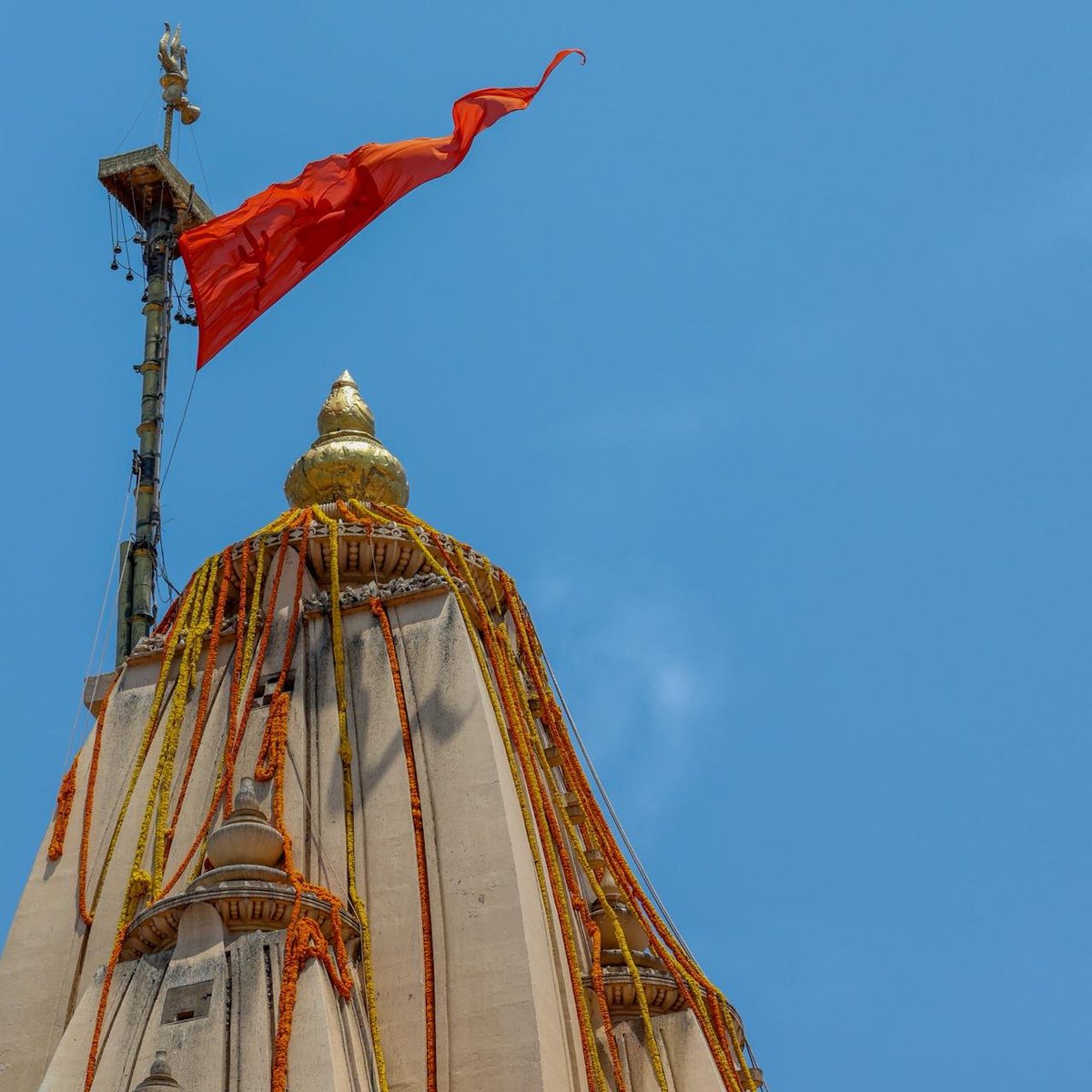
पवित्र सोमनाथ मंदिर के गगनचुंबी शिखर पर गर्व के साथ लहराता पावन ध्वज भारतवर्ष की आस्था की विजय का प्रतीक है। यह कोटि-कोटि भारतीयों की सामूहिक चेतना का दिव्य उद्घोष भी है। सोमनाथ के शिखर पर केसरिया ध्वज हमारी अटूट श्रद्धा की जीवंत विजयगाथा है। यह ध्वज अनंतकाल तक भारत के गौरव का गान करता रहेगा, हर भारतीय को प्रेरणा देता रहेगा।