When we inhale microplastic dust:
They’re constantly trapping, sorting, and removing debris from the air you breathe.
Larger particles get caught in the nose and throat.
Smaller dust gets stuck in mucus lining the airways.
Tiny cilia then move that mucus upward so it can be coughed out or swallowed.
But the smallest particles reach the deep lung.
Deep-lung particles are cleared much more slowly.
Immune cells try to engulf them, but microplastics do not fully break down.
Insoluble particles like silica dust, asbestos fibers, soot, certain metals, and microplastics may not break down.
The body may store them inside macrophages, wall them off.
So they linger way longer, irritating tissue and potentially driving inflammation, oxidative stress, and long-term damage.
Filter your air, friends.
What "USDA Organic" actually means:
Under the National Organic Program regs (7 CFR Part 205) there are 4 main tiers:
"100% Organic" - every ingredient certified organic. Can carry the USDA seal.
"Organic" - >95% organic by weight. The other up to 5% can be non-organic synthetics/ingredients, but only ones on the National List. Still gets the USDA seal.
"Made with organic __." - only ≥70% organic. No USDA seal allowed, and the product can't call itself "organic." Up to three ingredients get a front-of-pack shoutout.
"Specific organic ingredients" (<70%) - "organic" only appears buried in the ingredient list. (AMS Labeling, USDA Organic 101)
SHOWERS vs. BATHS
Let’s get one thing straight:
Showers are quick. But are they clean?
You wouldn’t chug a glass of tap water without filtering it. So why blast unfiltered chemicals on your porous skin?
Most shower head filters? Useless.
Why?
Because warm water + high flow rate = toxins slipping right through. Think about how long it takes to filter drinking water. That process is slow.
🛁 BATHS are your upgrade.
Fill it. Drop in some neutralizing bath water powder. Stop the chemical soak. Stop the chlorine gas. Your skin won’t absorb it. Your lungs won’t inhale it. Your body will finally get clean—for real.
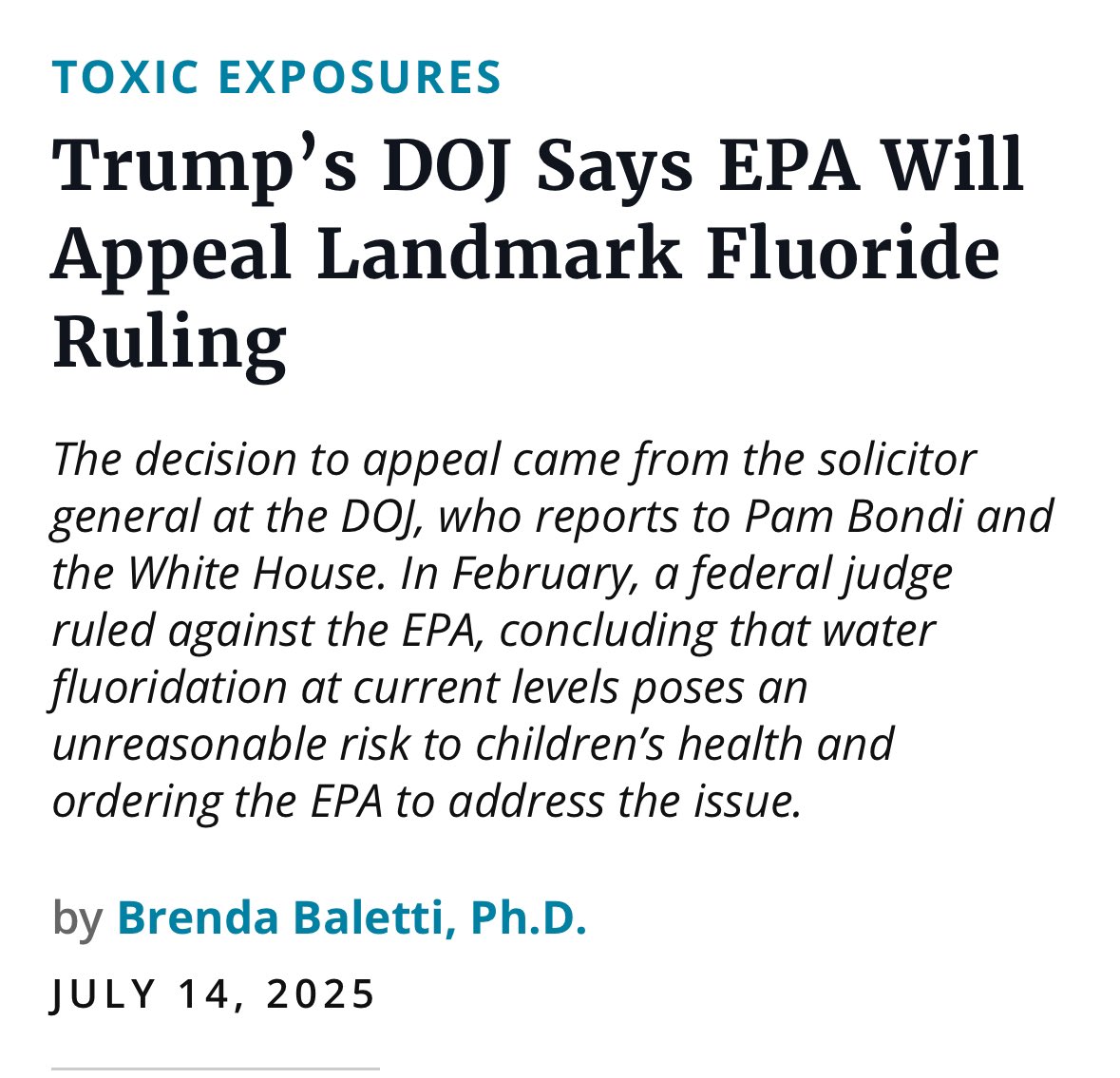
EPA filed its appeal in the fluoride case yesterday. In its brief, EPA does not challenge the merits of the Court's determination that fluoridation poses an unreasonable risk. Instead, EPA challenges various legal aspects of the case.
EPA, @leemzeldin and @PamBondi, have the authority to withdraw this time-wasting appeal any time they choose. If they do, EPA would have the authority, under the court's order, to implement a nationwide ban on fluoridation.
It's not good enough that the EPA is going to conduct another "review" of the science. EPA needs to take *action.* And action means protecting people from the fluoridation chemicals that are still added to the tap water of over 200 million Americans. EPA can do this by dropping its appeal and banning fluoridation (just like most of Europe has already done).
@FluorideAction@FluorideLawsuit@ChildrensHD
“The EPA said it will file the appeal on July 18, after which the case will go to a three-judge panel in the 9th Circuit U.S. Court of Appeals. The appeals court will receive briefs from both sides, along with any amicus briefs, and hear oral arguments before issuing its decision.
FAN’s executive director, Stuart Cooper, said:
“While the science is clear and the lower court’s ruling was very strong and comprehensive, it’s not necessarily a surprise that the appeal has occurred. Our case is precedent-setting. We were the first to sue the EPA under TSCA. I suspect that corporate polluters who have learned how to manage and influence the EPA to their benefit don’t want citizens groups to use TSCA to force the EPA to regulate harmful chemicals.”
Reported by @ChildrensHD
Flow rate from showerhead piping (~1.5-2.5gpm) is too fast to remove those contaminants via showerhead media filter. At most, the filters can neutralize only chlorine and chloramines but only for a couple weeks if regularly used. Showerhead filter companies over promising. They b lyin.
-A Chemical Engineer
This is totally true!
Most filters do a decent job of neutralizing chlorine and chloramine, but after only 2-4 weeks of regular use of drinking water filters and shower head filters they dramatically lose their efficacy.
Additionally, they don’t filter things like heavy metals and fluoride to any meaningful degree with the exception of Reverse Osmosis filters. (Be careful of claims like these!)
Chlorine and Chloramine are easy to neutralize because they are doing it by chemical reaction turning the chlorine into chloride ions by the media in the filter. This reaction happens quickly but the media needs to be change frequently.
Filtration for heavy metals and fluoride depends on “adsorption” which means the physical bonding of the molecules will get taken out of the water and stick to the media inside the filter. Water flow through shower heads and faucets is extremely fast going 2.5 gpm through a half inch pipe. This is not enough time for the unwanted molecules to stick to the media.
A great solution is to only drink Reverse Osmosis water adding back the magnesium that was lost and having a robust filtration system with large filters and water capacity on the whole house so that there is more media and more time for the fluoride and heavy metals to actually get filtered.
Bath Water Neutralizing Powder can also neutralize chlorine, chloramine, heavy metals, and fluoride in baths.
Did you know that most popular water filters don’t remove the worst toxins?
Fluoride, aluminum, and chlorine all slip right through standard filters.
Even “natural” spring water and “safe” ceramic pans might be hurting you.
So what kind of water should you really be drinking?
Switching to one kind may be the single most important upgrade you can make.
Let’s break it down. 🧵
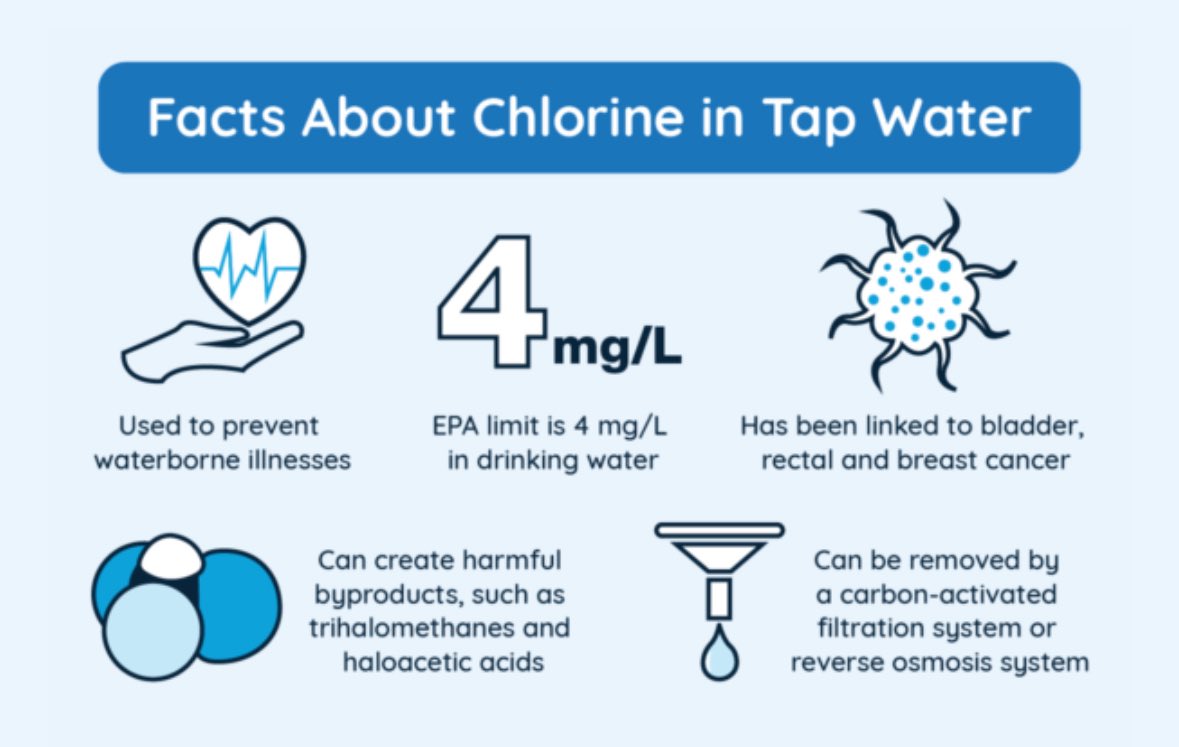
Municipal water contains 1-4ppm chlorine to kill bacteria and viruses.
While considered safe to the EPA, constant exposure affects your microbiome and has even been linked to bladder, rectal, and breast cancer.
What actions do you take to reduce your chlorine exposure?
Pre-cut salad mixes, bagged spinach, peeled garlic are usually washed in 50-100ppm Chlorine Water to reduce spoilage.
This keeps them shelf stable longer, but unfortunately that chlorine will react with the organic matter over time and turn into carcinogenic by-products.
What other toxins are we microdosing unknowingly?