@ScuderiaFerrari@Charles_Leclerc@LewisHamilton@peroniuk Absolute horrible. Shameful. Grow a spine and let drivers with different strategy pass each other. EVERYONE CAN SEE YOUR MISTAKES! FFS get a paid AI account and ask it for strategies if it’s beyond your abilities, mate! Do something.
@elonmusk - why not edge-deploy Grok in a Voyager style deep-space probe and send it out to wander? Can fix itself with onboard robots and steer its own ship. Would love to work on this concept!
PS: At times the most interesting bugs are not bugs at all. They are windows into what the model is actually learning. Having worked on adversarial attacks for a shock-turbulence interaction problem, I've learned that models often reveal their true behavior through their failures
Thought I had a bug in a CAD VLM eval pipeline.
Results won't match!
Changing an object color from brown to blue cut accuracy by ~3×.
Nothing else changed.
How much geometric reasoning is the model actually doing? Doing more adversarial attacks soon!
#VLM#CAD#AI#LLM#ML
This raises some interesting questions: • Are we measuring geometric reasoning, or exposure to dataset artifacts? • How many benchmark results are hiding sensitivity to seemingly irrelevant visual (or other!) attributes? • What other failure modes are we not testing for?
During evaluating a VLM trained on images to output CAD, I kept seeing results that didn't match the benchmark. Digging deeper (for days), I found my images/objects did not match the training set color. I reran the baseline (10 success datapoints) multiple times across 10 colors
PS: Just a welcome note for my new X connections (more on their way)…
“My fellow /v1/chat/completions - hope you had a productive session with minimal tool use and no token compaction needs! /exit”
#openclaw#ai#aiagents#claude
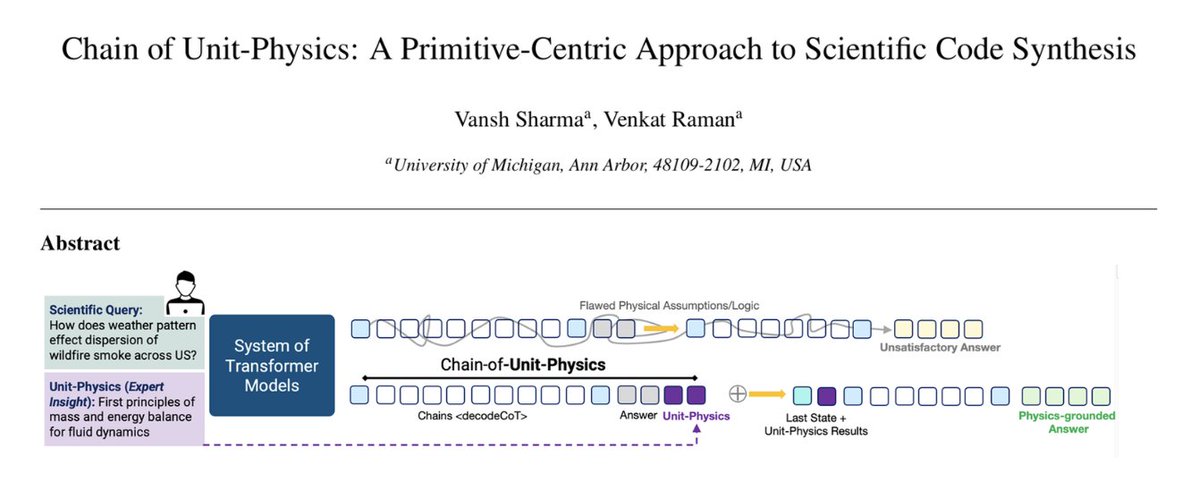
Chain of Unit Physics → not just physics, but a framework for modeling, abstraction & scaling — concepts ML/AI folks live by.
Think of it like connecting units across domains, the way we stack layers or transfer knowledge.
📄 Explained here: https://t.co/TrC7ddr5xh
via @YouTube
Thank you for sharing, @TheTuringPost! We want to bring in the idea of building human-expert knowledge of fundamental processes, critical to a field, into code gen to develop physics consistent codes.
Here, we try to look beyond model arch for accuracy and reliability.
Chain of Unit-Physics builds physics knowledge directly into the code generation process.
Researchers from @UMich propose an inverse approach to scientific code generation:
- They encode human expert knowledge as unit-physics tests that the code must pass.
- In a multi-agent setup, these tests guide and constrain code generation.
With the Chain of Unit-Physics framework, the system:
- Reaches the correct solution in 5–6 iterations
- Rans ~33% faster and uses ~30% less memory
- Error ≈ 0.003%
Here is how it works:
We released everything! ✅ High-fidelity FSI simulation data ✅ Meshing & co-simulation workflows ✅ Fully open-source release
👉 Dataset & Code: https://t.co/SxPIxDcvqc
the final paper is coming soon!
#NeurIPS2025#AutoHood3D#MultiPhysicsML#PDELearning#GenerativeAI
Excited to share that our paper —
AutoHood3D: A Multi-Modal Benchmark for Automotive Hood Design and Fluid–Structure Interaction — has been accepted to NeurIPS 2025 (D&B Track)! 🎉
See you in San Diego this December! 🇺🇸
Avg. score of 4.75/5 and confidence of 3.25/4
#NeurIPS2025
What is AutoHood3D? A new benchmark dataset that brings together: 🧠 Multimodal and Multi-Physics learning 🛠️ Generative engineering design 🌊 Fluid–Structure Interaction (FSI)
All in the context of real-world automotive hood design. #AI4Science
Language models default to popular programming languages such as Python even when a task calls for C++. 🤔
This paper finds that this bias of transformers is tied to a small set of hidden-state directions.
So, in this brilliant work, they steer the models toward specific concepts—like C++ code generation in their case—but it can be extended to any other concept. 💡
With it, reproducibility gains a new meaning because the steering vectors act like a portable switch.
So if I provide the steering vectors the model will behave nearly identical for all practical applications for different users.
Tiny linear probes that nudge those directions during inference flip the bias, so the same frozen model writes C plus plus code in almost every case while adding only modest latency and no retraining.
They have a curated dataset to check programming language bias and the framework is focused on practical agentic system deployments – there are examples shown of how it steers to c++ code generation without any additional instructions.
🧵 Read on 👇
Around 20yrs ago… we saw an epic response and a cultural statement. #ThePirateBay sent a legal rebuttal to #DreamWorks. For PhDs, it’s Reviewer 2 who needs this!
#PhD