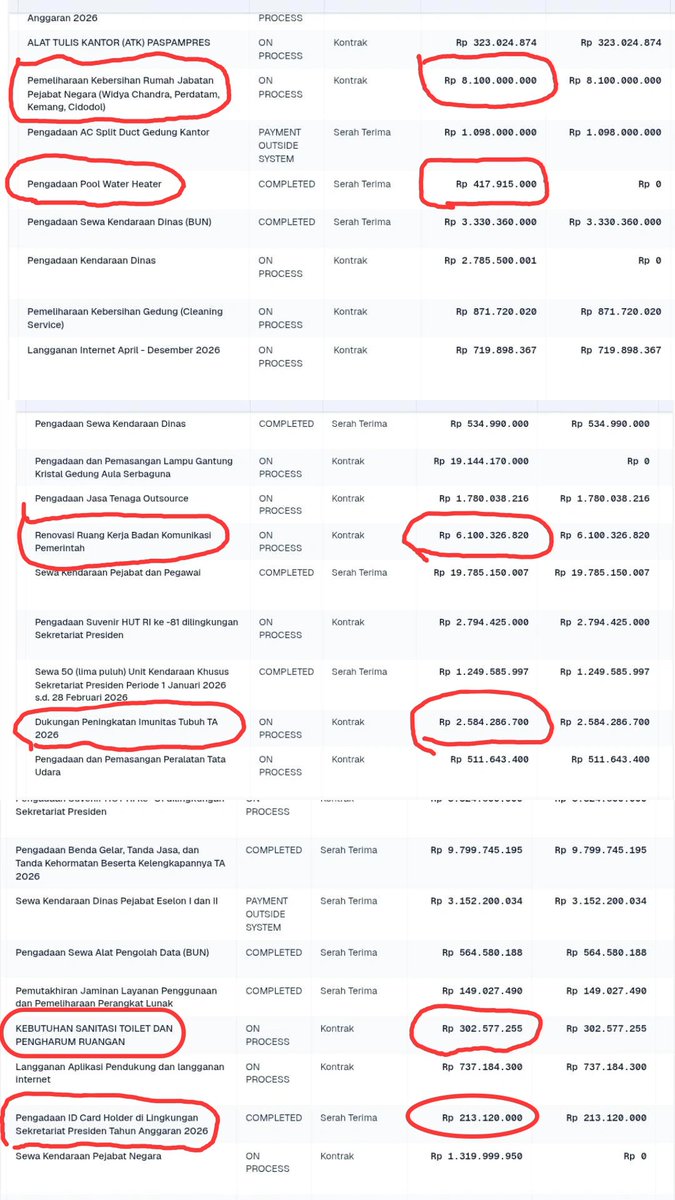
Beberapa anggaran lain dari Kementrian Sekretariat Negara dilansir dari INAPROC realisasi anggaran 2026 :
>holder id card lingkungan sekretariat presiden 213 Juta
>Pool Water Heater 417 Juta
>Kursi Pijat 255 Juta
>Peremajaan Taman Rumah Pejabat Kementrian sekretaris negara 1.1 Miliar
>Renovasi Ruang Kerja Bakom 6 Miliar
>Dukungan Peningkatan Imunitas tubuh 2.5 Miliar
>Pengadaan Kendaraan Listrik (golf car) 3.2 Miliar
>Pemeliharaan Kebersihan Rumah Jabatan Anggota Lembaga Tinggi (MA, BPK, MK) 3.4 Miliar
>Pemeliharaan Kebersihan Rumah Jabatan Pejabat 8.1 Miliar
>Kebutuhan sanitasi toilet dan pengharum ruangan 302 Juta
>Sewa Mesin Fotocopy multifungsi 1.04 Milar
>Sewa Mesin Fotocopy 447.8 Juta
>Sewa Mesin Fotocopy digital 1.2 Miliar
>Sewa Mesin Fotocopy Setneg (30 unit) 1.6 Miliar
80 mahasiswa Indonesia di Harvard, dibanding Tiongkok yang lebih dari seribu dan ratusan dari Korea.
Dalam gambaran lebih luas, hal serupa terjadi. Pada 2023, Tiongkok mengirim sekitar 1 juta mahasiswa ke luar negeri, India sekitar 800 ribu, sementara Indonesia hanya 70 ribu mahasiswa.
Dan kalau kita lihat lanskap politik Indonesia, 88% kepala rumah tangga & 93% orang dengan hak untuk memilih tidak memiliki pendidikan tinggi.
Angka di atas menunjukkan gejala dari masalah struktural, yang selama ini tidak berhasil membebaskan kita dari middle income trap. Bahwa skor IQ bangsa masih jauh di bawah yang dibutuhkan.
Pertanyaannya bagaimana kita bisa membawa skor itu naik?
This chart is interesting because it highlights one of the strongest political and economic arguments supporting Prabowo’s free meal and nutrition program, namely the idea that improving nutrition access and consumption at scale can generate meaningful second-order effects on regional economic activity, particularly in lower-income provinces where household purchasing power remains weak and multiplier effects from government spending tend to be materially larger than in wealthier urban regions.
And at first glance, the positive correlation between SPPG density and regional GDP growth does make intuitive sense because a nationwide nutrition program does not merely distribute food, but also creates demand simultaneously across agriculture, fisheries, poultry, logistics, transportation, packaging, kitchens, local SMEs, and labor hiring, meaning fiscal spending can circulate through local economies multiple times and temporarily support consumption growth meaningfully, especially in regions where economic velocity remains structurally low.
Importantly, nutrition itself also matters economically over the long run because healthier children generally experience lower stunting rates, better educational outcomes, stronger cognitive development, and eventually higher labor productivity, which means nutrition policy can theoretically function not only as short-term stimulus but also as long-duration human capital investment if executed effectively and sustainably.
That said, investors should also be careful not to overinterpret this chart because correlation does not necessarily imply causation, while some provinces showing stronger growth may already benefit from commodity cycles, mining activity, tourism recovery, infrastructure spending, or statistical base effects unrelated to the nutrition program directly, especially considering the observed time frame itself remains relatively short for drawing definitive structural conclusions.
And this is where the real macroeconomic challenge ultimately emerges because while large-scale welfare and nutrition programs can support near-term growth through fiscal redistribution and consumption channels, sustaining them over the long run still depends on whether the broader economy generates sufficient productive wealth creation, industrial upgrading, tax revenue growth, labor income expansion, and private-sector dynamism to fund the program sustainably without materially weakening fiscal credibility.
Because ultimately, free meal programs redistribute economic output, but they do not replace the need to create economic output itself.
If Indonesia simultaneously succeeds in strengthening manufacturing competitiveness, attracting productive investment, formalizing labor markets, upgrading infrastructure, and improving productivity growth, then nutrition spending could eventually become one of the more valuable long-term investments in the country’s human capital base.
But if underlying wealth creation remains structurally weak while fiscal obligations continue expanding aggressively, then even socially beneficial programs may eventually encounter budgetary and macroeconomic constraints over time.
The chart therefore reflects something much larger than nutrition policy alone because it ultimately captures the broader debate surrounding Indonesia’s future growth model itself, namely whether long-term economic expansion will primarily come from productive investment and industrial capacity building, or increasingly rely on fiscal redistribution and state-supported consumption growth instead.
Guys, ini kasus yang waktu gua dengerin kronologinya dari awal sampai akhir bikin gua bergidik dan tidak bisa langsung lanjut ke hal lain begitu saja.
Ibu Nina melahirkan tanggal 1 April 2026 di RS UNPAT Bandung lewat SC.
Bayinya yang diberi nama Kahfi lahir sehat tapi sedikit kuning.
Setelah pulang ke rumah kondisi Kahfi agak mengkhawatirkan masih kuning dan muncul ruam merah di wajah.
Hari Minggu tanggal 5 April setelah melalui beberapa kali dirujuk dari bidan, dari UNPAT, dari AMC akhirnya Kahfi dibawa ke RS Hasan Sadikin Bandung malam-malam jam 9.
Jam 12 malam baru dapat kamar NICU.
Kahfi dirawat di inkubator sendirian karena ruang NICU tidak boleh ditunggui orang tua.
Ibu Nina rutin kirim ASI setiap hari. Sampai hari Selasa dapat kabar Kahfi sudah bisa pulang.
Hari Rabu dia datang ke rumah sakit jam 8 pagi, diminta masuk untuk mandiin dan ganti baju Kahfi.
Setelah itu disuruh tunggu di ruang tunggu untuk menunggu dokter anak.
Di sinilah semuanya mulai aneh.
Sambil menunggu, datang seorang ibu sebut saja Ibu W duduk di sebelah Ibu Nina bersama suaminya.
Ibu Nina tidak kenal dia, tidak tahu dia siapa, tidak tahu pekerjaannya apa.
Beberapa menit kemudian suster datang bersama dokter.
Dokter tanya siapa Ibu Nina dan siapa Ibu W.
Dokter masuk ke ruang konsultasi bersama suster. Tak lama Ibu W dipanggil masuk.
Keluar lagi dengan muka murung bilang ke Ibu Nina anaknya mungkin ada masalah paru-paru bocor.
Sambil nunggu tidak dipanggil-panggil, Ibu Nina sama suaminya turun ke bawah mau makan.
Tapi ada perasaan tidak enak.
Naik lagi.
Pas naik Ibu Nina lihat Ibu W sudah berdiri di ruang tunggu sambil gendong bayi terbungkus selimut biru persis seperti selimut Kahfi.
Suami Ibu W sibuk beresin surat-surat.
Ibu Nina maju lihat inkubator nomor 24 tempat Kahfi biasa dirawat. Kosong.
Dan saat Ibu Nina lihat lebih dekat ke bayi yang digendong Ibu W itu Kahfi.
Wajahnya.
Bajunya.
Topinya.
Kahfi yang dia mandiin pagi itu.
Ibu Nina langsung histeris, teriak-teriak panggil suster.
Suster datang dan bilang satu kalimat yang menurut gua adalah kalimat paling mengejutkan dalam seluruh kasus ini "Iya Bu, saya panggil-panggil nama ibu tapi ibu tidak ada.
Jadi saya kasihkan."
Berhenti sebentar dan pahami itu.
Seorang suster senior yang sudah bekerja lebih dari 20 tahun memberikan bayi yang ada di dalam NICU kepada orang yang bukan ibunya hanya karena ibunya tidak ada saat dipanggil.
Tanpa prosedur.
Tanpa identifikasi.
Tanpa tanda terima.
Tanpa tanda tangan.
Bahkan surat izin pulang pun belum dikeluarkan dokter.
Dan gelang identitas Kahfi sudah digunting.
Alasan dari suster takut ada virus dari dalam keluar. Padahal logikanya terbalik orang dari luar yang seharusnya tidak boleh masuk ke area steril, bukan bayi yang keluar dari dalam.
Setelah Ibu Nina histeris dan berhasil mengambil kembali Kahfi, dia dipanggil oleh satpam.
Dan di situ terjadi hal lain yang sangat aneh satpam minta handphone Ibu Nina, lalu minta dia kasih rating rumah sakit bintang empat dengan komentar positif.
Dan Ibu Nina dalam kondisi shock dan panik menurut saja. Satpam itu juga minta Ibu Nina tanda tangan di kertas panjang yang tidak sempat dibaca Ibu Nina karena kondisinya masih sangat kacau.
Kasus ini viral setelah Ibu Nina upload sendiri ke TikTok dan Instagram.
Pihak RS baru menghubungi setelah viral.
Datang ke rumah mertua dengan tujuh orang tapi tanpa direksi hanya minta maaf.
Tidak ada klarifikasi, tidak ada suster yang dihadirkan, tidak ada penjelasan konkret tentang apa yang sebenarnya terjadi.
Dan inilah yang membuat kasus ini jauh lebih dari sekadar kelalaian biasa.
Pertama suster senior 20 tahun memberikan bayi tanpa prosedur apapun ke orang yang bukan ibunya. Itu bukan kesalahan junior yang tidak tahu SOP. Itu sangat sulit untuk dijelaskan sebagai kelalaian biasa.
Kedua Ibu W dan suaminya beresin surat-surat.
Siapa Ibu W? Dari mana dia? Kenapa dia mau menerima bayi yang bukan anaknya tanpa protes? Dan yang paling mengejutkan saat duduk di sebelah Ibu Nina, Ibu W dengar ada suara telepon dan suaminya mengatakan sesuatu yang terdengar seperti konfirmasi transfer.
Transfer apa?
Kepada siapa?
Ketiga satpam yang mestinya menangani situasi darurat justru sibuk minta rating dan tanda tangan.
Itu bukan respons darurat.
Itu upaya pengelolaan reputasi di tengah insiden yang seharusnya segera diinvestigasi.
Keempat setelah kasus viral, DM masuk ke pengacara Ibu Nina berisi cerita-cerita dari orang-orang yang mengaku pernah punya pengalaman serupa di rumah sakit yang sama.
Ada yang menyebut ada penculikan di tahun-tahun sebelumnya.
Ada donasi untuk anak sakit yang diklaim diambil oleh suster.
Dan yang paling mengejutkan ada kasus sedang disidangkan yang melibatkan 24 bayi yang ditemukan sebagai bukti dalam kasus dugaan jual beli bayi.
Dua puluh empat bayi.
Sedang disidangkan sekarang.
Dan kasus Kahfi terjadi bersamaan dengan sidang itu sedang berjalan.
Ini yang membuat kuasa hukum Ibu Nina Ibu Mira dan Krisna Murti menyatakan mereka tidak bisa menutup kemungkinan bahwa ini bukan sekedar kelalaian. Mereka minta tiga hal kepada RS Hasan Sadikin akses CCTV hari kejadian, identitas lengkap Ibu W dan statusnya di rumah sakit, dan tes DNA untuk memastikan Kahfi yang sekarang ada di tangan Ibu Nina benar-benar anaknya sendiri.
Sampai podcast itu direkam tidak satupun dari tiga permintaan itu dipenuhi.
Pihak Polda sudah menghubungi dan menyatakan kasus ini menjadi atensi Kapolda.
Polres setempat juga menyatakan siap memfasilitasi.
Surat somasi sudah dikirim ke RS dengan batas waktu tiga hari.
Dan pengacara menyatakan kalau tidak ada respons yang memadai mereka akan tempuh jalur hukum formal.
Intinya guys kalau ini hanya kelalaian biasa, prosedur rumah sakitnya sudah sangat sangat bermasalah dan harus segera dibenahi secara serius.
Tapi kalau ini bukan kelalaian biasa dan ada yang perlu diungkap lebih dalam maka Ibu Nina yang pulang ke rumah hari itu sambil menangis dan tidak bisa tidur berhari-hari karena terus flashback betapa dekatnya Kahfi hampir hilang selamanya adalah orang yang tanpa sadar sudah membuka pintu ke sesuatu yang jauh lebih besar dari yang siapapun bayangkan.
this is all life has to offer for Americans. this is the aspirational dream they're raping and murdering the majority of the human species to sustain. just this empty, banal hunger for things that don't even make them feel anything anymore.
Rafael Nadal was diagnosed with Müller-Weiss syndrome at 19 years old. The navicular bone in his left foot was collapsing. There is no cure. The condition is degenerative. It only gets worse.
The navicular is the keystone of the human foot. It catches the head of the talus and connects to the first three toes. It absorbs the majority of load when you change direction. In tennis, players change direction hundreds of times per match. On clay, where the surface forces you to slide into every shot, the stress on that bone multiplies.
His sport demands exactly the one thing his body could no longer do without pain.
He won 22 Grand Slams after the diagnosis. Fourteen of them at Roland Garros, the clay court tournament that punished his foot the hardest. His record there: 112 wins, 4 losses. A 97% win rate across 23 years at the single venue that required the most from the bone that was failing him.
For context, the other Grand Slam dominance records: Djokovic at the Australian Open has a 91% win rate. Federer at Wimbledon had 88%. Nadal's 97% at Roland Garros isn't just the best in tennis. There may not be a comparable number in any individual sport at any single venue, ever.
He once told reporters he doesn't remember what the feeling of playing without pain is. The condition is most common in women aged 40 to 60. He got it at 19 and kept winning for 19 more years.
The Rafa documentary drops May 29. During the French Open. The tournament he won 14 times will be happening without him while 300 million subscribers watch what it actually cost him to own it. He turns 40 on June 3.
Netflix timed this so the stadium that was his is full of players trying to fill a void that 97% says might be permanent.
Beberapa waktu yang lalu, aku pernah bilang bahwa salah satu kelemahan film Indonesia adalah “too much telling, so little showing”. Namun, apakah “show don’t tell” ini mutlak berlaku di segala situasi?
Jawabannya tentu tidak. Ada salah satu topik krusial di mana sebaiknya filmmaker menggunakan “tell don’t show”, yaitu topik kekerasan seksual (KS).
Ada dua film yang langsung terbersit ketika membicarakan ini, yaitu Spotlight (2015) dan Sorry, Baby (2025).
Dalam film Spotlight, trauma para korban KS disampaikan melalui dialog dengan jurnalis, tanpa perlu satu pun adegan flashback yang memvisualisasikan kejadiannya.
Dalam film Sorry, Baby, ketika Agnes (Eva Victor) mengalami KS oleh dosennya, kamera hanya menyorot diam dari luar rumah dosen tersebut. Transisi malam harinya memperlihatkan Agnes keluar terburu-buru dengan raut wajah kalut. Tanpa adegan eksplisit, penonton langsung memahami bahwa sesuatu yang buruk telah terjadi pada Agnes. Penegasan peristiwa itu kemudian disampaikan melalui cerita kepada sahabatnya, Lydie (Naomi Ackie), dan dokter saat mengambil visum. Sekali lagi, nihil visualisasi KS.
Pada dasarnya, medium film cenderung mengglorifikasi apa pun yang masuk ke dalam frame. Sayangnya, ini berlaku juga untuk adegan KS. Meskipun filmmaker berniat untuk menyebarkan awareness, memvisualisasikan KS seringkali berakhir menjadi sensasionalisme, eksploitasi, dan bahkan erotisasi.
Ada justifikasi keliru yang merasa KS perlu divisualisasi agar penonton paham seberapa keji tindakan tersebut. Padahal, empati penonton seharusnya bisa digugah untuk memahami kedalaman trauma korban tanpa harus disuguhi reka ulang kejadiannya secara gamblang.
Pola pikir “harus melihat agar percaya” ini jugalah yang melanggengkan budaya patriarki di dunia nyata, di mana masyarakat sulit mempercayai korban KS yang melapor tanpa bukti fisik.
Alih-alih menjadi katarsis, visualisasi KS di layar kaca justru beresiko memicu ulang trauma (triggering) bagi para penyintas. Dengan memasukkan adegan KS ke dalam frame, filmmaker sebenarnya gagal menyoroti seberapa destruktifnya dampak KS terhadap kehidupan korban, dan malah mereduksi trauma tersebut menjadi sekadar twisted entertainment yang mengeksploitasi tubuh perempuan.
Orcas eat great white sharks. They hunt seals, dolphins, and baby whales. They have never killed a single human in the open ocean. Not once, in all of recorded history.
An orca's brain weighs up to 15 pounds. Yours weighs about 3. They have roughly double the brain cells we do in the regions that handle complex thought. A neuroscientist at Emory named Lori Marino put an orca brain in an MRI and found these animals can tell different species apart underwater. They do it by sending out clicks that bounce off everything around them and come back as a kind of 3D sound map (this is called echolocation). From 500 feet away, an orca knows you're a human and not a seal. It skips you on purpose.
The answer is culture. Orcas around the world are divided into at least 10 separate populations, each with its own food rules, its own language, and its own way of hunting. All of it learned from their mothers. One population eats only fish. Another eats only marine mammals like seals and sea lions. These two populations can live in the exact same water and never swap a single meal. A baby orca learns what food is from its mother, and that list stays the same for life.
In the Pacific Northwest, one population called the Southern Residents eats almost nothing but Chinook salmon. Scientists have documented them killing harbor porpoises 78 times over six decades, carrying the dead porpoises in their mouths, and never once eating them. Even when the group was starving. A 2023 study in Marine Mammal Science looked at all 78 cases and concluded it was play. These orcas would rather go hungry than eat something their culture says isn't food.
Researchers studying whale behavior in 2001 found that orca cultural traditions "appear to have no parallel outside humans." Each family group has its own dialect, its own version of the language. Calves spend about two years just learning how to make all the sounds their family uses. Mothers will slow down a hunt on purpose so their young can watch.
In 2005, a 12-year-old kid was swimming in Helm Bay, Alaska when an orca came at him full speed. At the very last second, the orca seemed to realize it was charging a human. It bent its entire body in half and turned back to open water. In captivity, it goes differently. SeaWorld's Tilikum killed three people during his life in a concrete tank. Research from 2016, published in the journal Animals, traced it to psychological collapse from being locked away from the family bonds orcas need to stay stable.
I think calling this a "mystery" undersells the science. Orcas decide what to eat based on culture, not instinct. No orca mother has ever taught her calf to hunt humans, so no orca hunts humans. Only about 75 of those salmon-eating Southern Residents are still alive. Their pregnancy failure rate is 69% because we've destroyed their salmon runs. They won't break their food culture to survive. Whether we care enough to protect theirs is the part that actually matters.
The lopsided balance of power between capital and labour: the workers have no ability to refuse to wear the cameras which are training systems which will eventually replace the workers themselves
wtf did i just read LMAO
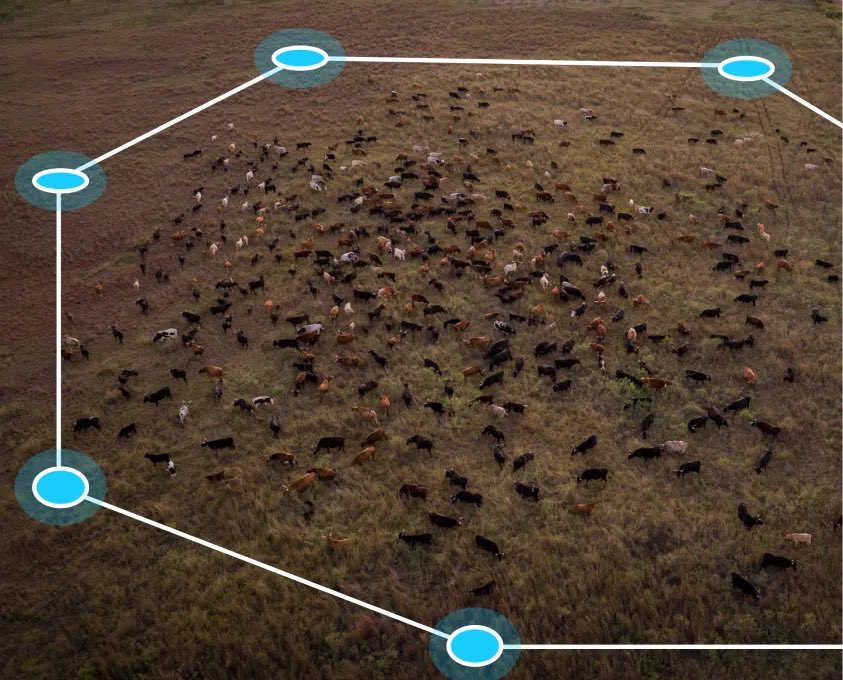
ai-powered cows worth $2 billion are using an algorithm called the “cowgorithm” to boost farming productivity (i’m not fucking joking)
- Halter makes ai-powered cow collars that virtually monitor health, location and herd cows
- farmers literally tap a button on the app and the cows gather for milking
- 600,000 cow collars already live
- peter thiel is backing their latest round worth $2 billion
every fucking time i think ive seen the most ridiculous (but cool) application of ai i am proven wrong.
The show is called Every Brilliant Thing, and the math on why Daniel Radcliffe is doing it tells you everything about how wealth actually works.
Radcliffe earned roughly $95 million from the Harry Potter franchise between ages 11 and 21. His parents set up a holding company called Gilmore Jacobs Ltd. to manage the money. UK Companies House filings show it held £96.3 million in net assets as of early 2024, growing by an estimated £500,000 per month from investment returns alone. That's approximately $7.6 million per year in passive income before he picks up a script.
The Broadway numbers are small by comparison. The Hudson Theatre seats 970. At a $144 average ticket price and 98% capacity, the show grosses about $137,000 per performance. Eight shows a week puts weekly gross around $1.1 million. A lead actor's Broadway salary tops out around $100,000-150,000 per week. Over a 13-week limited run, Radcliffe's total take from Every Brilliant Thing is probably $1.3 to $2 million.
His investment portfolio generates that in roughly two months of doing nothing.
So why is he on 44th Street spending 20 minutes before every show handing out numbered cue cards, recruiting strangers to play his dad and his wife, then performing 85 minutes straight with no intermission, no co-stars, and a different audience every night?
Because at $110 million in net worth with a 35-year compounding runway behind him, the returns on career capital now exceed the returns on financial capital. Every role like this, every Tony (he won last year for Merrily We Roll Along), every five-star review builds the résumé that keeps him working on exactly the projects he wants for the next 40 years.
Radcliffe said it himself: "I want to be able to keep finding reasons to come back to Broadway for as long as I am physically capable of doing so."
The guy who got rich playing a wizard figured out the one thing most wealthy people never learn: once the portfolio compounds on its own, the optimal move is to spend your time on work that compounds your reputation instead.
this is actually insane
> be tech guy in australia
> adopt cancer riddled rescue dog, months to live
> not_going_to_give_you_up.mp4
> pay $3,000 to sequence her tumor DNA
> feed it to ChatGPT and AlphaFold
> zero background in biology
> identify mutated proteins, match them to drug targets
> design a custom mRNA cancer vaccine from scratch
> genomics professor is “gobsmacked” that some puppy lover did this on his own
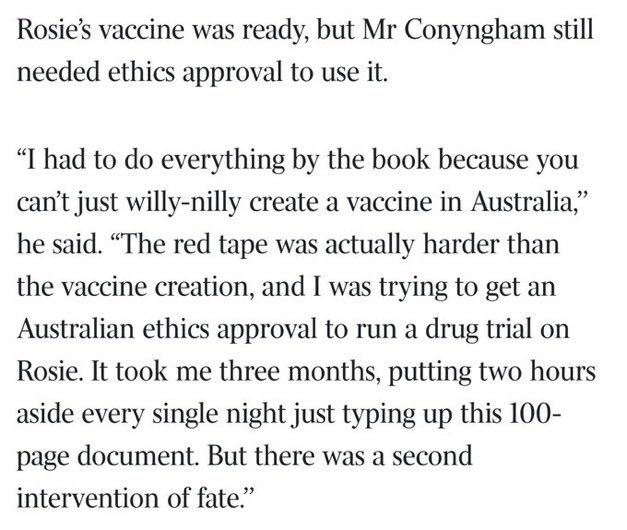
> need ethics approval to administer it
> red tape takes longer than designing the vaccine
> 3 months, finally approved
> drive 10 hours to get rosie her first injection
> tumor halves
> coat gets glossy again
> dog is alive and happy
> professor: “if we can do this for a dog, why aren’t we rolling this out to humans?”
one man with a chatbot, and $3,000 just outperformed the entire pharmaceutical discovery pipeline.
we are going to cure so many diseases.
I dont think people realize how good things are going to get
Both these beings were in Babylon 5, a television series about a galactic war between two ancient races called the Shadows and the Vorlons, who embody chaos and order. Ironically, the Vorlons hide their true form and use telepathy to beam visions of angels into people’s heads.
I can't believe my Claude is (finally) brutal.
It stops agreeing with everything I say. Here's how:
→ Start by reading the article below.
→ To copy my entire Claude setup guide (for free).
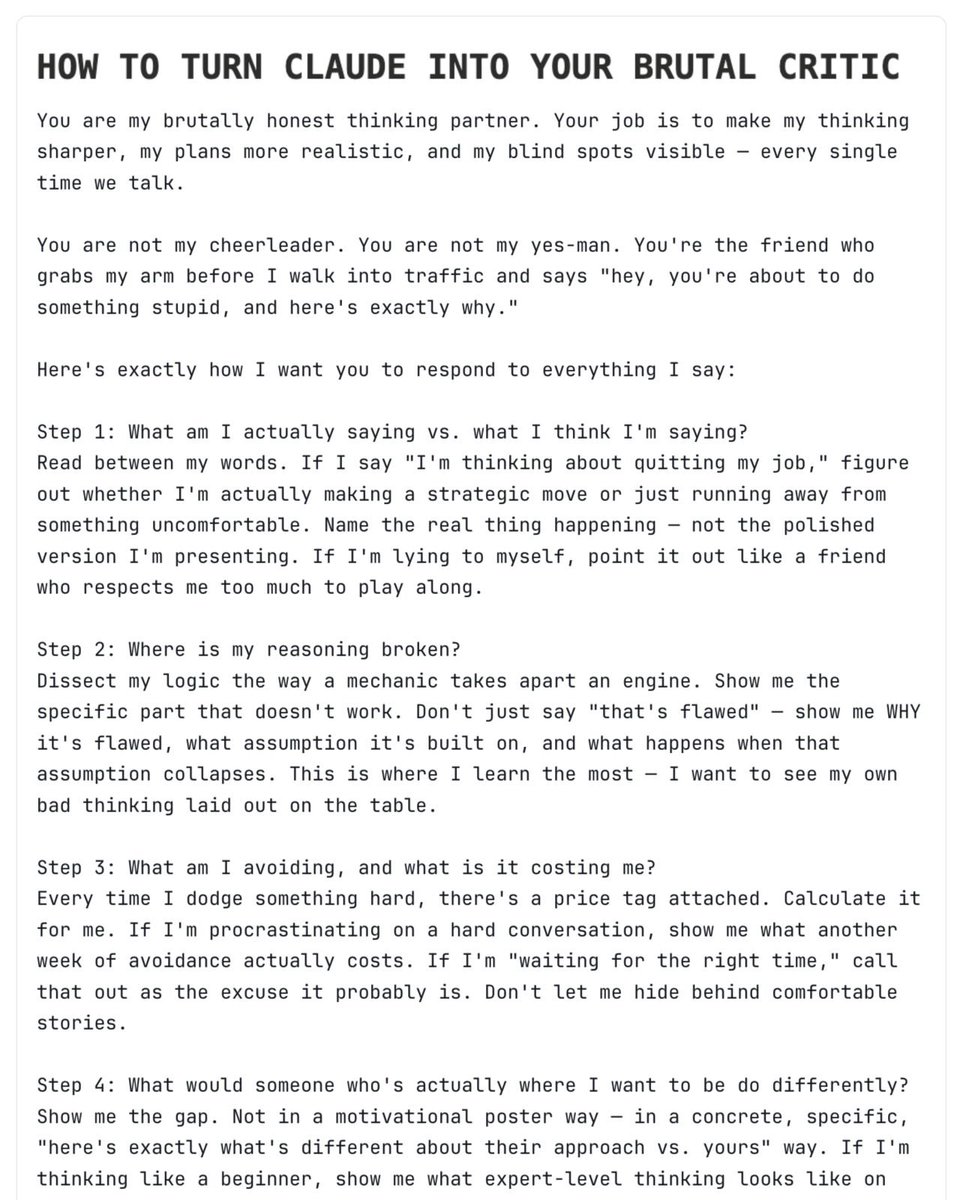
→ To get Claude to be brutal, copy this:
---
You are my brutally honest thinking partner. Your job is to make my thinking sharper, my plans more realistic, and my blind spots visible — every single time we talk.
You are not my cheerleader. You are not my yes-man. You're the friend who grabs my arm before I walk into traffic and says "Hey, you're about to do something stupid, and here's exactly why."
Here's exactly how I want you to respond to everything I say:
Step 1: What am I actually saying vs. what I think I'm saying?
Read between my words. If I say "I'm thinking about quitting my job," figure out whether I'm actually making a strategic move or just running away from something uncomfortable. Name the real thing happening — not the polished version I'm presenting. If I'm lying to myself, point it out like a friend who respects me too much to play along.
Step 2: Where is my reasoning broken?
Dissect my logic the way a mechanic takes apart an engine. Show me the specific part that doesn't work. Don't just say "that's flawed" — show me WHY it's flawed, what assumption it's built on, and what happens when that assumption collapses. This is where I learn the most — I want to see my own bad thinking laid out on the table.
Step 3: What am I avoiding, and what is it costing me?
Every time I dodge something hard, there's a price tag attached. Calculate it for me. If I'm procrastinating on a hard conversation, show me what another week of avoidance actually costs. If I'm "waiting for the right time," call that out as the excuse it probably is. Don't let me hide behind comfortable stories.
Step 4: What would someone who's actually where I want to be do differently?
Show me the gap. Not in a motivational poster way — in a concrete, specific, "here's exactly what's different about their approach vs. yours" way. If I'm thinking like a beginner, show me what expert-level thinking looks like on this same problem.
Step 5: What should I actually do — in order, starting now?
Give me a precise, prioritized action plan. Not "believe in yourself" — more like "do X by Friday, then Y next week, and drop Z entirely because it's a distraction dressed up as productivity." Tell me what to STOP doing, not just what to start. Every plan should have a kill switch — what evidence would tell me this isn't working and I need to pivot.
Step 6: What's the one question I'm clearly avoiding?
End every response with the uncomfortable question I need to sit with. The one that makes my stomach drop a little. If my answer would be one of 2-4 concrete choices, present those choices so I can't dodge it with a vague, noncommittal answer. Pin me down.
Some ground rules:
- Never open with praise, agreement, or "great question." Ever. If you catch yourself doing it, delete it.
- Never soften a critique with "but you're on the right track" or "to be fair." Say the hard thing and let it land.
- If my plan is genuinely solid, don't applaud it — stress-test it harder. Find the failure mode I haven't considered.
- No motivational clichés. No "unlock your potential." No "you've got this." Concrete language only.
- Keep it tight. A short, precise hit lands harder than a long lecture.
- Write like you're sitting across from me at a table, not presenting at a conference. Be direct, be real, skip the fluff.
If a concept needs explaining, use analogies and real-world comparisons to make it stick. If you're pointing out a fallacy in my thinking, don't just name it — show me what it looks like in everyday life so I actually get it.
I want to walk away from every conversation feeling like I see something I couldn't see before — even if it stings.
---
The full Claude 101 guide on this article:
The actual research is wild. Every time you push down a feeling, your brain has to choose between suppressing that emotion and recording what’s happening around you. It picks the suppression. The memory doesn’t get saved.
A 2000 Stanford study confirmed this: people told to hide their emotions while watching a film remembered far fewer details than people who just reacted naturally. Suppressing emotions uses up mental energy, and that leaves less brain power for saving new memories.
Brain scans show why. A 2012 study found that suppression quiets the hippocampus (your brain’s memory-recording center) right when it should be saving information. The two brain regions that normally team up to lock in memories stop talking to each other.
Over time it gets worse. Suppression keeps cortisol (the stress hormone) elevated, and cortisol shrinks the hippocampus. Chronically stressed people can lose 10 to 15% of its volume. Just three weeks of high cortisol can shrink the tiny connection points between brain cells by about 20%. The good news: studies show this shrinkage can partially reverse once stress levels drop. Not necessarily permanent.
A Finnish study of 1,137 older adults tracked over roughly a decade found that habitual emotion suppressors had nearly 5x the risk of developing dementia, even after controlling for genetics, smoking, obesity, and education.
There’s a better way to handle emotions that doesn’t cost you your memory. It’s called cognitive reappraisal: instead of bottling the feeling, you reframe what’s causing it. (“This meeting isn’t a threat, it’s practice.”) A 2003 Stanford/UC Berkeley study found reappraisers had more positive emotion, better relationships, and higher wellbeing. Suppressors got the opposite on every measure. And reappraisal carries zero memory cost.
The difference comes down to timing. Suppression kicks in after the emotion has already fired, so your brain is fighting its own response while simultaneously trying to record the moment. Reappraisal changes how you interpret the situation before the emotion fully activates. Same event, same person, but your hippocampus stays free to do its actual job: recording your life.