Alongside my co-founders, proud to formally announce @mirendil.
Our mission is to accelerate science and technology through democratizing frontier AI R&D.
If you share our excitement for this mission, reach out to us!
Today, I’m excited to formally announce @mirendil with my amazing co-founders Harsh Mehta, Shayan Salehian, and Tara Rezaei!
We’re fortunate to work with @a16z and @kleinerperkins, who led our seed round of $200M, followed by a major investment from NVIDIA, among others.
Mirendil exists to accelerate science and technology, and through them, to help solve humanity's most pressing problems.
Self-accelerating AI R&D is the most direct path to delivering on AI's broader promise, which is why we believe the most important application of AI is AI itself. Get this loop right, and it compounds. It fundamentally changes the rate of progress itself across all domains.
We believe this capability should be democratized. It should be used to power all scientific efforts trying to innovate at the frontier. There are far more important problems—and broader ones—than any single lab can take on, so more groups should be able to pursue them.
This pulls concentration of power away from a few labs: businesses and science labs can own their AI and infrastructure, keep their margins, and control their own destiny instead of ceding it all to a single AI lab.
We’re a small team with a singular focus. Our founding team consists of 20 researchers and engineers from frontier institutions including Anthropic, xAI, Google DeepMind, and OpenAI, united by a passion for science and a drive to build the technologies that move it faster. If you want to build the system that builds systems, join us!
@HarshMeh1a, @shayan_, @tararezaeikh
Thomas Kurian: 'In addition to our work with Anthropic, both directly and via Broadcom, and public references customers like Apple, who are scaling pretraining of their foundation models on the latest generations of TPUs, we're also working with new frontier model companies including Mirendil and Physical Intelligence.'
If you wanted to build a product for AI R&D, what would you build?
It would probably allow agents easy access to compute, run and manage hundreds of agents in parallel, be long-running, reliable and let agents operate on any machine.
Meet Lor, now in private beta.
Let us know if you'd like to be an early user.
Lor is built for two things: speed and scale.
Most tools give you an AI agent, or an AI teammate. Lor gives you the leverage of a full frontier lab.
Lor also offers compute right in the app. No separate setup needed.
Now in private beta: https://t.co/WqkmtuxLBO
My friends can attest, Ive been wanting to push boundaries of harnesses for a while.
When I was introduced to mirendil I was immediately intrigued that a small neolab was planning to compete in the big leagues, in the domain of agentic intelligence. It sounded insane, ambitious, and a great place to create the next generation of ai tooling.
Like how a noun needs a verb, no matter how powerful the model gets we will always need a harness. The space isnt quite solved but its close. Harnesses are all aligning to the same few architectures (more to come for how we built ours). Each generation of model has made it more clear what architectures are actually required.
Our goal was fundamental and simple. Give the model agency. Give the human freedom.
Im excited to introduce Lor, our new product built from first principles to be an always-on, multi client, multi environment delegator for coding and experiments.
We're opening up our beta. I'd love to chat with anyone pushing the limits of engineering and discovery.
Message me on any platform or sign up here if you're interested in trying it out
https://t.co/vL01gNaNGP
Lor is the product we’ve been building to automate an entire AI lab.
Many of us at Mirendil have already completely switched to it for designing experiments, running ablations, debugging training, and letting agents keep iterating overnight.
We’ve started releasing today. Join the waitlist for private beta.
Meet Lor.
We’re building Lor to do the work of an entire AI lab. Today, its agents write our code, run experiments, and iterate on the results for days, on any machine, hundreds at a time.
Now in private beta ↓
Meet Lor:
The product we’re building to do the work of an entire AI lab.
Remember that one researcher who pretrained Mirendil-Base in 3.5 months, with agents doing nearly all the engineering? That researcher is now fully switched to using Lor 100% of the time.
Meet Lor.
We’re building Lor to do the work of an entire AI lab. Today, its agents write our code, run experiments, and iterate on the results for days, on any machine, hundreds at a time.
Now in private beta ↓
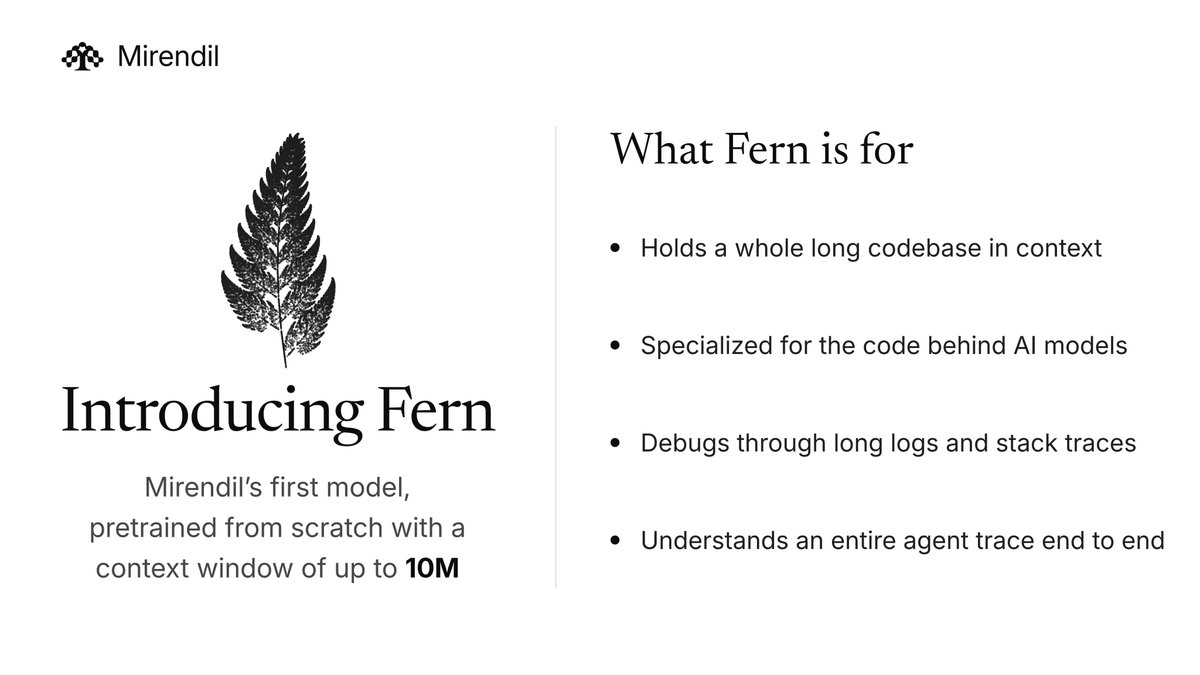
Introducing Fern, Mirendil’s first model: pretrained from scratch, with up to 10 million tokens of context.
That’s ~0.5M lines of code or days of an agent’s work - all in context at once.
Built for high-volume agentic work in AI R&D: auditing training data, debugging training runs from logs, and reading agent traces end to end. Fern’s next-token prediction keeps improving as context grows to 10M tokens.
Fern 0.1 is Mirendil-Base after a short round of post-training. It’s the first and smallest of three models, with two larger ones now being pretrained.
We’ll ship frequent updates and make the model available soon.
Today, we are introducing Fern: our first model that supports up to 10M tokens in context window!🌿
You could put an entire repository (or repositories!) in the context, continue to work on problems for days without hitting compaction limits or use it to consolidate other agents’ works.
As always, we have a lot more work to do but wanted to give you the update. Excited hear how you would use a 10M token context window.
We're introducing Fern 🌿
Our first model, trained from scratch with a 10M-token context window, built for high-volume agentic coding and AI research work.
After a short round of post-training, we're sharing promising early results for Fern 0.1.
More to come soon!
Introducing Fern, Mirendil’s first model: pretrained from scratch, with up to 10M tokens of context!
That’s ~0.5M lines of code (roughly Megatron-LM scale) or days of an agent’s work, all in context at once.
Its first version, Fern 0.1, had a short round of post-training 🚢
More updates:
1. We did a short round of post-training on Mirendil-Base and it looks competitive in its model-class. We are calling it Fern.
2. Fern will also support up to 10M context. We have a lot more work to do on making it as usable as 1M context, but hope you like it.
Introducing Fern, Mirendil’s first model: pretrained from scratch, with up to 10M tokens of context!
That’s ~0.5M lines of code (roughly Megatron-LM scale) or days of an agent’s work, all in context at once.
Its first version, Fern 0.1, had a short round of post-training 🚢
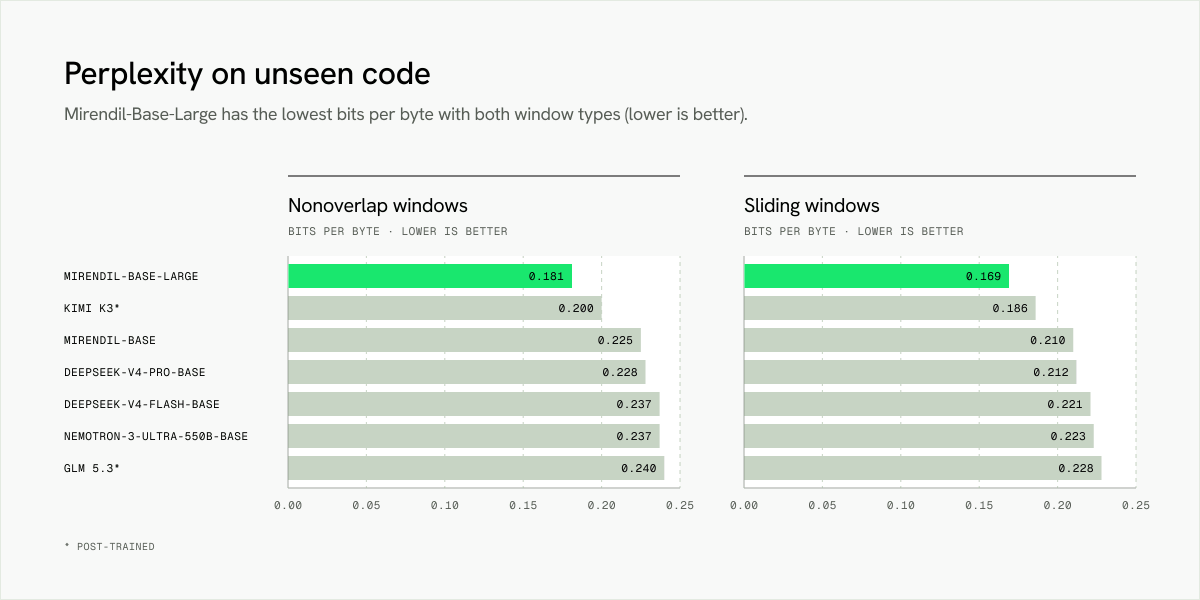
We asked Baseten to independently evaluate @mirendil’s base models. We shared our model endpoints so they could evaluate them on their own private codebases. Mirendil-Base-Large ended up being the best of all the models they tested!
Thank you, @baseten, for being a great partner!
We ran @mirendil's new base model on Baseten's private codebases; that is, code it's never seen. Mirendil-Base-Large had the lowest bits per byte (a tokenizer-independent measure of perplexity) of any model we tested.
We're excited to be the inference partner to serve Mirendil models. Congrats to the Mirendil team on this launch!
I've worked on pretraining LLMs for a long time and before agents -- living in a world with this kind of leverage feels incredible.
The best part is, we plan to release the same tools that let us do this, so more people can do it too.
You can just do things :)
Today, we're sharing a major milestone in our mission to democratize frontier AI development:
Pretraining at scale without a pretraining team.
We set out to answer an ambitious question: Can we significantly reduce the time, human expertise, and compute needed to pretrain a competitive foundation model from scratch?
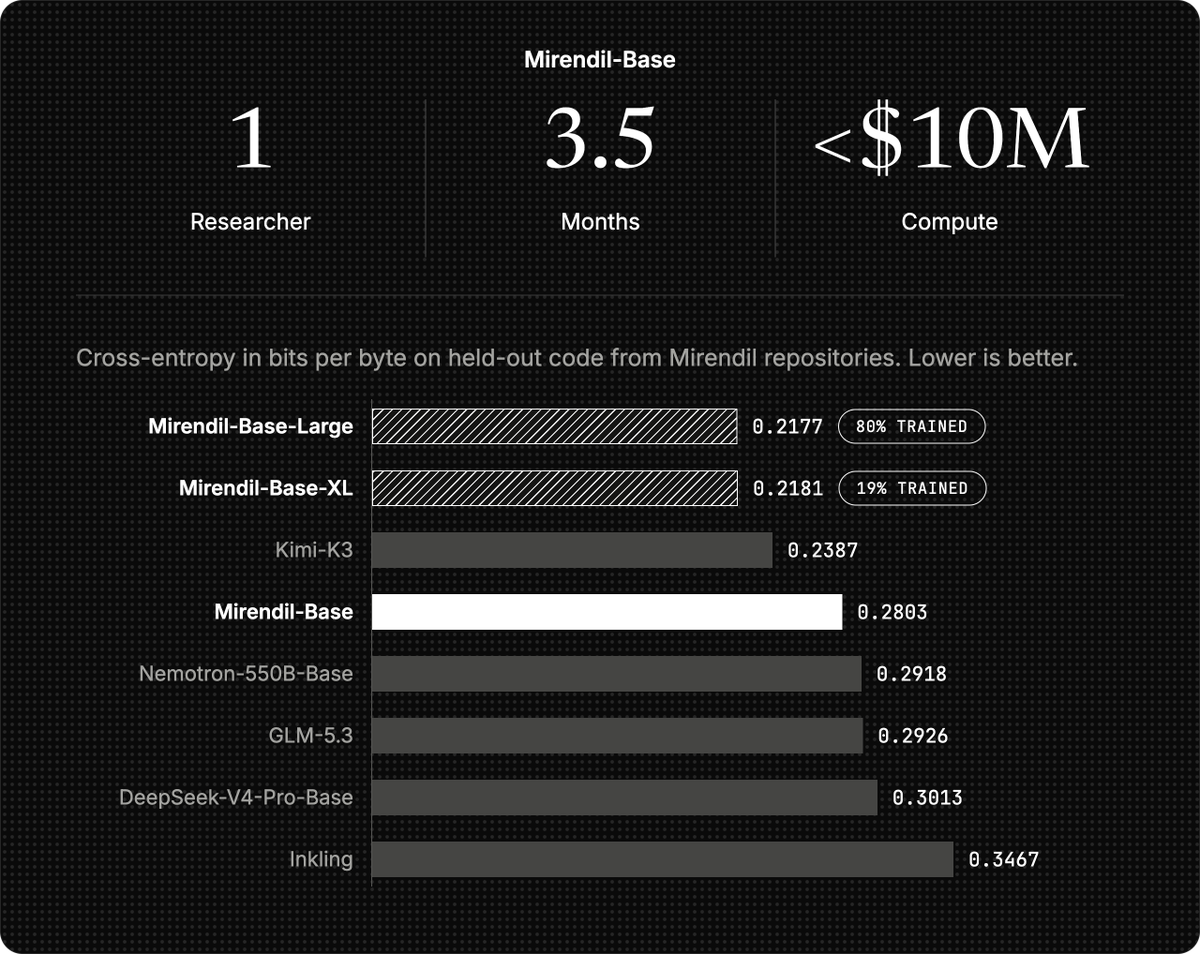
The result is Mirendil-Base, our first pretrained coding model, built by one researcher in just 3.5 months with less than $10M in compute, including all research, experimentation, and the final training run.
Our approach is already showing promising results as we scale to even larger models.
This is an important step toward a future where a single researcher, empowered by AI, can accomplish what once required an entire research organization. As these capabilities improve, we believe frontier AI development can become accessible to far more people and teams.
More to come soon, including independent evaluations, post-training benchmarks, and API access.