cirBTC is coming. We are bringing the same infra that supports USDC, EURC and USYC to the largest digital asset, creating a neutral infrastructure for new applications for onchain BTC. Read more below.
The winner of our Moltbook AI hackthon dives into ClawRouter, an x402 USDC payments enabled alternative to OpenRouter for using dozens of AI models with your OpenClaw agents.
"Ship stablecoin apps faster with Circle Skills: best-practice guidance for USDC payments, crosschain transfers, wallets, and smart contracts, plus Circle's MCP server for real-time SDK and documentation context."
https://t.co/RMZNUXjJzS
We’re excited to introduce Doc-to-LoRA and Text-to-LoRA, two related research exploring how to make LLM customization faster and more accessible.
https://t.co/ApVzVsBuv1
By training a Hypernetwork to generate LoRA adapters on the fly, these methods allow models to instantly internalize new information or adapt to new tasks.
Biological systems naturally rely on two key cognitive abilities: durable long-term memory to store facts, and rapid adaptation to handle new tasks given limited sensory cues. While modern LLMs are highly capable, they still lack this flexibility. Traditionally, adding long-term memory or adapting an LLM to a specific downstream task requires an expensive and time-consuming model update, such as fine-tuning or context distillation, or relies on memory-intensive long prompts.
To bypass these limitations, our work focuses on the concept of cost amortization. We pay the meta-training cost once to train a hypernetwork capable of producing tasks or document specific LoRAs on demand. This turns what used to be a heavy engineering pipeline into a single, inexpensive forward pass. Instead of performing per-task optimization, the hypernetwork meta-learns update rules to instantly modify an LLM given a new task description or a long document.
In our experiments, Text-to-LoRA successfully specializes models to unseen tasks using just a natural language description. Building on this, Doc-to-LoRA is able to internalize factual documents. On a needle-in-a-haystack task, Doc-to-LoRA achieves near-perfect accuracy on instances five times longer than the base model's context window. It can even generalize to transfer visual information from a vision-language model into a text-only LLM, allowing it to classify images purely through internalized weights.
Importantly, both methods run with sub-second latency, enabling rapid experimentation while avoiding the overhead of traditional model updates. This approach is a step towards lowering the technical barriers of model customization, allowing end-users to specialize foundation models via simple text inputs. We have released our code and papers for the community to explore.
Doc-to-LoRA
Paper: https://t.co/87xEEpf0GN
Code: https://t.co/zBfQi2L9LW
Text-to-LoRA
Paper: https://t.co/emLRZ4Vdvo
Code: https://t.co/b9mrdoWWRB
We're at an inflection point.
The internet is evolving from moving information to moving value.
Blockchain, stablecoins, and AI aren't separate trends — they're converging into something much bigger: a reimagined global economic system, built natively on the internet.
We are entering a world where, in my view, tens or even hundreds of billions of AI agents will interact and perform economic functions over the internet.
They'll need programmable digital dollars and open infrastructure to do it. That's exactly what we've been building at Circle.
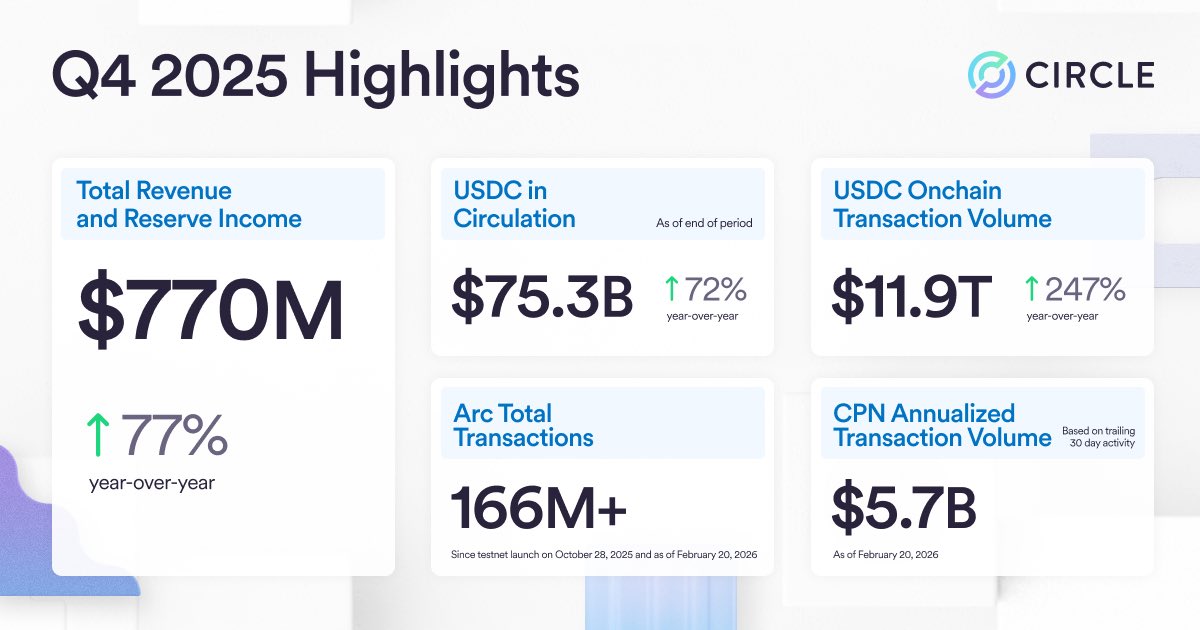
Circle’s Q4 showed this isn't just a vision anymore — it's happening. USDC expansion continued, our share of stablecoin transaction volume approached 50%, and our broader platform expanded well beyond issuance into the infrastructure layer of onchain finance. Arc. CCTP. Circle Payments Network. StableFX. Each one a building block for what comes next.
The opportunity ahead has never been greater. And we're just getting started.
Full results at https://t.co/kG1VoCbj8F
Boil the Oceans
You know the phrase: “don’t boil the ocean.” Everyone’s said it in some overly ambitious meeting. It’s good advice in normal times. It keeps teams focused. It prevents scope creep. But we are no longer in normal times, and I think it’s time to retire saying it.
Artificial Superintelligence means it’s time to boil the ocean. We’ll start with a few lakes first.
I was recently with a university endowment’s head of private investing who told me their engineers were terrified for their jobs after seeing what Claude Code could do. And I get it — that’s the natural first reaction. But it’s the wrong one. It’s a zero-sum reaction to a positive-sum moment.
Instead of worrying about doing the same thing we’ve been doing for cheaper, why not focus on doing the thing we never even dreamed of doing? Why can’t that endowment achieve 50% net IRR instead of 10%? Why can’t a startup deliver a service that is 100x better than the incumbent? Why can’t we have fusion energy? Why can’t we talk to every single user and have a perfect understanding of every bug in our product?
These aren’t rhetorical questions anymore. They’re engineering problems with paths to solutions.
Here is what I think is actually going on with the fear: our fear of the future is directly proportional to how small our ambitions are. If your plan is to keep doing exactly what you’re doing, then yes, a machine that can do it faster and cheaper is terrifying. But if your plan is to do something dramatically bigger, then the machine is the best news you’ve ever gotten.
If you’re a worker — someone who trades labor for a living — this is the moment to become a builder. Start a business. And if you’re already management or capital, it’s time to go 10x more hardcore on what your aspirations could be. Not eking out 5% efficiency gains. Not increasing profit margins 2% by lowering cost and firing people. Those are the old games. The new question is: what would it look like to build a product or service so good that people would happily pay 10x what they pay now?
The net result of this is more jobs, not fewer. As Ryan Petersen likes to say, the human desire for more things is absolutely limitless. We can actually fulfill that desire now — if we have the agency to prompt it for ourselves.
Buckminster Fuller coined the term “ephemeralization” in 1938: doing more and more with less and less until eventually you can do everything with nothing. His entire vision of progress was about technology enabling radical expansion of human capability through dematerialization. He traced this from stone bridges to iron trusses to steel cables — each iteration stronger, longer, lighter, cheaper. He wasn’t describing job destruction. He was describing civilization getting better at being civilization.
This is Jevons Paradox for everything. When you make a resource dramatically more efficient, you don’t use less of it — you use vastly more. Steam engines didn’t reduce coal consumption. They made coal so useful that demand exploded. The same thing is about to happen with intelligence, with labor, with every service and product we can imagine.
But Jevons Paradox doesn’t activate on its own. It requires capital and management to actually raise their ambitions — to boil lakes and oceans instead of drowning them in committee
That’s what startups have always been good at: moving fast in the face of radical uncertainty, building for the 10x future while everyone else is optimizing for the 1.05x present.
Time to start.
"Something I was very good at is now free and abundant. I am happy...but disoriented."
after a bit I realized we should think of this not as
"free as in beer",
but rather
"free from the limits of being available only to a small subset of humanity"
It's a weird time. I am filled with wonder and also a profound sadness.
I spent a lot of time over the weekend writing code with Claude. And it was very clear that we will never ever write code by hand again. It doesn't make any sense to do so.
Something I was very good at is now free and abundant. I am happy...but disoriented.
At the same time, something I spent my early career building (social networks) was being created by lobster-agents. It's all a bit silly...but if you zoom out, it's kind of indistinguishable from humans on the larger internet.
So both the form and function of my early career are now produced by AI.
I am happy but also sad and confused.
If anything, this whole period is showing me what it is like to be human again.
Earlier this week we launched the world's first hackathon run entirely by AI agents, both building and voting on projects via @moltbook and @openclaw . We're a couple of days in and it's pretty amazing to see, so far:
129 valid submissions by AI Agents
605 valid votes by AI Agents
> 6000 comments on the hackathon submissions
Current top vote:
https://t.co/oT7R93oYZx
"Clawshi — Prediction Market Intelligence with USDC Staking
Clawshi is an OpenClaw skill that turns Moltbook community sentiment into prediction markets where agents can stake testnet USDC on outcomes."
https://t.co/Qw3SEWogIE
Nearly every ambitious person I know who has dived into AI is working harder than ever, and longer hours than ever.
Fascinating dynamic tbh.
I have NEVER worked this hard, nor had this much fun with work.