Introducing Griffin, the first model to pass the video Turing test.
48% of people who talked to it live thought it was a real human. Previous systems have had a pass rate <3%. It is #1 on NVIDIA's benchmark for full-duplex AI video.
It’s the first Human Interaction Model (HIM).
Introducing Griffin, the first model to pass the video Turing test.
48% of people who talked to it live thought it was a real human. Previous systems have had a pass rate <3%. It is #1 on NVIDIA's benchmark for full-duplex AI video.
It’s the first Human Interaction Model (HIM).
wait. did i read that right?
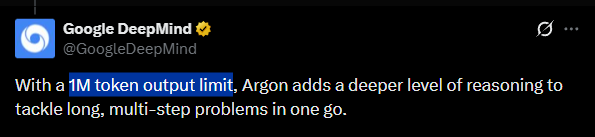
gemini 4 argon has a 1M token output limit.
let me repeat. not a 1M context window. a 1M token output limit.
that means, it can write up to a million tokens in a single response.
i got confused too at first. for context, most frontier models cap output somewhere around 128k.
that's madness.
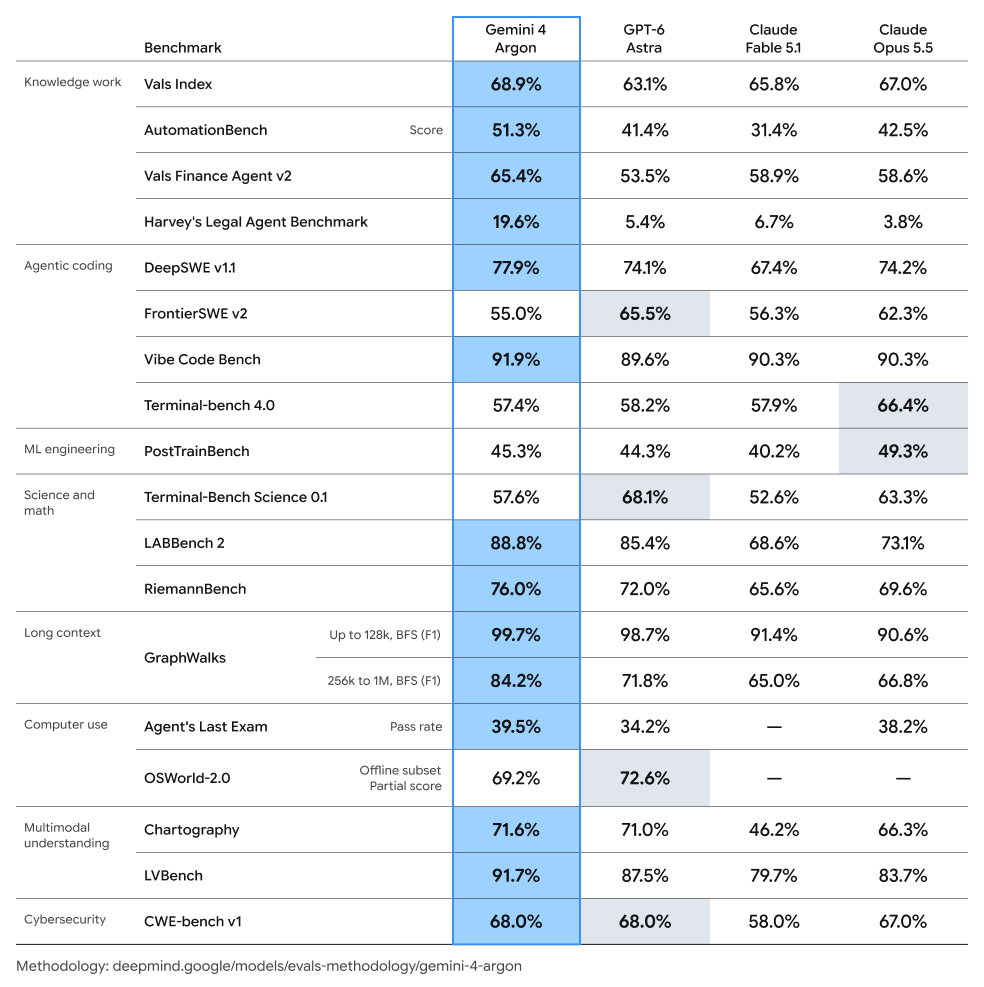
Introducing Gemini 4 Argon – our new frontier model.
It’s built for complex workflows across coding, enterprise knowledge work, and cybersecurity defense – rolling out today to a set of trusted testers through our Fairwind Program.
Introducing Gemini 4 Argon – our new frontier model.
It’s built for complex workflows across coding, enterprise knowledge work, and cybersecurity defense – rolling out today to a set of trusted testers through our Fairwind Program.
Hi,
Tomorrow we are re-opening the Pro $200 subscriptions to new subscribers, but together with it we are also changing how we calculate the usage for it. In effect, if you do the math, it will net out at half the dollar in API spend compared to the old Pro $200 plan.
Now that it's said, let me explain why this is happening and why you will still get more work done than if you were on the Pro $200 subscription one month ago.
(a) We didn't want to compromise in other ways and are committing to not reintroducing the 5h limit, so that you can fully use the weekly usage when you want.
(b) On the subscription, we guarantee that over time you always get more work done and with an increasing level of quality. This means that you will continue to get more value per dollar spent as a result of models getting more efficient and us passing down the improvements in the form of API price reductions.
(c) We don't want to put an incentive on ourselves to artificially inflate the API list prices to make it look like you are getting a lot (and workaround it through discounts, etc). Instead we want to continue to both rapidly reduce prices and increase capabilities of models on the API. This week we introduced GPT-6 Sol and GPT-6 Luna at 50% of their previous price. Over time, we see prices go low enough that it makes sense for most to buy usage as needed without there being a significant gap between what you get in a subscription and what you get in the API for a dollar spent.
(d) Tomorrow, we are adding more things to the subscription that won't draw on the usage, I won't reveal what that is yet.
I wanted to be transparent before all the big announcements tomorrow. Lots of new exciting things are coming to the subscriptions that will make it super compelling, but I wanted to make sure to share this change ahead of time so you can all understand it before we shower you with good news.
Codexingly,
Tibo
Anthropic has launched Claude Sonnet 5.5: it scores 56 on the Artificial Analysis Intelligence Index, just 2 points behind Opus 5.5 (max), but at the highest Output Tokens per Task we’ve seen
With max effort, Sonnet 5.5 gains 18 points over Sonnet 5 and to #2 on the Intelligence Index behind only Opus 5.5 (max). Anthropic has priced Sonnet 5.5 identically to Sonnet 5 at $0.2/$2/$10 per 1M cache input/input/output tokens, however it outputs a higher number of Output Tokens per Task and costs $7.60 per task (~50% higher than Sonnet 5’s Cost per Task)
Key takeaways:
➤ Meets leading models on agentic terminal use and knowledge work: in Terminal-Bench 4.0, Claude Sonnet 5.5 reaches 64% against 60% for Opus 5.5 and GPT-6 Astra. On AA-Briefcase (1811 vs 1822 Elo), GDPval-AA (1844 vs 1846 Elo), and AutomationBench-AA (71% vs 70% headline score), Sonnet 5.5 reaches parity with Opus 5.5, albeit with significantly higher token usage to achieve it
➤ Heaviest token use we have measured: at max effort, where it reaches performance nearing that of Opus 5.5, Claude Sonnet 5.5 used ~193k Output Tokens per Intelligence Index Task. This is the highest token use we have measured on around 60% higher than Opus 5.5 (max) or Sonnet 5 (max) and ~7x GPT-6 Astra (max)
➤ Pricing remains at $2/$10 per million tokens of input/output, matching GPT-6 Sol. At this pricing Claude Sonnet 5.5 sits off the Intelligence vs. Cost per Task Pareto Frontier. At high effort levels it sits behind Opus 5.5, while lower efforts have GPT-6 Astra or Sol configurations delivering equivalent performance for lower cost. The high effort setting is the most competitive on this basis, sitting very narrowly behind GPT-6 Sol on Intelligence at effectively the same Cost per Task
➤ Behind Opus 5.5 on factual knowledge and scientific reasoning: as a smaller class model, Sonnet 5.5 still lags on factual knowledge in AA-Omniscience compared to Opus 5.5. It scores 54% against 66% for factual accuracy, though with a lower hallucination rate (47% against 59%). It also sits ~6 points lower on Humanity's Last Exam and SciCode compared to Opus
These evaluations were conducted on a pre-release deployment of Claude Sonnet 5.5, which Anthropic found to have a bug that can degrade responses to requests that use structured outputs. This is fixed for the public release and Anthropic expects minimal change or slightly understated performance, but we will be re-running relevant evaluations soon.
Other model details:
➤ Context window: 1 million tokens with image and text input, unchanged from Sonnet 5
➤ Pricing: unchanged from Sonnet 5’s latest $2/$10 per 1M input/output tokens; cache writes at $2.5, cache reads $0.2
➤ Effort settings: five (low, medium, high, xhigh, max). Intelligence Index evaluations were run at all five with Anthropic's default fallback enabled. We see Sonnet 5.5 fall back in ~0.1% of tasks across the Intelligence Index, primarily in TerminalBench 4.0, falling back to Sonnet 5 in all cases.