long-form storytelling with current generative ai tools is like taking a trip to HELL and going 3 inches further from there.
you take context from here, paste it there, generate 15-second clips and stitch them together... yuk.
most platforms today have become aggregators of models with a few proprietary workflows. but there are at least 2-3 more layers we need to build to enable long-form storytelling and get out of the "generate 1,000s of shots and get great results" p*rn.
to begin with, the obvious three layers are —
1/ coherence layer: remembers characters, arcs, scenes, and script. not just storage.
2/ possibility layer: showcasing model limitations upfront from the prompt and reference images.
3/ narration layer: understanding causality (maybe a world model), narrative style, and director's intent.
and i think the scale at which he operates, and the constraints in which he operates, regulatory, government, general price sensitivity, is unprecedented.
he’s able to create more shareholder value compared to almost any other billionaire in the world.
the sad part, partly due to our culture, is that nobody understands how he thinks or how he operates. of course, that gives him an advantage to move fast and move in stealth, but i think for the rest of the founders, it’s a missed opportunity.
@jennykrakovsky hey jenny, we are building a platform to enable feature length filmmaking - still early tho.
we are a team of filmmakers, ai engineers and product devs - if you're up for it, we can help with this project.
we can learn and you will move fast - talk in DMs?
What if filmmaking felt less like typing prompts…
and more like talking through your vision with a creative partner?
Filmmakers shouldn’t have to think like prompt engineers.
They should be able to talk through emotion, tension, pacing, characters, and story naturally.
So we built Director’s Room, a voice-first AI director that helps filmmakers brainstorm scenes, refine ideas, generate storyboards, create cinematic shots, compose music, and stitch entire films together through conversation.
The future of filmmaking won’t feel like prompting.
It’ll feel like directing.
Built during the Cursor x ElevenLabs Worldwide Hackathon.
@cursor_ai@ElevenLabs #ElevenHacks
this is huge coming from a political leader like stalin. i'm genuinely surprised that he's not taking the usual route of becoming overly emotional on camera and turning the moment into public mourning, but instead going back to the ground to collect real feedback so he can return stronger.
i think we're going to see a lot more of this in the political tech landscape. leaders will become increasingly data-driven and use ai more deeply to understand people, shape narratives, and strengthen their campaigns.
What if filmmaking felt less like typing prompts…
and more like talking through your vision with a creative partner?
Filmmakers shouldn’t have to think like prompt engineers.
They should be able to talk through emotion, tension, pacing, characters, and story naturally.
So we built Director’s Room, a voice-first AI director that helps filmmakers brainstorm scenes, refine ideas, generate storyboards, create cinematic shots, compose music, and stitch entire films together through conversation.
The future of filmmaking won’t feel like prompting.
It’ll feel like directing.
Built during the Cursor x ElevenLabs Worldwide Hackathon.
@cursor_ai@ElevenLabs #ElevenHacks
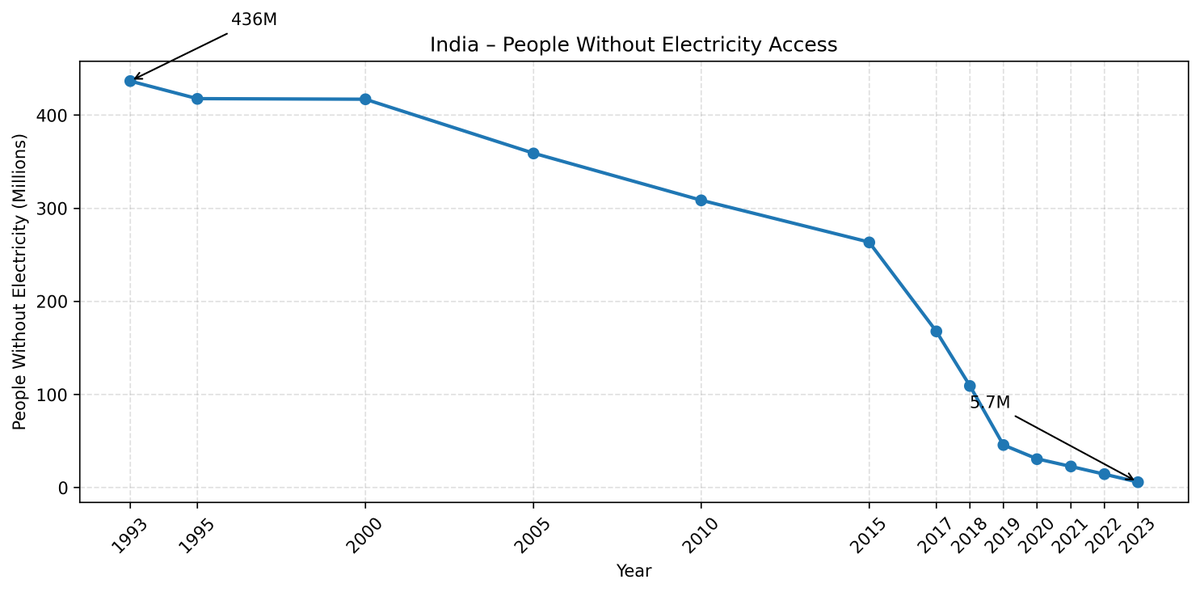
It means that from 2000 to 2015, the focus was largely on fixing the supply side of electricity: increasing generation capacity, building transmission networks, expanding the grid, and reforming the electricity sector itself.
From 2015 onwards, the focus shifted toward the demand side: actually connecting households, solving last-mile delivery, and ensuring electricity reached individual homes rather than just villages.
You can almost see an accelerated growth curve during the demand-side phase.
The interesting question is: why did the supply side take so long?
The answer might be that the supply-side infrastructure is extremely capital-intensive and sequential. You cannot electrify homes at scale unless generation exists first, transmission lines are built, substations are operational, and the grid becomes stable enough to support millions of additional users.
In many ways, the post-2015 acceleration was possible only because the foundational infrastructure work from the previous 15 years had already been completed.
It means that from 2000 to 2015, the focus was largely on fixing the supply side of electricity: increasing generation capacity, building transmission networks, expanding the grid, and reforming the electricity sector itself.
From 2015 onwards, the focus shifted toward the demand side: actually connecting households, solving last-mile delivery, and ensuring electricity reached individual homes rather than just villages.
You can almost see an accelerated growth curve during the demand-side phase.
The interesting question is: why did the supply side take so long?
The answer might be that the supply-side infrastructure is extremely capital-intensive and sequential. You cannot electrify homes at scale unless generation exists first, transmission lines are built, substations are operational, and the grid becomes stable enough to support millions of additional users.
In many ways, the post-2015 acceleration was possible only because the foundational infrastructure work from the previous 15 years had already been completed.
It means that from 2000 to 2015, the focus was largely on fixing the supply side of electricity: increasing generation capacity, building transmission networks, expanding the grid, and reforming the electricity sector itself.
From 2015 onwards, the focus shifted toward the demand side: actually connecting households, solving last-mile delivery, and ensuring electricity reached individual homes rather than just villages.
You can almost see an accelerated growth curve during the demand-side phase.
The interesting question is: why did the supply side take so long?
The answer might be that the supply-side infrastructure is extremely capital-intensive and sequential. You cannot electrify homes at scale unless generation exists first, transmission lines are built, substations are operational, and the grid becomes stable enough to support millions of additional users.
In many ways, the post-2015 acceleration was possible only because the foundational infrastructure work from the previous 15 years had already been completed.
yesterday, i met an entrepreneur with good credentials (ex-apollo, springleaf, etc.) who wanted to jam about a product idea he'd been exploring. in the meeting, it became clear that he wanted to spend a lot of time thinking about this space before even thinking about execution.
he doesn't know how to use vibe-coding platforms, but he built a prototype in freaking excel — sample UI, buttons and it's just crazy amount of work.
this is one of the most consistent patterns i've seen with good product people and entrepreneurs: they spend a lot of time refining the idea before they ever go to their engineering or design teams for execution.
of course they talk to execution teams early to understand what's possible and what's not, but not for any groundbreaking product direction.
this skill is going to be tremendously valuable in the ai era: the ability to bulletproof ideas before going to execution. otherwise, you end up building a low-resolution product that might solve a problem or two, but can't support deep vertical integration.
We’re building something similar in this space - an agentic video creation platform tailored to Indian context and nuances.
Our team is from from ISRO, Instabase, NITI AI, and Semmai.
We go beyond generating one-off videos - we also help with strategy and volumized content creation to maintain a coherent, high-quality social channel.