Introducing Exa Connect: connecting agents to data beyond the public web.
Available today with ZoomInfo, Crunchbase, Similarweb, and many other leading data providers.
https://t.co/MlEhWoCIiF
Introducing Exa Agent: frontier web research at less than half the cost of GPT 5.5 and Opus.
/agent orchestrates a mixture of cost-effective models to complete any web research task, from simple data enrichments to building gigantic lists.
Exa powers most of the popular coding agents. We wrote about how we build and evaluate coding-related web search.
Blog and open evals: https://t.co/dwnVmYCJO3
In my opinion, MCP is not redundant and bad performance owes mainly to skill issue:
Redundancy
The most important leverage an agent can have is amazing context engineering, and CLIs/APIs simply aren't designed to expose precise, concise interfaces for specific use cases. To achieve that, you need a client-server relationship where the client (agent) tells a server about itself and the server exposes an intelligent selection of capabilities (tools), or if the client (agent) post-filters the set of tools (in MCP, what is returned by `initialize`).
Well, MCP is such a technology! Could you hack CLIs/APIs to achieve the same thing? Sure, but they're not designed for selective exposure that minimizes an agent's context pollution. You need some new protocol layer thing that allows for that, even if that just wraps CLIs/APIs, because of this agent-specific problem. MCP!
Performance
Most of the performance issues I see in MCPs owe to bad implementation. That they promote good context engineering is a moot point if they're designed such that context gets mega polluted, and unfortunately many MCPs mega pollute context. One way this happens is exposing way too many tools - it's pretty common right now for API-wrapping MCPs to just expose every single API endpoint and request field, with some MCPs in the tens of thousands of tokens size because of this. This wouldn't be an issue if agent harnesses allowed for selective tool filtering per MCP, but most agent harnesses (e.g., Claude Code) don't support this.
Also developers are not mindful enough of tool call response token payloads, which also need to be minimized to avoid context pollution - it is all too common for responses to constitute of the full API response payload. This has been partially mitigated by the rise of subagents but is still a major issue that often APIs/CLI based tool implementations may not have because in those implementations there are existing patterns to filter payloads.
In my personal Claude Code setup, I address these problems by 1) implementing an "MCP proxy" layer that lets me manually remove tools from MCPs, 2) implementing post tool call hooks that filter response payloads. And in the Exa MCP, we are careful to 1) return only fields that an agent needs 2) filter parsed HTML to only relevant tokens using models that we train. But these features need to be built into MCPS and agent harnesses as first class citizens.
Lastly, I will note that it is obviously the case that agents know how to use APIs/CLIs that are in their training data very well, almost always better than MCPs. But that issue should get fixed over time as LLMs get trained on more MCP data.
Overall
I tend to be relatively pro when it comes to new shit that needs to be built specifically for AIs (after all, our company is in the business of building a search engine from scratch for AIs lol). But this is my experience as someone who has thought about this way too much.
Curious for people's thoughts! Maybe I am missing something.
Introducing Exa Deep: putting an agent inside every search
For each query, an agent runs in a loop until it gathers all information, then returns structured output.
Evals show Deep is Pareto optimal at 4-60s latency, ideal for quick, cost-efficient research!
Building a search engine might be the last software problem that AI solves.
That's because it's extremely hard to perfectly search through exabytes of unstructured data.
In this blog post, we detail just one part of our search stack - the data processing framework. We explain why we built it from scratch to optimize for the special workloads a modern search engine requires.
Very proud of @nityasnotes who wrote a beautiful blog post and @hubertyuan_ for designing a beautiful system :)
Wonder if the chip layer (NVDA, AMD, AVGO) commitments overlap with the clouds (Azure, ORCL, CRWV, AWS). If so, the $1.4T headline shrinks to ~$0.6T. Add Stargate leverage and OAI’s out-of-pocket goes smaller. Pure speculation of course — hope we see clearer disclosures soon.
I would like to clarify a few things.
First, the obvious one: we do not have or want government guarantees for OpenAI datacenters. We believe that governments should not pick winners or losers, and that taxpayers should not bail out companies that make bad business decisions or otherwise lose in the market. If one company fails, other companies will do good work.
What we do think might make sense is governments building (and owning) their own AI infrastructure, but then the upside of that should flow to the government as well. We can imagine a world where governments decide to offtake a lot of computing power and get to decide how to use it, and it may make sense to provide lower cost of capital to do so. Building a strategic national reserve of computing power makes a lot of sense. But this should be for the government’s benefit, not the benefit of private companies.
The one area where we have discussed loan guarantees is as part of supporting the buildout of semiconductor fabs in the US, where we and other companies have responded to the government’s call and where we would be happy to help (though we did not formally apply). The basic idea there has been ensuring that the sourcing of the chip supply chain is as American as possible in order to bring jobs and industrialization back to the US, and to enhance the strategic position of the US with an independent supply chain, for the benefit of all American companies. This is of course different from governments guaranteeing private-benefit datacenter buildouts.
There are at least 3 “questions behind the question” here that are understandably causing concern.
First, “How is OpenAI going to pay for all this infrastructure it is signing up for?” We expect to end this year above $20 billion in annualized revenue run rate and grow to hundreds of billion by 2030. We are looking at commitments of about $1.4 trillion over the next 8 years. Obviously this requires continued revenue growth, and each doubling is a lot of work! But we are feeling good about our prospects there; we are quite excited about our upcoming enterprise offering for example, and there are categories like new consumer devices and robotics that we also expect to be very significant. But there are also new categories we have a hard time putting specifics on like AI that can do scientific discovery, which we will touch on later.
We are also looking at ways to more directly sell compute capacity to other companies (and people); we are pretty sure the world is going to need a lot of “AI cloud”, and we are excited to offer this. We may also raise more equity or debt capital in the future.
But everything we currently see suggests that the world is going to need a great deal more computing power than what we are already planning for.
Second, “Is OpenAI trying to become too big to fail, and should the government pick winners and losers?” Our answer on this is an unequivocal no. If we screw up and can’t fix it, we should fail, and other companies will continue on doing good work and servicing customers. That’s how capitalism works and the ecosystem and economy would be fine. We plan to be a wildly successful company, but if we get it wrong, that’s on us.
Our CFO talked about government financing yesterday, and then later clarified her point underscoring that she could have phrased things more clearly. As mentioned above, we think that the US government should have a national strategy for its own AI infrastructure.
Tyler Cowen asked me a few weeks ago about the federal government becoming the insurer of last resort for AI, in the sense of risks (like nuclear power) not about overbuild. I said “I do think the government ends up as the insurer of last resort, but I think I mean that in a different way than you mean that, and I don’t expect them to actually be writing the policies in the way that maybe they do for nuclear”. Again, this was in a totally different context than datacenter buildout, and not about bailing out a company. What we were talking about is something going catastrophically wrong—say, a rogue actor using an AI to coordinate a large-scale cyberattack that disrupts critical infrastructure—and how intentional misuse of AI could cause harm at a scale that only the government could deal with. I do not think the government should be writing insurance policies for AI companies.
Third, “Why do you need to spend so much now, instead of growing more slowly?”. We are trying to build the infrastructure for a future economy powered by AI, and given everything we see on the horizon in our research program, this is the time to invest to be really scaling up our technology. Massive infrastructure projects take quite awhile to build, so we have to start now.
Based on the trends we are seeing of how people are using AI and how much of it they would like to use, we believe the risk to OpenAI of not having enough computing power is more significant and more likely than the risk of having too much. Even today, we and others have to rate limit our products and not offer new features and models because we face such a severe compute constraint.
In a world where AI can make important scientific breakthroughs but at the cost of tremendous amounts of computing power, we want to be ready to meet that moment. And we no longer think it’s in the distant future. Our mission requires us to do what we can to not wait many more years to apply AI to hard problems, like contributing to curing deadly diseases, and to bring the benefits of AGI to people as soon as possible.
Also, we want a world of abundant and cheap AI. We expect massive demand for this technology, and for it to improve people’s lives in many ways.
It is a great privilege to get to be in the arena, and to have the conviction to take a run at building infrastructure at such scale for something so important. This is the bet we are making, and given our vantage point, we feel good about it. But we of course could be wrong, and the market—not the government—will deal with it if we are.
Could be an interesting business model… put two of these in a mall and charge like an arcade. Say $5 / 15min. With 8h/day fully booked, your $16k CapEx pays back in ~100 days. Of course, utilization and rent mean payback might be 6–12mo, but still compelling. #AGI#Robot
Thinking for longer (e.g. o1) is only one of many axes of test-time compute. In a new @Google_AI paper, we instead focus on scaling the search axis. By just randomly sampling 200x & self-verifying, Gemini 1.5 ➡️ o1 performance. The secret: self-verification is easier at scale!
One of the features I've mosted wanted in AI Studio for a long time! Just paste a YouTube link into the command line and ask Gemini 2.0 questions about it - it's multimodal understanding is kind of mindblowing. Try it here: https://t.co/3ioM7tihCG
DeepSeek R1 671B running on 2 M2 Ultras faster than reading speed.
Getting close to open-source O1, at home, on consumer hardware.
With mlx.distributed and mlx-lm, 3-bit quantization (~4 bpw)
Yup, different players are pursuiting different business models (Software/SaaS/Compute, Hardware/Autonomous lab, Service/CRO, IP/in-house development etc). Very exciting time of AI for Science #AI4Sci
Excited to share our work on efficient and precise force field optimization for biomolecules with Large Atomic Model DPA-2 ⚛. Substantial improvements over GAFF2 demonstrated via FEP examples on TYK2 inhibitor and PTP1B systems.
https://t.co/OwBqgSzMBN
#AI4Sci#OpenScience
It seems to me that before "urgently figuring out how to control AI systems much smarter than us" we need to have the beginning of a hint of a design for a system smarter than a house cat.
Such a sense of urgency reveals an extremely distorted view of reality.
No wonder the more based members of the organization seeked to marginalize the superalignment group.
It's as if someone had said in 1925 "we urgently need to figure out how to control aircrafts that can transport hundreds of passengers at near the speed of the sound over the oceans."
It would have been difficult to make long-haul passenger jets safe before the turbojet was invented and before any aircraft had crossed the atlantic non-stop.
Yet, we can now fly halfway around the world on twin-engine jets in complete safety.
It didn't require some sort of magical recipe for safety.
It took decades of careful engineering and iterative refinements.
The process will be similar for intelligent systems.
It will take years for them to get as smart as cats, and more years to get as smart as humans, let alone smarter (don't confuse the superhuman knowledge accumulation and retrieval abilities of current LLMs with actual intelligence).
It will take years for them to be deployed and fine-tuned for efficiency and safety as they are made smarter and smarter.
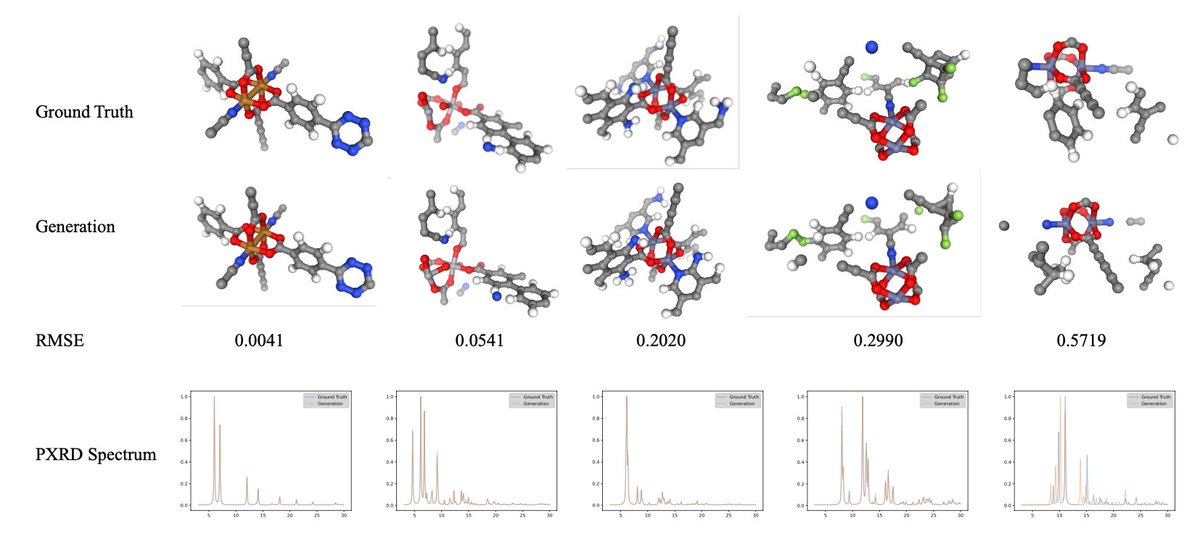
Introducing #XtalNet by @guolin_ke and team: E2E crystal structure prediction from PXRD data with contrastive learning and #diffusion based conditional crystal structure generation. paper: https://t.co/2jEaSwoJrB dataset:https://t.co/6g0rocThVW #AI4Sci#GenAI#Crystallography
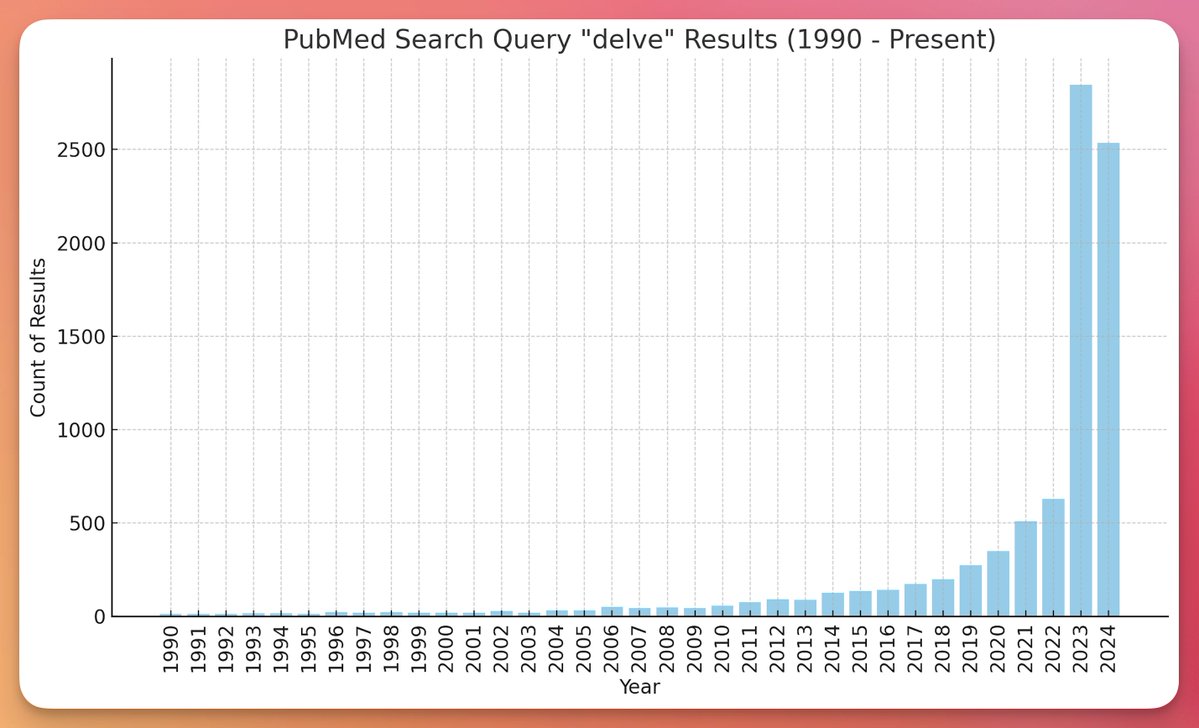
Are medical studies being written with ChatGPT?
Well, we all know ChatGPT overuses the word "delve".
Look below at how often the word 'delve' is used in papers on PubMed (2023 was the first full year of ChatGPT).