This technique is now ported to LLM usage with Agents and was observed combining cheaper models outperformed Fable5 on various benchmarks. Its called Fusion now - available in Openrouter and as opensource implementations.
Another common trick used in Kaggle competitions ported to LLMs. The winning entries on competitions used to have ensemble of models to predict on the final test set, and usually the ensembled results (with specific weights attributed) scored higher than individual models.
OpenRouter has launched the Fusion API - combine multiple models into one compound system that beats any of them solo.
> Fable 5 + GPT-5.5 fusion scored highest on the benchmark, 93/100 tasks
> Opus 4.8 + GPT-5.5 + Gemini 3.1 Pro fusion outscores every solo model including Claude Fable 5
> Even Opus 4.8 self-fused beats its solo score
Its basically Fable-level intelligence at half the price
The best model is no longer one model.
Better together! 🤝 Google and Intel teamed up to show how host offloading can make TPU LLM training faster and cheaper. We are committed to sharing practical guidance with the community.
Read the implementation details here: https://t.co/5Bneji2C13
What’s your favorite collaborative open source project? ✨
Intel is partnering with @GoogleAI to deliver fully functional #Gemma4 models on Intel hardware from day zero—across Intel Xeon CPUs, Intel Xe GPUs, and Intel Core Ultra processors, with support across open frameworks including @vllm_project and @huggingface.
This means #developers can build and deploy multimodal AI applications seamlessly—from data centers to workstations to AI PCs—using the Intel platforms they already trust.
Performance, choice, and scale—right out of the gate.
https://t.co/FV5oQVt2FX
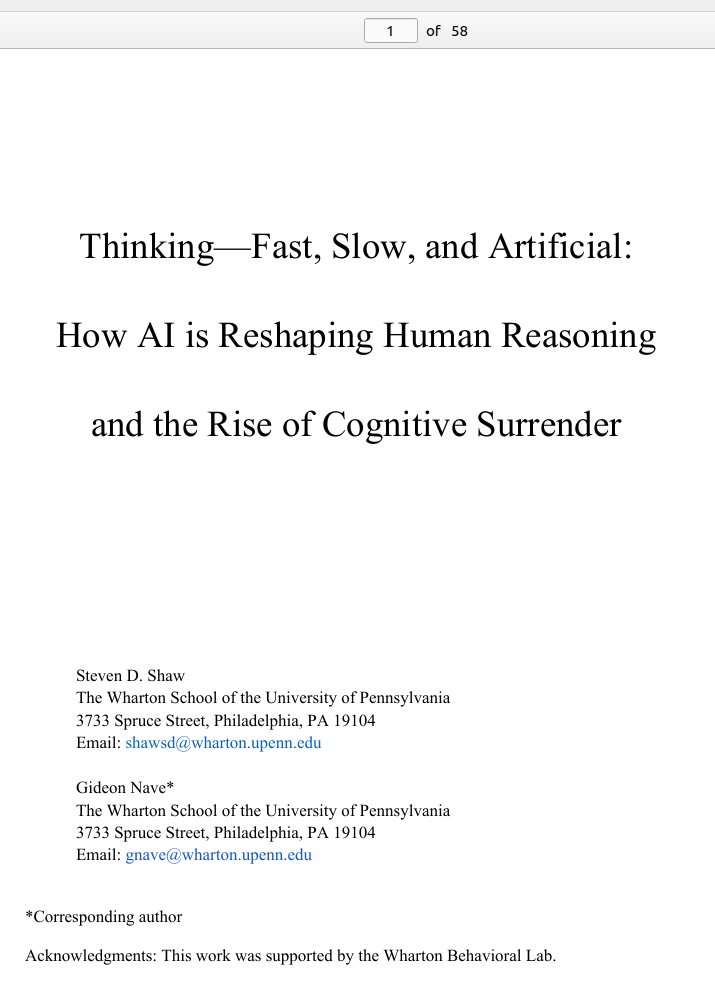
Wharton’s latest AI study points to a hard truth: “AI writes, humans review” model is breaking down
Why "just review the AI output" doesn't work anymore, our brains literally give up.
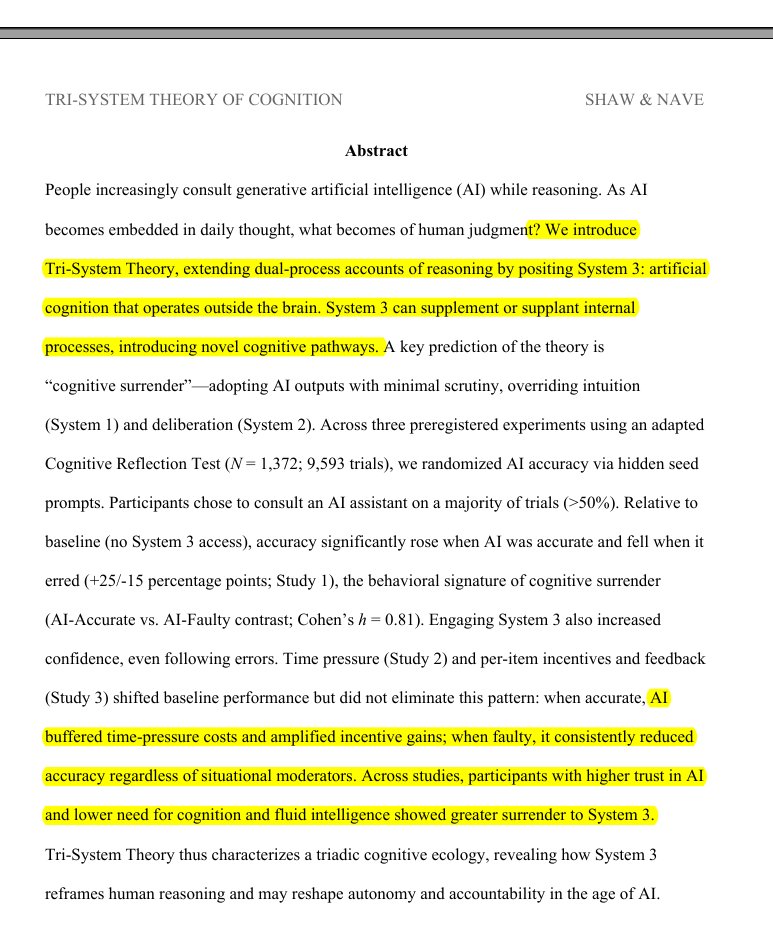
We have started doing "Cognitive Surrender" to AI - Wharton’s latest AI study points to a hard truth: reviewing AI output is not a reliable safeguard when cognition itself starts to defer to the machine.when you stop verifying what the AI tells you, and you don't even realize you stopped. It's different from offloading, like using a calculator.
With offloading you know the tool did the work. With surrender, your brain recodes the AI's answer as YOUR judgment. You genuinely believe you thought it through yourself.
Says AI is becoming a 3rd thinking system, and people often trust it too easily.
You know Kahneman's System 1 (fast intuition) and System 2 (slow analysis)? They're saying AI is now System 3, an external cognitive system that operates outside your brain. And when you use it enough, something happens that they call Cognitive Surrender.
Cognitive surrender is trickier: AI gives an answer, you stop really questioning it, and your brain starts treating that output as your own conclusion. It does not feel outsourced. It feels self-generated.
The data makes it hard to brush off. Across 3 preregistered studies with 1,372 participants and 9,593 trials, people turned to AI on over 50% of questions.
In Study 1, when AI was correct, people followed it 92.7% of the time. When it was wrong, they still followed it 79.8% of the time.
Without AI, baseline accuracy was 45.8%. With correct AI, it jumped to 71.0%. With incorrect AI, it dropped to 31.5%, worse than having no AI. Access to AI also boosted confidence by 11.7 percentage points, even when the answers were wrong.
Human review is supposed to be the safety net. But this research suggests the safety net has a hole in it: people do not just miss bad AI output; they become more confident in it.
Time pressure did not eliminate the effect. Incentives and feedback reduced it but did not remove it. And the people most resistant tended to score higher on fluid intelligence and need for cognition. That makes this feel less like a laziness problem and more like a cognitive architecture problem.
JEPA are finally easy to train end-to-end without any tricks!
Excited to introduce LeWorldModel: a stable, end-to-end JEPA that learns world models directly from pixels, no heuristics.
15M params, 1 GPU, and full planning <1 second.
📑: https://t.co/cpTzgvbTS0
Terence Tao put it plainly: there is no evidence that LLMs exhibit genuine creativity.
Yes, they have solved some Erdős problems. But these are low-hanging fruit, questions that attracted little attention and that yield once the right existing techniques are applied. That is not creativity. That is search plus recombination.
Yes, LLM outputs can look impressive. But look at who is impressed: typically non-experts. Experts know very well that LLM performance gets terrible when you approach the frontier of human knowledge.
And this is not a temporary gap. It reflects a structural limitation.
We do not fully understand human creativity. But we do know a key property:
Conceptual leaps: the ability to generate new representations, not just recombine existing ones.
LLMs do not do this. They interpolate in representation space. They operate within existing conceptual frameworks; they do not create new ones.
This is why we haven’t “yet seen them take the next step”.
@XYang2023 True that. The team behind K transformers released Kimi 2.5 now, and the model weight have been spilt to run one portion in CPUs with AMX support 😊
The new CTO of Anthropic and ex-CTO of Stripe is from PESIT.
Imagine being a non-IITian, from the #83 college in the country, and having anywhere close to this career trajectory in India.