Climate variability can alter the risk of armed conflict. A study maps how two major climate modes—the El Niño–Southern Oscillation and the Indian Ocean Dipole—influence conflict emergence. In PNAS: https://t.co/l5AIWmhIZF
I’m a climate scientist. Let me fix this headline.
“Nearly a century ago, scientists showed that burning fossil fuels warms the planet.*
Today, we know human emissions account for over 100% of the warming.**
Yet dark money and disinformation still work to keep Americans addicted to fossil fuels.”***
* in 1937, Guy Callendar published a paper showing that the world had already warmed over the last 50 years due to human emissions what he called “carbonic acid“ – what we now call CO2 – from burning fossil fuels
** If you are wondering, “how could humans be causing more than 100% of the warming?”
— it’s because, according to natural factors, the earth should be cooling right now.
So our emissions are offsetting that cooling AND causing all of the observed warming.
*** For more on the well funded disinformation campaign, read or watch Merchants of Doubt and The Petroleum Papers
As unusually hot weather hits parts of the world, it's worthwhile to recall the 2023 #IPCC’s Synthesis Report. It showed that every increment of warming results in rapidly escalating hazards.
➡️ https://t.co/4jqrv1HpAz
Today in absurd grant review comments we have:
Only studying females is a weakness…in a grant on endometriosis. 🤷♀️🤷♀️🤷♀️
Aren’t you all supposed to have a ton of education?!?
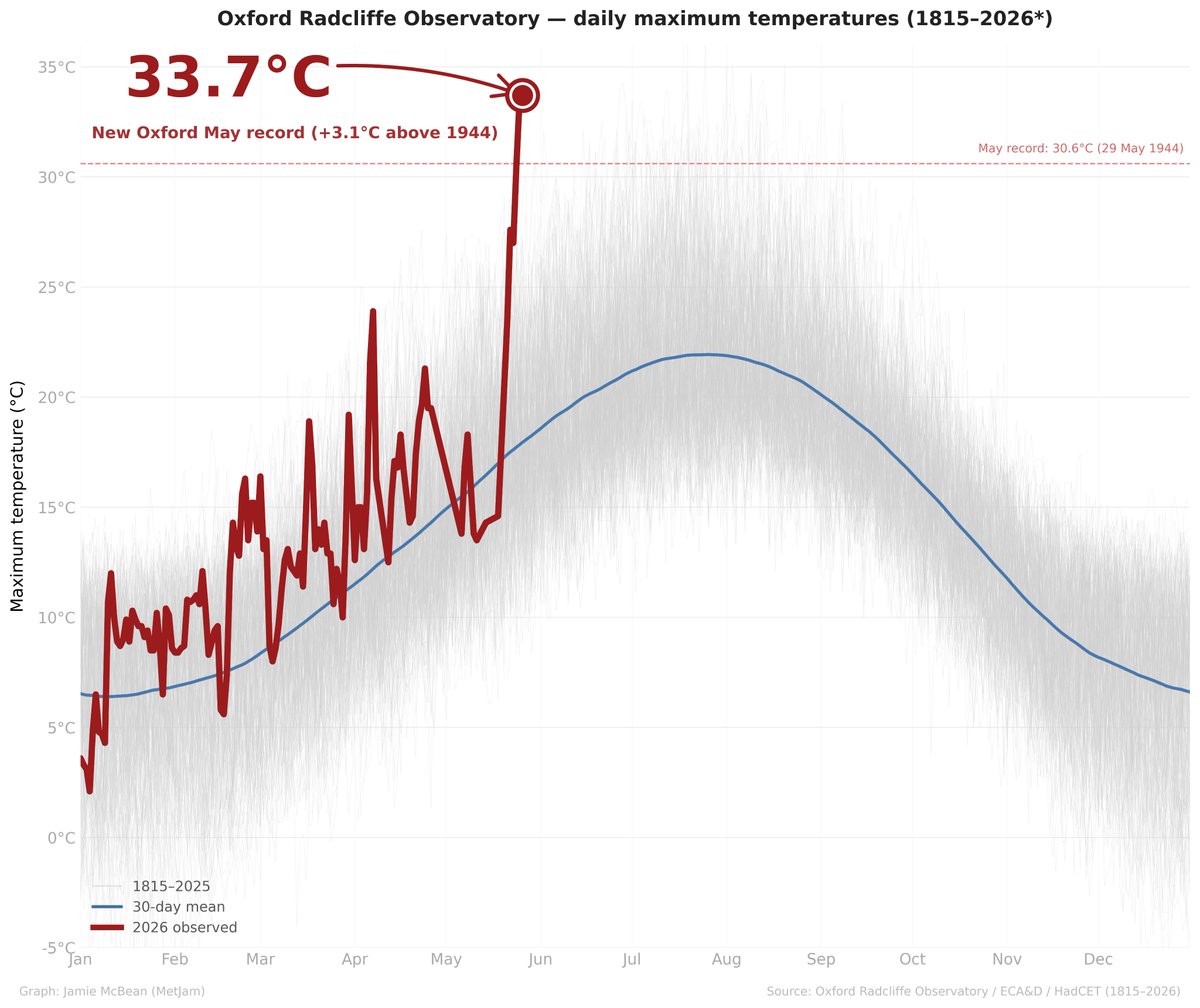
Oxford, the longest running continuous weather station in UK history, with temperature observations stretching back to 1815, has preliminarily broken its maximum temperature record for May yesterday by OVER 3ºC with a temperature of 33.7ºC. Unprecedented in its 211-year history.
If the promise of a tasty meal makes you want to jump for joy, you may relate to the loggerhead turtle.
These animals have an uncontrollable urge to dance whenever they anticipate food—a trait scientists used to test whether the reptiles can memorize their favorite feeding sites based on Earth’s magnetic fields.
Learn more on #WorldTurtleDay: https://t.co/KZ5TAPCMAM
A short reply to this Nature editorial: Of course, science needs humans.
No AI has yet become obsessed with an idea for 20 years, argued endlessly over tea, ignored conventional wisdom, made glorious mistakes, and accidentally changed the world.
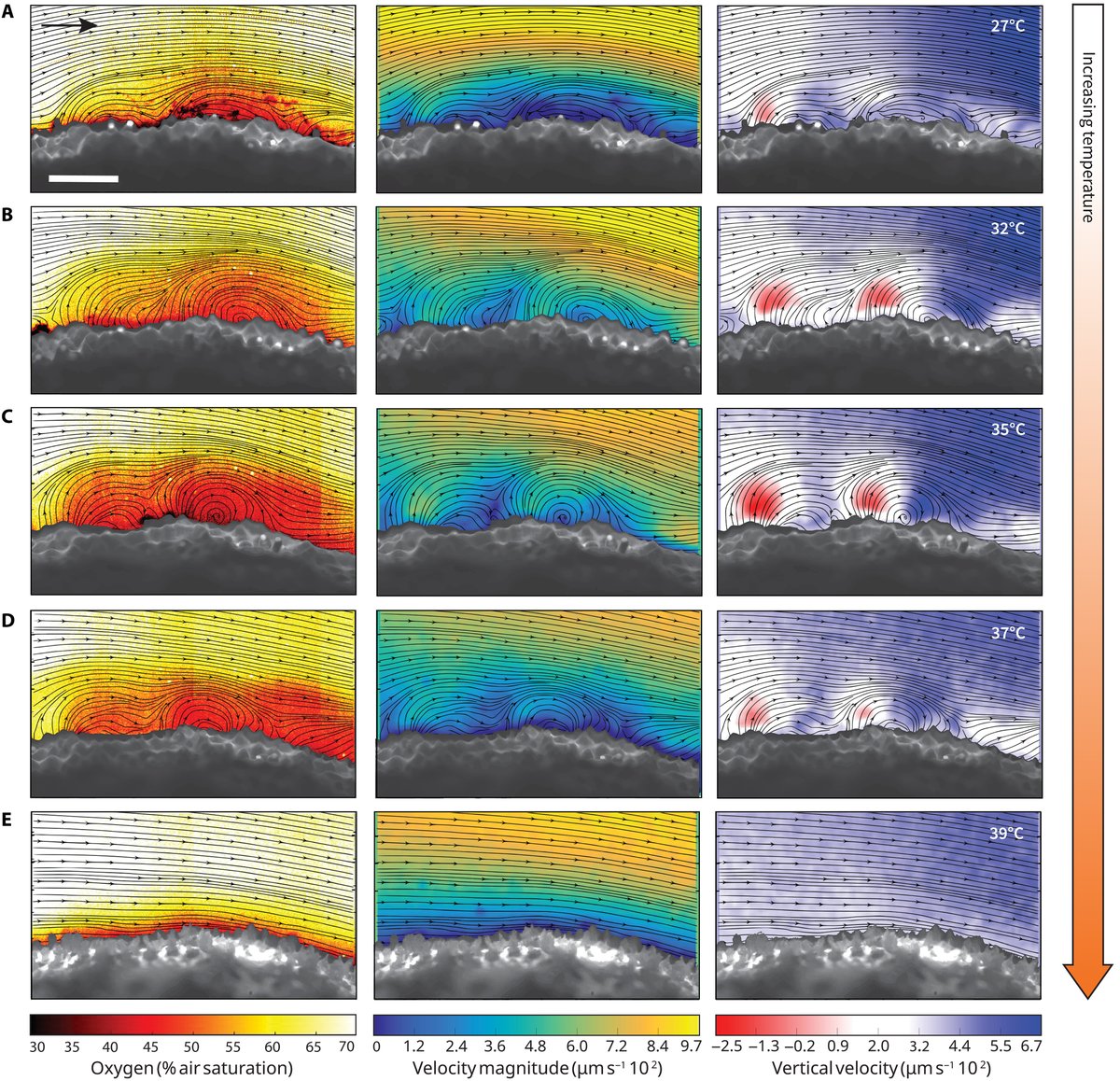
A new study tracks deoxygenation in the world’s rivers across nearly 4 decades, finding that dissolved oxygen concentration has decreased by 0.045 milligrams per liter per decade due to #ClimateWarming. https://t.co/NIznWbt2As
Hypoxia occurs in a body of water when oxygen levels drop and suffocate life.
Researchers used new observations to explore how a previously overlooked mechanism of vertical exchange circulates water and regulates hypoxia in coastal oceans. @OSUCEOAS https://t.co/QW857QyGRc
China's claim of "indisputable sovereignty" over nearly the entire South China Sea, including areas within the West Philippine Sea, as reflected in its so-called "nine-dash line," has no legal basis under international law.
Two papers in Nature present AI systems that can assist throughout multiple processes involved in scientific research. The systems are designed to assist researchers in accelerating scientific discovery, not to replace them.
https://t.co/JuvyumVGPN
https://t.co/wztQgV2Ist
What can the latest AI do for science ?
The latest development is the emergence of systems that can orchestrate parts of the scientific workflow:
• literature synthesis
• hypothesis generation
• recursive critique
• integration across fragmented knowledge domains
This may speed up incremental discovery, especially in fields already rich in structured data such as computational biology, chemistry, and drug repurposing.
👉 Yet, true scientific autonomy remains out of reach for AI
Current systems remain heavily dependent on:
- existing literature distributions
- prevailing conceptual frameworks
- human-defined objectives
That creates a risk of epistemic homogenization: many researchers using similar AI systems may converge toward similar hypotheses and fashionable paradigms.
The most difficult aspects of science remain weakly automated:
- recognizing when assumptions are wrong
- identifying meaningful anomalies
- reframing questions
- exercising experimental judgment
⬛ AI can help science as long as we recognize both its capabilities and limitations.
In the Experimental Reef Lab, scientists with AOML and CIMAS are taking coral resilience experiments to the next level by exposing them to multiple stressors at once including thermal stress, ocean acidification, & hypoxia (low oxygen).
Learn more: https://t.co/9qtd8XPyGm