Space surveillance, SSA/SDA, orbital debris expert. Retired USAF with 30+ years of space experience. Physics (M.S.) and Imaging Science (PhD). USAFA '92.
3/n This animated plot illustrates the evolution of the orbit plane of the debris field, with the color coded to the area/mass of the objects. Only objects with an accuracy < 1000 km at epoch are shown (677 as of 2025-02-24).
Update: Debris from active PRC satellite Yaogan 50-02.
@S4S_SDA has now cataloged 62 pieces of debris originating from the PRC's active Yaogan 50-02 satellite (68196 / 2026-051A) on around 20 July 2026 (ref my initial analysis on Substack, link in thread).
In spite of the numerous objects, Yaogan 50-02's satellite bus continues to have at least a partially operational attitude determination & control and propulsion subsystems as evidenced by the station-keeping maneuver observed subsequent to the event (ref Substack).
Thankfully, all objects have high area to mass and are rapidly bleeding off energy in spite of their higher altitudes. Reference the animated Gabbard below, where it's fascinating to observe perigee heights increasing (but movement to the left illustrates energy is being loss).
#SpaceDomainAwareness #SpaceSustainability #SpaceDebris
(Orbital data courtesy of @S4S_SDA via @SpaceTrackOrg and used with permission per ODR 24-002-4)
Optical observation conditions for this object are currently poor at our sites due to orbit/Earth's shadow. Nevertheless, a pass over Australia, recorded on 2026-10-08, still showed some debris around METEOR 2-7 #12456.
New space debris event with Soviet satellite launched in 1981
Yesterday @LeoLabs_Space provided public notification of a debris-generating event from the defunct Soviet Meteor-2-7 satellite launched in 1981 (US catalog 12456 / 1981-043A). As of this writing, there has not been a notification of the event from @S4S_SDA via @SpaceTrackOrg . LeoLabs has reported "tens of fragments" (ref their x post in comments).
This is actually the second such event from this satellite, with the first occurring in March of 2004. The Meteor-2 satellites were the 2nd generation of Soviet weather satellites. @planet4589 provides a mass estimate of ~ 1500 kg.
Using pre- and post-orbital position information (element sets), the time of the debris event is approximately 2026-10-05 09:45 +/- 10 min UTC.
Meteor 2-7's altitude of 855 km is in a dense region for orbital debris. Might we have experienced an impact from one of the numerous untracked debris objects? It is furthermore observed that the event time estimate places the 81 degree inclined satellite near its highest latitude position (ref graphic below), where the debris spatial density is highest. We will likely never know....
#SpaceDomainAwareness #SpaceTrafficManagement #LongTermSustainmentOfSpace
(Orbital data courtesy of U.S. Space Forces – Space (S4S) via https://t.co/m3OEycBT6w and used with permission per ODR 24-002-4)
LeoLabs has detected another debris-generating event in orbit. This is the latest in a series of events we've seen over the last 6 months. Together, they point to a worrying trend for space safety and security, and underscore the critical need for persistent sensing.
China's active Yaogan-50 02 satellite experiences a debris event on around 20 July 2026, but appears to still be maneuver capable. 43 pieces of debris cataloged to date. Although high altitude, the debris appear to have a high area to mass and thus much shorter lifetimes than originally anticipated. Details in my substack post (link in thread)
💥 🛰️ Debris event from USSF's "LDPE-1" GEO Satellite on 27 July 2026.
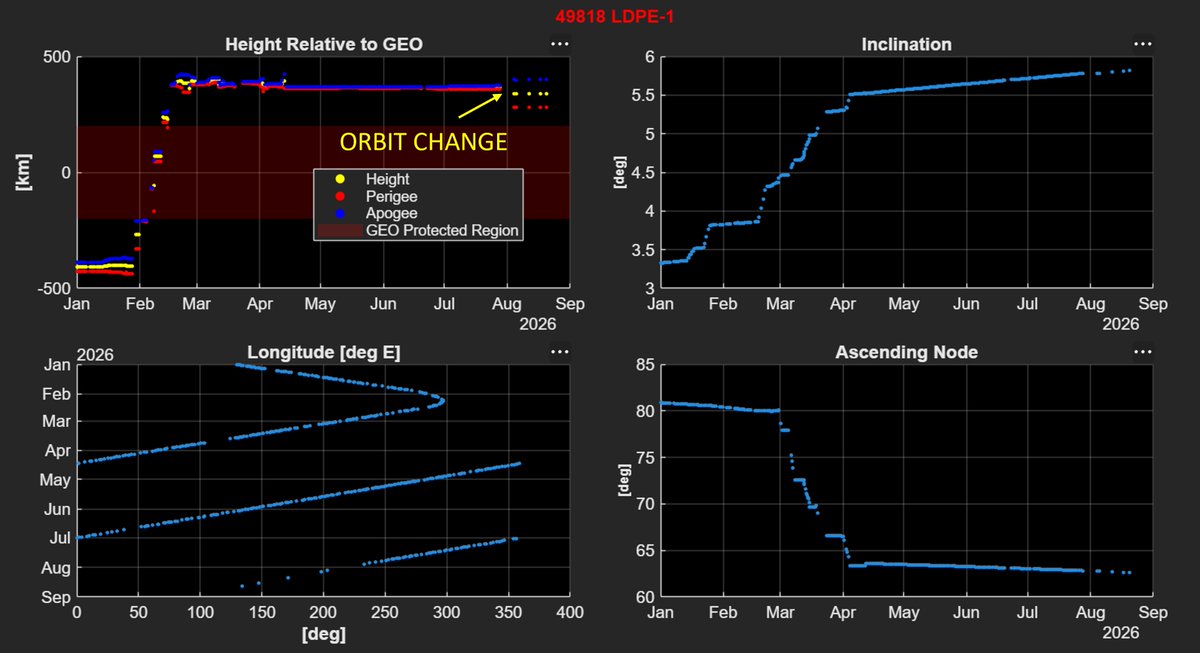
The Long Duration Propulsive ESPA-1 (LDPE-1) appears to have experienced a debris event on 27 July 2026 at 12:50 UTC (+/- 30 min). This is satellite 49818 in the @SpaceTrackOrg catalog (Int Des 2021-118B).
Two public sources of data corroborate the event:
1️⃣ orbital position information from @S4S_SDA via https://t.co/m3OEycBT6w (see graphic below) and
2️⃣ seven new objects appeared in the Vimpel catalog which associate back to LDPE-1 at a time concurrent with the orbit change--to within a ~ 1 hr window 2 sigma'ish
Thankfully LDPE-1 was operating in a supersynchronous orbit ~365 km above GEO altitude, or clear of the GEO Protected Region at the time of the event, and fully remains clear of the GEO Protected Region. The last noted meaningful maneuver was in April 2026, but predominant sources indicate the satellite was still active.
Unfortunately, some of the debris generated now encroaches into the GEO Protected Region.
LDPE-1 is a Northrop Grumman "ESPAStar" payload. There are several ESPAStar payloads active in GEO today with more missions planned. Hopefully the systemic root cause of the debris event is not something that could be repeated in the other platforms.
#SpaceDebris #LongTermSustainmentOfSpace #SpaceDomainAwareness #SpaceDomainNormsOfBehavior
Orbit data from @S4S_SDA via https://t.co/m3OEycBT6w, used with permission per ODR 24-002-4.
On related matters, I was surprised to learn that China is not a signatory to the Hague Code of Conduct? In short, launch NOTAMs are optional for China is my short take. I'm interested in learning more about comparable bilateral/multilateral agreements China may have if others could weight in....
Debris associated with Russian upper stage from Feb 2026 GEO launch cataloged.
On 12 Feb 2026, a Russian GEO launch placed Elektro-L No.5 (67756 / 2026-028A) and the first Iranian GEO satellite, "Jam-e Jam 1" (67757 / 2026-028B).
@mickeywzx caught the GEO insertion and subsequent Block DM-03 rocket body (67758 / 2026-028C) passivation with an amazing EO collect video, cropped portion below. (Original video here https://t.co/XJgugKhNe1)
The passivation appeared to result in numerous additional objects. It was unclear at the time if this was simply ice (frozen liquid oxygen effluent) from the depletion burn, or if persistent objects may actually be present.
In the video, Elektro-L No.5 and the Jam-e Jam 1 satellite are seen receding to the upper left relative to the upper stage (presumably the brighter object is Elektro-L No.5).
Well, it appears there were in fact some persistent objects. A piece of debris (100099 / 2026-028D) from the upper stage was cataloged by U.S. Space Forces – Space (S4S) on 20 July 2026. It is likely additional pieces accompanied this one, but they may not be held in track custody with sufficient fidelity to enter the catalog.
#SpaceDomainAwareness #SpaceDebris #LongTermSustainment
Correction!
By newly published TLE, these are Russian GSO mission on the same day, deployed weather sat Elektro-L No.5 with secondary payload Iran-DBS. The venting and debris are from Blok-DM-03 upper stage.
SUMMARY: US cataloged new debris object. Object determined to originate from PRC's operational geosynchronous satellite Gaofen 13 in early 2024. Russia has been tracking the debris object since close to the origination time. No apparent anomalies with Gaofen 13 - observables support continued routine operations. Debris object is relatively dim and has a high area/mass.
DETAILS:
Today @S4S_SDA cataloged a new piece of debris in geosynchronous orbit attributed to an object with international launch designator 2020-071. This was the launch of China's Gaofen 13 satellite (46610 / 2020-071A) - widely understood to be a GEO-based large aperture optical system providing persistent surveillance of the PACOM area of responsibility (AOR).
I determined the newly US-cataloged debris object (62337 / 2020-071C) has been in custody by Russia since near the time it originated from GAOFEN 13 (Vimpel catalog object 143589). Examining the historical Russian states, it's probable the object originated from GAOFEN 13 around 10-14 Jan 2024.
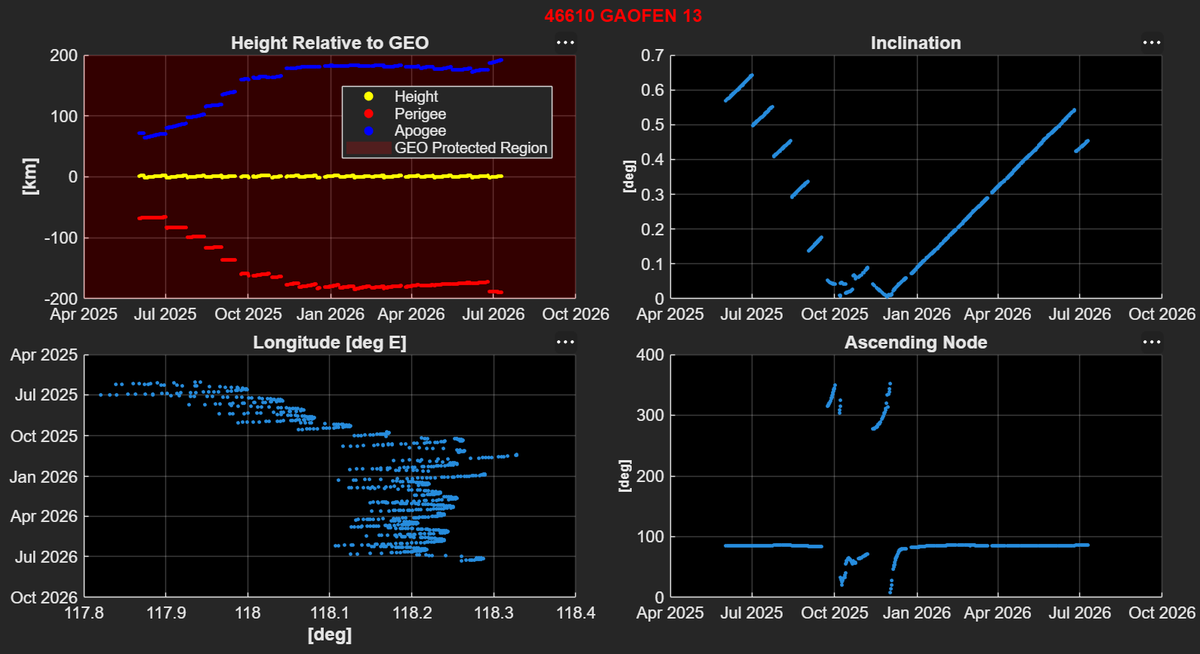
GAOFEN 13 is clearly still operational and is routinely performing both N-S and E-W (longitudinal) station-keeping maneuvers at 118 deg E (ref graphic).
OBJECT PROPERTIES
1️⃣ Optical Signature: The object is relatively dim having a normalized visual magnitude of ~16.6 Mv, or equivalent to an approximately 0.5 m diameter sphere (assuming a 0.2 albedo).
2️⃣ Area to Mass: The object has a very high area to mass of ~ 2.8 m^2/kg, thus subject to significant solar radiation pressure perturbations. These perturbations produce an annual eccentricity cycle which will oscillate from 0 to ~0.09 (it is near a peak now).
3️⃣ Mass: this is a crude estimate, but given the optical signature and area / mass, I estimate the object to be ~0.01 kg (10 grams).
This appears to be a low-energy "shedding" event with likely few additional objects. The debris object will be challenging to maintain due to the high solar radiation pressure and dim optical signature.
#SpaceDebris #SpaceDomainAwareness
Orbit data from @S4S_SDA via @SpaceTrackOrg, used with permission per ODR 24-002-4.
H/T @planet4589