Google is turning Android into a walled garden. Mandatory ID, registration fees, and a 9-step 'advanced flow' for sideloading? That's not security, it's a monopoly move.
Sign the petition:
https://t.co/WWlgcjOP1L
Know more:
https://t.co/jRinZZtjIC @AlteredDeal#KeepAndroidOpen
Allahabad Child Development Centre and the CBCS, University of Allahabad have organized an Open House dedicated to Autism Awareness & Inclusive Education.
Learn about #Neurodiversity through our interactive session.
📅 25th April 2026
🕘 9:00 AM
📍CBCS, Senate Hall Campus, UoA
Neither 'Clarificatory' Nor 'Procedural' – Proposed Amendments to IT Rules Are Dangerous Expansion of Executive Power
@indumugic, Jhanvi Anam ✍️ | @internetfreedom
https://t.co/FKsLa2ncYk
After MeitY’s 30 March notification on the new IT Rules, the Ministry has now extended the consultation deadline from 14 April to 29 April.
This shift would not have been possible without over 2,500 concerned citizens who sent their comments.
This is not the end. Keep sending your submissions.
Important: So NO BAIL to Umar Khaled says SC.. NO personal liberty under UAPA: this despite the fact that even the trial has not begun after more than 5 years. Meanwhile, rape and murder convict Ram Rahim has been given parole once again. Prior to his latest parole, VVIP convict Rahim has come out of prison 14 times since being convicted in 2017. Yeh hai India ka criminal justice system!😡
IFF's Statement on the Sanchar Saathi App Pre-Installation Directive
The Department of Telecommunications (DoT), specifically its AI & Digital Intelligence Unit (AI & DIU) on 21st November, 2024 has under the Telecommunications (Telecom Cyber Security) Rules, 2024 issued a sweeping Direction mandating the pre-installation of the Sanchar Saathi mobile application on all mobile handsets manufactured or imported for use in India. As a preliminary matter the DoT has yet to by itself disclose the full text of the direction. Initial reports by Reuters revealed it's existence and subsequently it's full text was disclosed by Medianama which form the basis of our statement, which will be followed up by RTI, analysis as well as steps, if required to support a challenge to it in a court of law.
The direction by requiring manufacturers and importers of mobile handsets to pre-install the Sanchar Saathi App represents a sharp and deeply worrying expansion of executive control over personal digital devices. The stated objective of curbing IMEI fraud and improving telecom security is, on its face, a legitimate state aim. But the means chosen are disproportionate, legally fragile, and structurally hostile to user privacy and autonomy. Clause 7(b) is the clearest expression of this. It requires that the pre-installed Sanchar Saathi application be “readily visible” and that, “its functionalities are not disabled or restricted.” In plain terms, this converts every smartphone sold in India into a vessel for state mandated software that the user cannot meaningfully refuse, control, or remove. For this to work in practice, the app will almost certainly need system level or root level access, similar to carrier or OEM system apps, so that it cannot be disabled. That design choice erodes the protections that normally prevent one app from peering into the data of others, and turns Sanchar Saathi into a permanent, non-consensual point of access sitting inside the operating system of every Indian smartphone user.
Viewed through the lens of the Supreme Court’s judgment in K.S. Puttaswamy (2017) that reaffirmed the fundamental right to privacy, this structure cannot pass the proportionality test. K.S. Puttaswamy requires that any intrusion into the right to privacy must meet the standards of legality, necessity, and proportionality. Even if we assume legality and necessity for the limited purpose of checking the genuineness of devices, the order clearly stumbles on proportionality. The government’s own ecosystem already offers less intrusive means to verify IMEI numbers and detect fake handsets such as the Sanchar Saathi web portal, SMS-based KYM (Know Your Mobile) services, and USSD codes all allow a user to perform this task without a permanent app baked into the firmware. There is no technical explanation in the order for why a one-time or occasional verification exercise justifies a resident, non-removable application with elevated privileges that lives on the phone for the lifetime of the device. Forcing a permanent app installation for a sporadic verification function is not a marginal overreach; it is a textbook example of disproportionate state action under the Puttaswamy standard.
The problems deepen when we look at the scope and safeguards. The order invokes “telecom cyber security” as a catch all justification, but it does not define the functional perimeter of the app. Clause 5 of the Directions refers to identifying acts that “endanger telecom cyber security,” an expression so vague that it invites function creep as a design feature, not a bug. Today, the app may be framed as a benign IMEI checker. Tomorrow, through a server side update, it could be repurposed for client side scanning for “banned” applications, flag VPN usage, correlate SIM activity, or trawl SMS logs in the name of fraud detection. Nothing in the order constrains these possibilities. In effect, the state is asking every smartphone user in India to accept an open ended, updatable surveillance capability on their primary personal device, and to do so without the basic guardrails that a constitutional democracy should insist on as a matter of course. IFF is deeply concerned with this direction that sets up a precedent to enforce client side scanning on all smartphones in India and calls for its recall.
As a first step we have filed a RTI with the Department of Telecom not only for a copy of this direction/order but also the underlying justification on how and why it was issued. We will fight this direction till it is rescinded.
Your prompt engineering approach is probably wasting time with too many examples.
But ONE example is often all it takes.
This is One-Shot Prompting, and it's the most underrated technique in modern AI workflows.
Here's how to master it in 5 minutes 🧵:
In Chhattisgarh's Hasdeo, 5000 acres of dense forest are being destroyed by Adani. This is not just deforestation — it's the erasure of Adivasi land, wildlife habitat, and a climate lifeline. Yet, the government and media remain silent. #SaveHasdeo
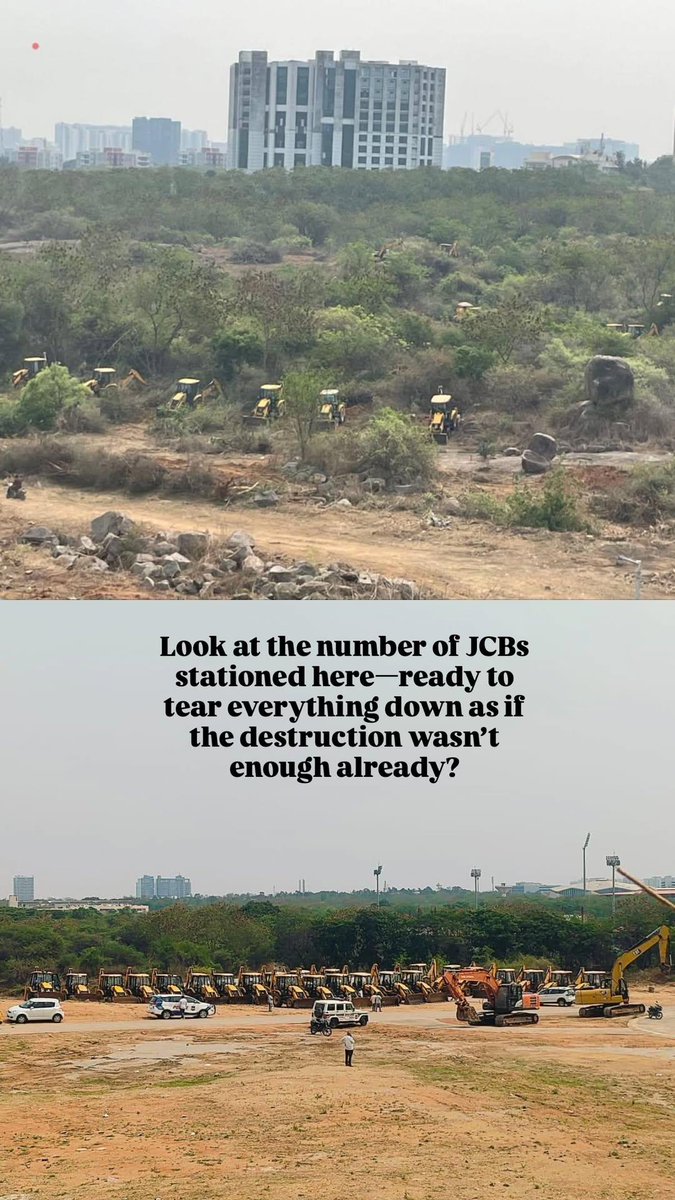
Meanwhile in Hyderabad! Government sent dozens of bulldozer to clear University of Hyderabad reserve forest area of 400 acres. Stop this nonsense immediately @TelanganaCMO@revanth_anumula.
I stand with the students and people of Hyderabad. 🙏
@rishibagree Hey @grok, so, this post about the government boosting India’s R&D, while the private sector lags behind global players. Does the govt really care about education and science? Keep it clear
@reliancejio@JioCare, a relative paid for a Jio AirFiber connection on Feb 1, it turned out to be unfeasible. Since then, no response, no refund, and calls to support just say "under processing." The so-called "engineer" who visited is also unreachable. This is unacceptable!
@JioCare Oh wow, reopened? So what was happening all this time closed without resolution? How many times will you "reopen" the same issue without actually fixing it?
@JioCare Spare me the scripted responses, @JioCare. Give me a real update. Who is handling it? When will it be done? No more fake deadlines.
@TRAI@DoT_India@jagograhakjago@thecroindia this is the 33rd day of Jio taking money & giving nothing in return. How is this acceptable?
@JioCare@DoT_India , @TRAI , @jagograhakjago , are you aware of these deceptive practices? How is such blatant disregard for consumers allowed to continue? (3/5)
@JioCare Is this your standard operating procedure—to string customers along indefinitely? How many others are trapped in this loop of false assurances? (2/5)