GIVEAWAY TIME! 🎉
To mark #Bitcoin's 17th Birthday, we're doing a #giveaway!
Here’s how to participate:
🔸 Follow us @wirexapp
🔸 Like & RT this post
🔸 Reply with 'HAPPY 17TH BIRTHDAY $BTC' in the comments
1 winner will win $100 in $BTC. Go!
GIVEAWAY TIME! 🎉
It’s $USDC Birthday, and to mark this day, we're doing a #giveaway!
Here’s how to participate:
- Follow us @wirexapp
- Like & RT this post
- Reply with 'HAPPY BIRTHDAY $USDC' in the comments
1 winner will win $100 in $USDC. Go!
Just got my @CoinfestAsia ticket! The largest Web3 festival in Asia where innovation meets adoption! ☀️🏖 Who else is coming to Bali on 22-23 August? 👀 #JoiningCoinfest2024
The answer to this question posed by @HHorsley and @Matt_Hougan (who are crushing it at Bitwise) is likely to be when price breaks new ATH followed by acceleration above +$100k.
It's much easier to see why by comparing across previous cycles the % of coins that haven't moved in +1yr vs. $BTC price. See chart below.
Historically, LT holders wait until a new ATH in price before realizing profit and selling en masse. That creates the inverse relationship visible on the chart in bull markets between +1yr HODL (orange line) and $BTC price (black line) as those LT holders sell their coins to newcomers.
This time could be different, but in terms of this specific behavior...it's probably not.
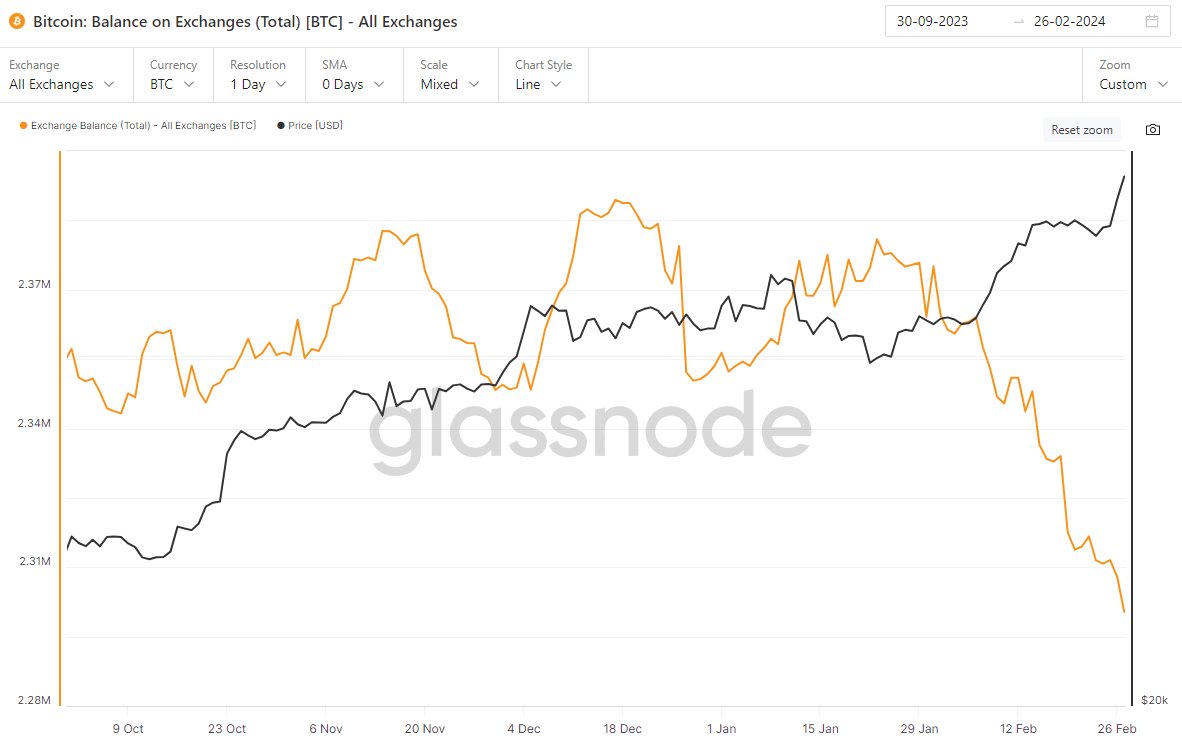
The black line is BTC's price (right scale)
The orange line is the number of BTC coins on all centralized exchanges. (left scale)
Note the trend since January 11 (the start of Spot BTC trading). Straight down as the ETFs suck up the available supply of BTC.
All centralized exchanges currently hold 2.3 million BTCs, a 5 1/2 year low.