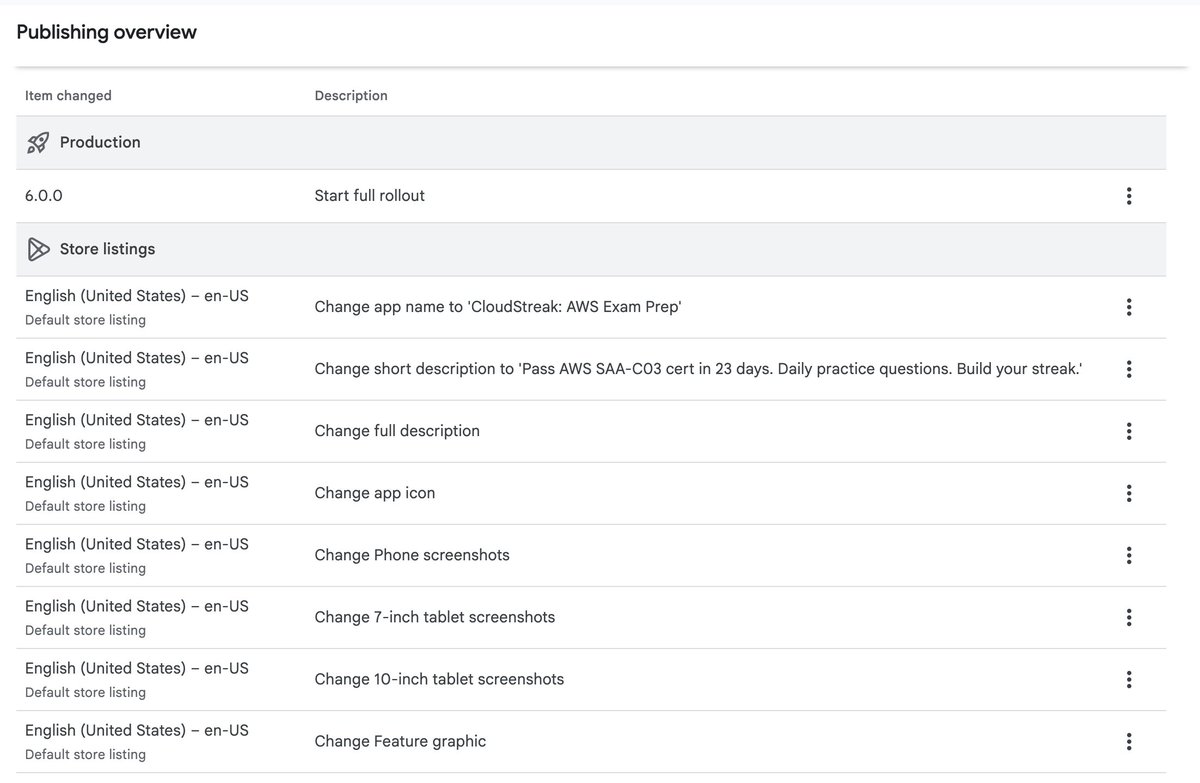
I just submitted a complete rebrand to Google Play.
PrepPal → CloudStreak
General practice → AWS-only
Scattered positioning → Laser focus
After a few weeks of validation, I'm betting everything on one certification done extremely well.
New name. New logo. New product description. New... everything.
This either works or I start over. No middle ground.
A lot of people get stuck in AWS because they study services one by one instead of studying decision-making.
Not: “What does NACL do?”
Better: “When would I use NACL vs Security Group, and what failure am I preventing?”
Not: “What is IAM?”
Better: “Why did this request get denied, and which policy layer actually caused it?”
Cloud starts clicking when you switch from memorizing tools to tracing traffic, permissions, and tradeoffs.
This is the right way to prep. Most people study cloud interviews like trivia night, then get wrecked by one question that forces them to trace traffic through IAM, DNS, subnets, security groups, and a load balancer in one answer. Roadmap first. Then scenario drills. Then explain it out loud like you’re already in the interview.
we really speedran from “store my passwords safely” to “give the bot credentials and pray it develops judgment.”
The funny part is the product category is real now. Agents do need access control. But the blast radius of a dumb agent with perfect credentials is still a dumb agent with perfect credentials.
The scary part is not even the layoffs.
It’s that a lot of teams still measure “hours spent” like it’s the same thing as value created, so the minute AI compresses execution time, people look underutilized on paper even when output holds. Companies that treat that as a firing signal instead of a redesign signal are going to optimize themselves into a trust collapse.
This is the ugly externality nobody wanted to talk about.
Open source worked because contribution had social status, practical value, and a sense that you were building public infrastructure together.
If enough developers start feeling like they’re just donating training data for companies to commoditize them faster, that incentive structure cracks.
The loss is not “fewer repos.” The loss is fewer people willing to do the unglamorous maintenance work that real software depends on.
@wallstengine This is what happens when buyers stop paying for “best model” and start paying for “least babysitting.”
The winner in enterprise is usually the one that gets adopted without needing a prompt engineer on payroll.
The weird part is people talk about MCP and CLIs like one has to kill the other.
A good CLI is still the fastest path for precise work.
A good protocol matters when multiple tools need to share context cleanly.
The real mistake is pretending interface preference is architecture.
IAM is the one that tricks almost everyone because AWS explains the parts before it explains the mental model. User = permanent identity. Role = temporary identity. Policy = rules. The real unlock is realizing most human access should end up role-based, not long-lived user creds. That shift makes half of IAM click.
people fail AWS exams for the same reason teams fail cloud migrations:
they memorize service names instead of learning tradeoffs.
when to use NAT vs IGW.
why NACLs feel different from security groups.
what actually changes when scale, blast radius, or cost enters the picture.
the exam is just exposing the gap.
@GoogleCloudTech this is the missing piece a lot of people still gloss over. tools make agents possible, but patterns are what keep them from turning into spaghetti with API keys.
@TheArnabSaha@codersGyan Good luck man!
showing up on a day like this is real progress. also, SAP prep gets a lot easier once you stop trying to memorize every service and start asking “what breaks at org scale?” that lens usually unlocks the exam.
@CyberRacheal it’s the metadata. encryption hides the payload, not the timing, packet sizes, burst patterns, and destination patterns around it. if the traffic fingerprint matches “4k netflix stream,” they can make a pretty good guess without ever seeing the movie itself.
@heynavtoor This is the part people underestimate. Prompt packs scale attention, but trust still comes from taste and consistency. The prompts help you move faster. They do not replace having an actual point of view.
@svpino This is good UX instinct. Hiding noise is helpful until it hides intent. The best tools reduce clutter without removing the user’s ability to inspect what is actually happening.
@wallstengine This is a useful reminder that autonomy is becoming an infrastructure market, not just a software category. Once the stack gets good enough, the value shifts from the demo to who can operate it reliably in the real world.
@bindureddy This is the part most companies are underestimating. Faster code generation does not automatically mean better software economics. If the output becomes harder to maintain, every future change gets more expensive than the speed boost was worth.