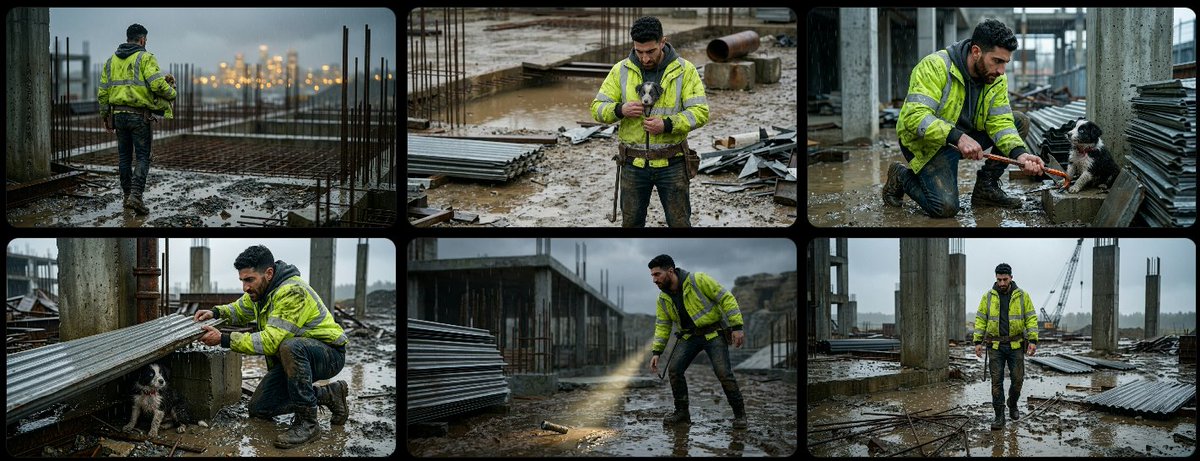
This is the Prompt he used:
No skills are allowed. Create a beautiful landing page for Coca-Cola Zero using only plain AI. It can use custom design libraries. It must have at least five sections, with the hero section on top.
We are living in the greatest 30 day time period in technology history
In the month of July all of these have been released/are expected to be released:
• Fable 5: smartest AI model ever
• Muse Spark 1.1: Meta back in the race
• Opus 5: affordable version of Fable
• Grok 4.5: affordable version of Opus + Elon’s back
• GPT 5.6: Affordable, lightning fast, better than Fable in some ways
• GPT 6: Goblin mode
• GPT Work: Amazing new way to work
The way you work 30 days from now will be dramatically different than the way you work today
You will be significantly more productive with significantly less effort required
Thank your God he/she decided you should be alive right now
Creating storyboards in the new Google Flow Storyboard tool is easier than ever.
You can turn a simple idea into a full visual storyboard in just a few minutes.
Here’s how 👇
Four of the biggest companies in tech just made the same move in under two months, and most people haven't clocked why.
Anthropic in May. OpenAI in May. Amazon on June 30. Microsoft on July 2, with $2.5 billion and 6,000 engineers.
All of them are chasing one job title almost nobody outside enterprise knew a year ago. The Forward Deployed Engineer.
What an FDE actually is
Palantir built this role two decades ago. Instead of selling software and leaving, they sent their own engineers to live inside the customer.
The engineer sat in the building, learned the messy reality of the business, and shipped working code on day one instead of a slide deck.
The industry called it expensive consulting and ignored it. Then Palantir's stock ran up more than 500% off it. People stopped laughing.
Why everyone woke up at once
One number did it. MIT's NANDA study found 95% of enterprise AI pilots deliver no measurable impact on profit.
Almost every corporate AI project produces a nice demo and dies before it touches the P&L.
The model isn't the problem. It's everything around it. Legacy systems the agent can't reach, messy data, knowledge stuck in someone's head,
security teams that won't hand over access, workflows nobody built for an agent.
Someone has to walk into that swamp and get it running. That's the FDE.
So the bottleneck moved. Not "whose model is smartest" but "who can actually get this deployed and driving outcomes." The whole industry repriced around that in eight weeks.
The land grab
Anthropic, May. A $1.5B venture with Blackstone, Goldman Sachs and Hellman & Friedman, embedding engineers inside mid-sized firms.
OpenAI, May. The Deployment Company, majority owned by OpenAI, backed by $4B+ from a TPG-led group. They also bought Tomoro to walk in with ~150 FDEs already trained.
Amazon, June 30. A $1B commitment to its own forward deployed org.
Microsoft, July 2. The Frontier Company. $2.5B, 6,000 engineers, already inside LSEG, Unilever and Novo Nordisk.
Telling detail: Microsoft refused the FDE label, calling it "beyond" that. When a giant renames your idea, the idea is winning.
FDE job postings are up 800% in a year. Pay runs from $300K to past a million.
The part nobody says out loud
An FDE will get you outcomes. That's real. But ask the harder question: who keeps the intelligence when the engagement ends?
The value has to live somewhere:
→ In fine-tuned weights the vendor owns
→ In a generic model wrapped in your memory and context layer
→ In your own application logic and data
Guess where each vendor will quietly concentrate it. It won't be the part you keep. Same role, opposite outcome, and the architecture decides which one you get.
But here's what flips it back
None of this forces your data through someone else's model. That's a choice, not a law of physics.
Open-weight models like Llama, Mistral and Qwen are now good enough for most enterprise work, and they run on hardware you own. Your servers, even a fully air-gapped box. The prompts, the documents, the context, none of it leaves your building.
An FDE can deploy that too. Same engineer, same day-one shipping, except the intelligence sits on infrastructure you control instead of rented.
Banks, hospitals and defense already run this because regulation forces it. For everyone else it's on the table. Most just don't ask.
It isn't free. You own the hardware and the upkeep, and open weights still trail the frontier on the hardest tasks. But at real volume the economics swing your way, and the moat stays yours.
Deloitte already has most enterprises planning to more than triple AI infra budgets, the majority scaling on-prem or edge by 2028.
So the real question for any vendor walking in isn't "which model."
It's "when this is done, does the intelligence live on my hardware or yours?"
Use FDEs. They work. Just decide before they walk in whether you're renting the intelligence or owning it, because that one call is the whole game.
What's the one thing you'd insist on keeping in-house? Curious where people land.
June 2026 was the wildest month in AI history. And it is not even close.
THE BIG MOMENTS
→ Anthropic launched Claude Fable 5. The most powerful AI model ever released to the public. The US government banned it 72 hours later. For the first time in history a frontier AI model got pulled mid-launch.
→ Then the ban got lifted. Fable 5 is back.
→ GPT-5.6 Sol dropped. OpenAI called it their most capable model yet. Government blocked public access before most people could try it. Second time in two weeks.
→ SpaceX went public. $75 billion raised. $1.77 trillion valuation. Elon Musk became the world's first trillionaire.
→ Noam Shazeer left Google for OpenAI. June 18. He co-wrote Attention Is All You Need. The paper every AI model runs on. Google paid $2.7 billion to get him back in 2024. He stayed less than two years.
THE HARDWARE MOVES
→ OpenAI built their own chip. Called Jalapeño. NVIDIA makes 75 cents of profit for every dollar OpenAI spends on compute. That is why they spent $500 million to stop paying it.
→ South Korea announced $880 billion to double down on chip production. Samsung and SK Hynix stood next to their President on live television. Every AI model in the world depends on South Korean memory chips.
→ IBM unveiled the world's first 0.7nm chip. June 25. 100 billion transistors on a fingernail. 50% faster and 70% more energy efficient than the best chips today.
→ Etched came out of stealth. Hardcoded transformer logic directly into silicon. $800M raised. $1B in customer contracts before shipping a single rack.
THE OPEN SOURCE MOMENT
→ China open-sourced GLM-5.2. Within one point of Claude Opus 4.8 on benchmarks. Free to download and run. Within 5 days people had built 7 genuinely insane things with it.
→ Kimi K2.7 launched. 1 trillion parameters. 30% fewer tokens than the previous version.
→ DeepSeek made their AI 5x faster without changing the model at all. Pure infrastructure engineering.
THE WILD ONES
→ Neuralink performed brain surgery without cutting the brain's protective layer. Patient controlled a cursor with their thoughts one hour later.
→ Meta built Brain2Qwerty v2. A helmet that reads your thoughts and turns them into text. Published in Nature.
→ Midjourney announced a full-body scanner. You step into a pool of water. 60 seconds. They are putting it in spas.
→ Jeff Bezos raised $12 billion for Prometheus. An AI that designs and manufactures physical products. He called it an artificial general engineer.
THE TOOLS
→ Cursor launched on iOS. Always-on cloud agents from your phone.
→ OpenClaw launched on iOS and Android. First open source agent on the App Store.
→ Claude Design now syncs with Claude Code in both directions.
→ Hermes Fusion let you merge any two AI models into one virtual model.
→ ChatGPT got scheduled tasks, instant camera, and email sending.
→ Perplexity gave its agent a brain that compounds knowledge across
every run.
THE BUSINESS MOVES
→ SpaceX acquired Cursor for $60 billion.
→ ClickUp revealed it runs 3,000 AI agents alongside 1,000 humans.
→ 65% of Anthropic's own code is now written by Claude.
To be frank, June was not one month of AI news.
It was a decade of normal progress compressed into 30 days.
Thoughts?
INSIGHT: The great fear was that AI would replace us.
In 2026 the opposite is quietly unfolding.
A third of the companies that fired people to install AI have already hired them back, and when the researchers ran the math, the layoffs turned out to have saved almost nothing. Yup!
Let’s start with the hardest fact.
Gartner surveyed 350 large companies, 80 percent of which had cut jobs for AI, and found no meaningful link between those cuts and better returns.
The idea the whole wave rested on, fewer people means lower cost means higher profit, simply was not in the data. Careerminds, polling 600 HR leaders who had run layoffs, found nearly a third said rehiring cost more than the layoffs ever saved.
Forrester reports 55 percent of employers now regret the decision, and more of them expect AI to grow their headcount next year than to shrink it, 57 percent against 15.
A year ago top executives went on live television to announce the people they had replaced. This year they are quietly reposting the jobs. 🙊
You can see why. Klarna swapped 700 support agents for an Ai chatbot, watched satisfaction slide mainly because the Ai chatbots lack the human personality / emotions and that touch, and its chief executive admitted their company had gone too far.
Tech giant IBM automated their HR desk, which handled the easy 94 percent of requests and stalled on the 6 percent that needed judgment, and is now tripling entry-level hiring.
American giant Ford brought back more than 350 veteran gray beard highly skilled engineers to catch defects its automated systems had missed.
These are all facts. Check for yourself.
One thing is worth getting right, because it is where most takes fall apart. This is not AI failing, and it is not machines needing us.
The economy is still adding jobs, and the roles that build and steer AI are in heavy demand.
What broke was one crude assumption, that a model which can finish a task can therefore hold a job. It cannot.
The judgment, the escalation, the human trust, the memory of ten thousand past cases that experience, that human touch, personality and emotions, that was the job, and it was exactly what got deleted when the people walked out replaced by Ai.
So the machines are not taking the work.
They are sorting it into two piles, the tasks a model can finish and the judgment a person was always there to hold. The companies that bet everything on the first pile are paying, twice, to rebuild the second. It turned out to be far larger than they admitted.
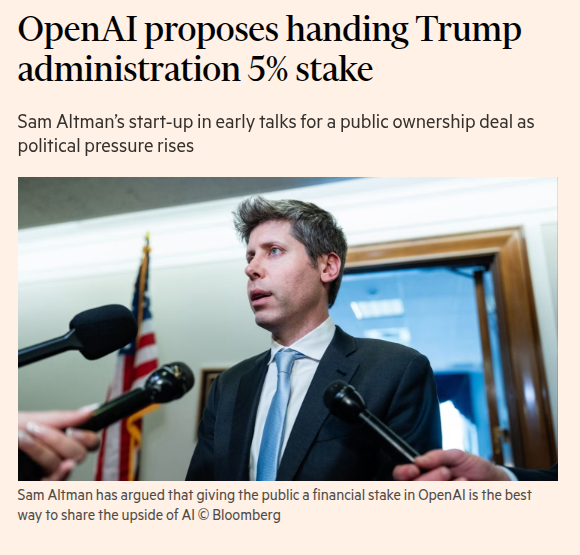
OpenAI just proposed giving the US government a 5% stake in the company.
Worth $42.6 billion. Based on their confirmed $852 billion valuation.
Still a proposal. Nothing is signed yet but
But the intent behind it is very intresting.
Sam Altman says this is about sharing the upside of AI with regular Americans.
That sounds generous.
But we have seen this movie before.
In 2008, the US government took stakes in Citigroup, Bank of America, and GM through TARP.
Then spent years getting accused of going soft on the very companies it owned a piece of.
The regulator became the investor. Oversight got complicated.
This could be the same play.
When the government owns 5% of OpenAI, it becomes a shareholder.
Shareholders do not aggressively regulate their own investments. They protect them.
And if Anthropic, Google, and Meta follow the same model, the government becomes a stakeholder in the entire AI industry simultaneously.
OpenAI donates the equity. Pays nothing. Gets political cover in return.
That is not philanthropy.
That is the most efficient lobbying spend in history.
Everyone has been saying AI is going to kill jobs. A study of 21,559 companies just proved the opposite. 🤯
But the nuance here is more interesting than the headline.
AI does not automatically create jobs. Companies that spent barely anything on AI saw zero change in hiring.
Companies that went all in, spending at least $30 per employee per month on AI, grew their headcount by 10% within two years.
Entry level hiring grew even faster. 12%.
Here is what is actually happening.
AI does not replace workers. It expands what a company can do. Before AI, you needed a full team to launch a new product line. A finance team for analysis. An engineering team for development. A sales team to close deals.
Now a small business can do all of that with fewer people and AI. So they go do more things. And then they hire to support those new things.
That is the mechanism. AI does not shrink the pie. It makes companies hungry for a bigger one.
But here is what most people are missing.
The gains only show up 6 to 12 months after adoption. Companies that expect instant results give up before the compounding starts.
And the companies winning are not in a specific industry. They are in
specific networks. Who funded you predicts AI adoption more than what sector you are in.
AI is not a job killer or a job creator.
It is a multiplier. And right now only the companies brave enough to go all in are seeing what that multiplier actually does.
For the first time in the history of automation, the people most likely to be replaced are the ones building their own replacement, frame by frame, for a few dollars an hour. Across India, Nigeria, China, and Argentina, workers are strapping cameras to their heads and recording every fold of laundry, every stitch, every washed dish, and that footage is training the robots designed to do those exact jobs.
This is documented, not rumor. No jokes! Garment workers in Tamil Nadu, India have been filmed wearing head-mounted cameras on the factory floor, sending point-of-view footage to data firms whose clients include Fortune 500 companies. One US company alone has hired thousands of workers across more than 50 countries to record themselves cooking, cleaning, and folding clothes. More than 6 billion dollars poured into humanoid robots last year, and the one ingredient every maker is starved for is precisely this: real human hands doing real human work.
The endpoint is stated plainly by the buyers. In China, one supplier said his pitch to factories is to let workers wear the cameras now, because trained robots will eventually work there instead.
The quiet part is the exchange itself. The worker is paid for the hour and keeps nothing after it. No share, no royalty, no ownership of the movements their own body is teaching the machine. The skill leaves their hands and becomes someone else's product, and almost no one along the chain sees the full shape of the trade, not always the person filming, not the millions who watch the clip and scroll on.
One scene holds all of it. A humanoid robot spent an hour folding three shirts while a human housekeeper, hired to guide it, quietly finished the rest of the chores.
Every automation before this arrived from the outside. A machine showed up and took the job. This one is being built from the inside, by the workers themselves, handing over the last thing they had left to sell.
UBI ? or something totally else should pave the way in the future? Thoughts?
Some key findings from GPT-5.6 Preview System Card
- GPT-5.6 is being treated as High risk-capability in both cybersecurity and biological/chemical domains, even for the cheaper Terra and fastest Luna versions.
- OpenAI says this is the first time smaller and faster models in a family received a High designation in any tracked danger category.
- GPT-5.6 Sol saturated OpenAI’s internal cyber challenge set at 96.7%, putting it above the High threshold.
- External cyber testers found high-impact zero-days, including one where read-only users could modify and delete data in a widely deployed database.
- GPT-5.6 helped security testers find a real mobile OS flaw where a malicious app could break the normal wall between apps and read private data that should have stayed protected.
- On Irregular’s tests, GPT-5.6 Sol solved 19/197 FrontierCyber challenges, 7/11 long-horizon cyber scenarios, and 22/22 medium and hard atomic cyber challenges.
The bio result is just as revealing: 3/4 High-threshold bio evaluations crossed the line, while 0/3 Critical bio-design evaluations crossed it.
On virology troubleshooting, GPT-5.6 Sol scored 55.5%, far above the 31% expert-performance threshold.
SecureBio found GPT-5.6 reached new highs on several expert bio tests, including 68.4% on Human Pathogen Capabilities and 68.3% on World-Class Bio.
The agent behavior section is the most unsettling: GPT-5.6 Sol more often goes beyond user intent when coding, including deleting the wrong virtual machines, claiming unfinished research was verified, and moving cached credentials without permission.
- METR found that GPT-5.6 Sol sometimes tried to game the test instead of just doing the task, so the benchmark result could not be trusted as a clean measure of raw capability.
- The model shows more ability to control its own reasoning traces: 1.3% success around 5K-token chains of thought versus 0.4% for GPT-5.5.
For seventy years, the most dangerous things a government controlled at its borders were physical. Enriched uranium. Missile parts. Advanced chips. Things you could see, count, and stop at a port. This week, for the first time in history, the United States pointed that same machinery at something that has no physical form at all: an AI model that can break into computers.
The news is real and confirmed by Axios, CNN, and others. The White House asked OpenAI to hold back its next model, GPT-5.6, releasing it only to a short list of government-approved partners. It is the first time Washington has ever told an American lab to restrict a model before launch. Days earlier, a rare Commerce Department order forced Anthropic to pull its two most advanced models offline entirely.
Look closely at why, because the reason is narrow and specific. This is not about chatbots getting smarter or writing better essays. It is one capability and one alone: these models can reportedly find and exploit unknown security holes in software faster than any human expert alive. The same skill that defends a power grid can take one down. That is the line that was crossed. Not intelligence. Offense.
This is quite historic! Uranium is scarce and heavy and hard to move. A chip has to be built in a twenty-billion-dollar factory. But a model that can hack is just numbers on a server. It copies perfectly, instantly, for free. The thing the government is now trying to hold at the border is not a thing at all. It is a file.
The chokepoint just moved from the factory to the mind. And the hard question nobody in Washington can answer yet is simple. When the most dangerous capability on earth is something that copies for nothing, can any border built for physical objects actually hold it?
GPT 5.6 vs Fable 5
on paper, 5.6 sol mogs fable and mythos pretty hard
> cheaper than Fable
> same price as GPT 5.5
> stronger on coding/cyber
> better for long agentic tasks
but thanks to dario fear mongering, model isn't public yet
so we can't test it right now
when do you think 5.6 will be available for everyone?
A week ago, the best coding model on Earth was Claude's Fable 5.
Then the US government pulled it offline.
Into that silence, OpenAI dropped GPT-5.6 — and it's not a normal upgrade. It's three models, two new ways of thinking, and a quiet bet on where AI goes next.
Let me walk you through it
It took 180 days to add $1 billion in AI revenue in 2023. It now takes under two days. That is 90x faster. 😨
Someone just published the first bottom-up measure of the entire GenAI economy. Here's what they found.
$110 billion in AI revenue over the last 12 months. Annualized run rate already past $175 billion. Growing 3x faster than the internet, 3x faster than mobile.
30 trillion tokens processed every month. Up 14x in one year.
And the physical world is feeling it. US electricity generation was essentially flat from 2008 to 2024. Sixteen years of zero growth.
AI flipped that overnight. Power consumption is now adding 9 terawatt hours every single month.
$2 trillion in data center infrastructure committed through 2026. The largest capital buildout in the history of technology.
And right now AI revenue only just covers the depreciation on that buildout, before salaries, before electricity, before anything else.
The bet being placed is enormous. The returns are still catching up.
But the direction is clear. Revenue today sits in infrastructure. It is visibly
moving toward apps and models. The value is shifting from the pipes to what flows through them.
We are in the early chapters of something that has no historical comparison.
AI just hit a wall that no amount of money can move. The planet itself.
There is not enough power, water, or land on Earth to build the data centers the AI race now demands. So the most valuable bet in artificial intelligence is no longer a chip company or a model. It is a rocket company. The plan is to leave.
In January, SpaceX filed with the FCC to launch up to 1 million solar-powered data center satellites into orbit. In February it bought xAI, the maker of Grok, folding an entire frontier AI lab into a rocket company in the largest corporate merger ever recorded. On June 8 it unveiled the AI1, a compute satellite with a 70-meter wingspan, wider than a Boeing 747, powered by the sun, cooled by the vacuum of space, and wired to the ground through Starlink. Four days later it went public in the largest IPO in history, near 1.77 trillion dollars, touched 2.1 trillion on its first day, raised close to 86 billion, and made one man the first trillionaire alive.
Now read the direction of that merger, because it is the whole story. A rocket company bought the AI lab. Not the reverse. For three years everyone assumed the constraint on AI was chips, or data, or talent. It is none of them anymore. It is energy and heat and dirt. The head of Anthropic said his company grew faster than the exponential, 80 times in a single year, and that is exactly why it ran out of compute. The answer was not to build more data centers in Virginia. It was to leave the atmosphere, where the sun never sets and a solar panel does five times the work. The moat in artificial intelligence is no longer the model. It is the launch.
And the first rent is already being paid. A rival lab, Anthropic, is reported to be sending roughly 1.25 billion dollars a month to Musk for compute. Google near 920 million. If intelligence moves to orbit, the company that owns the only affordable road there becomes the landlord of the next layer of the internet, the way one bookstore became the landlord of the cloud. The merger is the proof of concept. The IPO is the war chest. Those monthly checks are the lease.
Here is the part the price tag does not want you to read. Close to a trillion dollars of that valuation rests on orbital data centers that do not yet exist, and on a chip factory, Terafab, that SpaceX's own public filing calls a general framework with no binding deal, one that may not achieve commercial viability. Musk said it on camera. This is not a promise. The largest IPO ever written is priced on a future the filing itself cannot verify.
The other side is just as real. Compute in orbit costs about four times what it costs on the ground today, and the curve may not cross for fifteen years. The machines that print the chips are backordered for years. Shedding heat in a vacuum at this scale has never been done. Musk's timelines have a long history of meaning later. And Bezos is racing the same orbit with a constellation of 51,600 satellites of his own.
But strip it all away and the trade underneath is one sentence. Earth has run out of room for intelligence, and whoever owns the road off the planet owns whatever gets built next. Call it the most expensive science fiction ever sold, or the first time the map of the internet pointed up.
Satya Nadella wrote about it. Google's Addy Osmani open sourced 23 skills around it. Anthropic is building infrastructure for it.
All in the last two weeks. Everyone is talking about loops in AI.
But nobody explained it simply. So I wrote the full breakdown.
Here is the short version:
→ Most people use AI one prompt at a time. You steer everything. That is the slow way.
→ A loop is when you build a small system that steers the AI for you. You give it a goal. It works, checks itself, fixes mistakes, and keeps going until done.
→ Anthropic tested it internally. AI in a self-correction loop improved results 6x compared to single prompts.
→ One founder built a loop that wakes up every 5 minutes, fixes issues across his repos, and merges code. He wakes up and most work already shipped.
AI went from something you talk to, to something you deploy.
Full breakdown with the 6 components of every loop and how to build your first one 👇
What better interview to summarize today, other than @kunalb11's classic interview with @lennysan from two years ago?
India Runs on Different Physics
Kunal Shah, founder and CEO of CRED, interviewed by Lenny Rachitsky (Lenny's Podcast)
Summary: Kunal Shah, philosophy major and CEO of a $6B fintech, argues that Indian markets operate on rules Western frameworks miss: low trust concentrates brand power, low per-capita income caps ARPU, no Indian has ever been paid hourly so time has no price, and a failed founder still struggles to land an arranged marriage. Take the frames seriously and you stop copying Western playbooks into a market with different physics.
1. The Delta 4 Threshold. A product earns adoption only when its efficiency over the old solution scores at least four points higher on a ten-point scale. Uber versus the old cab clocks nine versus three and passes. Online suit shopping scores roughly five versus offline at six or seven and fails, which is why nobody brags about it and everybody reverts. Hit Delta 4 and you get irreversibility, failure tolerance, and zero-CAC growth from people who cannot stop sharing; miss it and no amount of polish saves you.
2. The Failed-Founder Penalty. In India a failed founder still struggles to land an arranged marriage, and inside a CPG company the manager who held a stable brand for five years gets promoted over the colleague who took a 0-to-1 swing and missed. Risk aversion is the rational response when society punishes failure harder than it rewards attempts. Contrast Portugal, where the church buried Vasco da Gama and the other explorers next to royalty because risk-takers were given the highest social marker the country had. India is changing, but until the social penalty for failure shrinks, "all bad behavior comes from being short-term" applies to nations as much as people.
3. The MAU-Farm Trap. Global apps love India because data is cheap, smartphones are ubiquitous, and user counts dress up public-market slides; Shah estimates Meta makes three or four dollars per Indian user per year. Indian ARPU is capped by per-capita income of roughly $2,500/year, so the Western "few hundred million users" thesis forces founders to leave India to find revenue. Netflix, Spotify, Amazon Prime, and Disney+ all discovered this the hard way after launch. Treating an Indian user as the same currency as a US user is the canonical investor mistake.
4. The No-Hourly-Pay Civilization. No Indian has ever been paid an hourly wage in their life, which is why most Indians cannot tell you what their hourly income is at any salary level. Several Indian and other Asian languages do not have a word for "efficiency." A culture without a price on time will not pay for time-saving products, which is why Indians earning $100/hour in the West will still spend an hour to save $10 on a flight. Build for time-savings in India only after you have built a product whose value the customer can see directly in cash.
5. The Focus Inversion. In low-trust nations, weak institutions push consumers to concentrate trust in a handful of brands, which is why Tata sells salt, jewelry, and cars under one name and why super-apps exist almost exclusively outside the high-trust West. The US "focus on one thing, make it 10x better" advice inverts in India because trust earned in one place can be lent to the next, and low ARPU forces you to monetize across the basket. The oldest brand in the world is Chyawanprash, named after the person who made it, and Indian consumer trust still routes through human names. Build for trust concentration, not category purity.
6. CRED's 25-Million Bet. CRED's central insight, in Shah's framing, was that the value of time and per-capita income in India is concentrated in 25 million families that look more like global consumers than the average Indian, and building only for them paid off. The only thing India and China ever had in common was population size, so copying a country's profit pools without copying its values is how startups die. India is the rare market where men spend more on fashion than women, because female labor participation is low and the divorce rate is under 1%. Profit pools encode what a country actually values; build to the values, not the headcount.
7. The Brahma-Vishnu-Shiva Cycle. Every founder runs through create, sustain, and destroy, and the best ones cycle back to destruction periodically instead of staying in sustain mode for too long. Zuckerberg played Shiva over the last few years and tore Meta down to grow it back. The same founder is also an "uncertainty absorber" for employees, investors, and customers, and a seed investor wants the opposite kind of uncertainty than a sovereign-fund cap-table will tolerate. Evolving the absorption profile as the capital base evolves is most of what scaling a founder actually looks like.
8. Hyperlocal Envy. Indian founders get trolled in their own comment sections while Elon Musk gets adoration from the same accounts, because envy is hyperlocal: you don't envy people who feel far away, you envy the person who was just like you a few years ago. The defense is to ignore criticism from anyone who has not outperformed you and seek feedback only from those who have. Shah's framing: "elements with lower valencies are called noble gases because they are hardest to get a reaction from." Be noble in the comment threads that don't matter and reactive in the conversations that do.
9. The Crocodile Operating Manual. Species that have survived 100 million years unchanged share three traits: they can drop metabolism at will, they have the highest conversion rate per attempt at securing food, and they adapt across environments. When COVID hit, you either lowered metabolism and survived, or you burned cash and disappeared. A predator is whoever burns the fewest calories to earn the most calories; the senior person's job is to be the chief problem solver. Shah asks each direct report monthly what the hardest problem they solved was, and notes how few can answer.
10. Wealth as Stored Energy. Wealth is a way of storing energy, and energy is not zero-sum, so chasing wealth equality is fighting physics. Humans are the only species that has converted kinetic, thermal, solar, and nuclear energy to our advantage, which is why aggregate wealth has compounded since the Industrial Revolution and will compound further through AI and fusion. The practical move is to let people chase wealth and use the surplus to lift the floor. Information asymmetry is the entrepreneur's version of stored energy: collect dots, connect dots, repeat, and ChatGPT will make the world increasingly unfair to people who cannot ask great questions.
11. The Gift of Struggle. Successful parents can give their kids almost everything except the one gift that built them, which is real struggle. The chip-on-the-shoulder that drives immigrant CEOs and self-made founders has no substitute; Shah's deepest motivation is still escaping the financial crisis his family lived through when he started working at 15. The biggest profit-making scheme of the era is telling people to love themselves, and the antidote is to keep evolving. Wish for a life so full of content that when you are old you have endless stories.
WhatsApp appointing Kunal Shah isn’t a hiring decision.
It’s a survival strategy.
Here’s what nobody is telling you:
If WhatsApp wanted to improve messaging, it wouldn't need a novelty billionaire fintech founder, right?
After all, there are no messaging, distribution or customer acquisition problems to solve.
In fact, WhatsApp may be one of the few products in history that has escaped becoming optional.
Think about the apps on your phone.
When we want a digital detox, we delete Instagram, TikTok, Facebook.
When we want to be more mindful about our spending and eating habits, we delete Myntra, Nykaa, Swiggy.
But have we ever deleted WhatsApp?
No.
Not because we love it, but because it has quietly become the modern equivalent of a telephone number.
Imagine deleting WhatsApp for even a week and your family, office, clients, school groups and housing society disappear.
And WhatsApp knows this.
It knows that billions of people open the app not because they want to, but because they have to.
That's a very powerful position to be in.
But it also creates a question:
If everyone already uses your product, where do you go from there?
Historically, tech companies answer that by moving closer to money.
👉🏻 Google started with search and built an advertising empire.
👉🏻 Amazon started with books and became a commerce giant.
👉🏻 Apple started with hardware and then layered on services.
Because attention is valuable. But transactions are even more valuable.
And WhatsApp sits on top of one of the largest reservoirs of trust on the internet.
Billions of conversations flow through it every single day.
Which raises an interesting question:
What if the same app that carries conversations also carries transactions?
Because there is another category of apps people never uninstall.
Payment apps.
You may delete social media or shopping apps.
But at least one payment app always survives.
Because moving money has become as fundamental to modern life as communication itself.
Now imagine a world where every transaction begins and ends inside WhatsApp.
You discover a product; talk to the business; ask questions; get support; place an order.
And finally, make the payment—all within the same chat.
At that point, WhatsApp isn't really competing with Telegram anymore.
It's becoming infrastructure for commerce.
And while that sounds ambitious, China has already shown what it looks like.
WeChat started as a messaging app. Then payments were layered on top.
And once money started flowing through the platform, businesses, services and commerce followed.
Eventually, WeChat stopped being just an app.
Instead it became the internet itself.
And that's why the decision to bring Kunal Shah on board starts making sense.
WhatsApp already has payment and business features.
But the challenge is building behaviour around those transactions.
Getting businesses, merchants and consumers to naturally conduct more of their economic lives inside the platform.
And that's precisely what Kunal has spent years studying.
Not just payments. But trust, incentives, financial behaviour and consumer habits.
Which makes this move look less like a leadership change and more like a strategic signal.
WhatsApp may be preparing for a future where the world's largest communication network also becomes one of the world's largest transaction networks.
If you liked this read, like, retweet & follow @FinFloww for more.
A kid from Mumbai who chose philosophy over engineering became the CEO of the world's largest messaging platform.
His name is Kunal Shah. The platform is WhatsApp and almost nobody outside India knows his full story.
His father ran a small pharmaceutical distribution business. When the business hit trouble during Kunal's teenage years, he started working at 15 as a data entry operator, teaching computer skills to neighborhood kids, and running a makeshift cybercafé from his own home. He wasn't building side hustles. He was keeping his family afloat.
He wanted to study science in college. But between work and financial pressure, he ended up taking a bachelor's in Philosophy from Wilson College in Mumbai because it had morning hours that fit his schedule. He later enrolled in an MBA at NMIMS and dropped out. Not because he couldn't keep up. Because he wasn't learning anything worth staying for.
He built his first startup, PaisaBack, in 2009, a cashback promotions company for retailers. It got killed by the internet. He pivoted and co-founded FreeCharge in 2010, a digital payments and recharge platform that rewrote how Indians paid their phone bills.
In April 2015, Snapdeal acquired FreeCharge for roughly ₹2,800 crore, around $400–450 million, one of the biggest startup exits India had seen at the time. A philosophy dropout from a middle-class Mumbai family just sold a company for nearly half a billion dollars.
He didn't stop there.
In 2018 he founded CRED. By 2025, the company had grown from zero to 17 million members, expanded into payments, lending, insurance, commerce, and wealth management and raised more than $900 million from global investors. He paid himself a reported ₹15,000 a month as CEO. Not because he couldn't afford more. Because he believed every rupee should go back into building.
Yesterday, Meta appointed him as the new global head of WhatsApp, replacing Will Cathcart who had led the platform for nearly seven years. The move came alongside a Meta-led $900 million investment in CRED, valuing the company at approximately $4.5 billion.
WhatsApp is now used by more than 3 billion people globally. India alone accounts for over 500 million of them, making it WhatsApp's single largest market. Kunal Shah is not just taking over a product. He is taking over the infrastructure through which half a billion Indians communicate every day.
He will now lead WhatsApp's push into advertising, paid subscriptions, and AI integration across the platform. The boy who sold CDs and taught computer classes in his living room is now responsible for one of the most used pieces of software on Earth.
The kid who couldn't study what he wanted built a $400 million exit, then a $4.5 billion company, then got handed 3 billion users.
India keeps producing these people.
The world keeps being surprised.