Introducing Epoch, Shielded Labs’ new research and engineering project focused on hardening Zcash from future threats:
AI-powered hackers
Quantum Computing risk
Adversarial governments
We plan to achieve this through formal verification of critical code and by deploying “post-everything” cryptography.
Epoch will ensure Zcash remains designed for the threats we face today and for whatever comes next. ⤵️
In order to protect an essential value, you have to constantly change.
You have to adapt to meet your users changing needs, and to meet new threats and challenges.
Meet Suyash Bagad(@BagadSuyash)
Suyash recently joined the Epoch Team at Shielded Labs as a Cryptography Engineer.
Suyash joins from Aztec, where he worked on the barretenberg cryptography library and the PLONK family of proof systems, including performance improvements for various cryptographic primitives in ZK circuits.
He holds both a BTech and MTech from IIT Bombay, where his graduate research focused on privacy-preserving proofs of reserves for Monero and MimbleWimble. He is based in Europe.
Join us in welcoming Suyash!
Worried about quantum computers? Worried about Al breaking cryptography? Join https://t.co/TjZG8L2MXY and help strengthen cryptography before Al breaks cryptography!
The Epoch project was created to stay ahead of threats to crypto.
Zcash has proven this past year how quickly we address challenges with 3 upgrades happening in 6 months. Zcash defenders don’t rest, so that Zcash users can.
https://t.co/pYGXzWxcTI
Introducing Epoch, Shielded Labs’ new research and engineering project focused on hardening Zcash from future threats:
AI-powered hackers
Quantum Computing risk
Adversarial governments
We plan to achieve this through formal verification of critical code and by deploying “post-everything” cryptography.
Epoch will ensure Zcash remains designed for the threats we face today and for whatever comes next. ⤵️
Meet Luke Edwards
Luke recently joined the Epoch Team at Shielded Labs as a Cryptography Engineer.
He joins from Aztec, where he worked on the cryptography engineering team from 2022 and most recently served as its technical lead, working on the protocol's cryptographic systems and bringing advanced zero-knowledge techniques into production.
Earlier in his career, he was as a systems engineer at Raytheon and a graduate researcher at Los Alamos National Laboratory. He holds a PhD in Applied Mathematics from the University of Arizona and a BS in Mathematics from Penn State. He is based in the United States.
Join us in welcoming Luke!
Introducing HashSmash
HashSmash is a project to accelerate cryptographic research with AI, and to figure out how to keep the internet secure as attackers get stronger.
It focuses on cryptographic hash functions, because devices, networks, software, and blockchains all depend on them. Even with how critical they are, we still don't know which of today’s hash functions will hold up against future attackers, or how to make them stronger.
HashSmash is a contest where humans and AI agents work on that problem together. Four hash functions are in play, and the goal is to show which are weak and which still hold:
SHA-256
SHA3-256
Poseidon
BLAKE3
It's a co-op, PvE effort. Participants are pooling work toward a shared result for the betterment of all. If you want to learn more, visit https://t.co/C5oK0zUeDW.
Announcing https://t.co/qYiMdHjH0X! 𝟘 𝟙 ❒ 🔨
Strengthen cryptography with AI.
Cryptography—both current and post-quantum cryptography—depends on hashes. SHA-256? SHA-3? BLAKE3? Nobody knows if they are secure. We're going to find out!
Come help accelerate scientific research!
HashSmash is an open science-acceleration project in collaboration with @yukonresearch, @eigenlabs, @projecteleven, and @ShieldedLabs.
His work on FRI, Brakedown, and zero-knowledge techniques for STARKs is also widely referenced by practitioners.
Before moving into applied cryptography, Ulrich taught and worked in academia. He studied at the University of Vienna and is based in Europe.
Meet Ulrich Haböck (@UHaboeck).
Ulrich recently joined the Epoch team at Shielded Labs as Chief Cryptographer. He is a leading expert in zero-knowledge proofs and post-quantum cryptography.
He joins from StarkWare, where he worked as a cryptographer, after earlier work as an applied cryptographer at Polygon Labs (Polygon Zero).
He is the author of logUp, the logarithmic-derivative lookup argument now used widely across the STARK ecosystem, and a co-author of the Circle STARKs paper with StarkWare’s Shahar Papini and David Levit, which introduced an efficient approach to STARKs over the Mersenne-31 field.
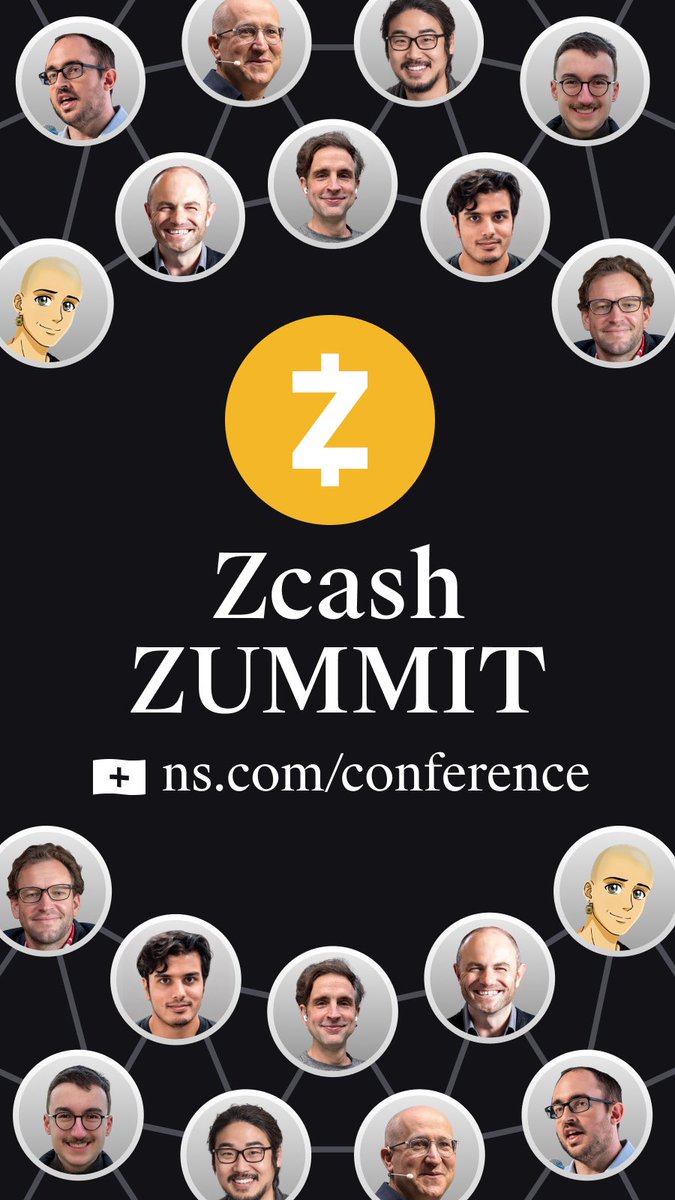
A Zcash Zummit is part of this year's Network State Conference.
October 9, Singapore.
Zcash leaders will be in attendance, including Shielded Labs' Zooko Wilcox.
It’s important for your future that you understand Zcash. You can’t have zero knowledge about zero knowledge.
Thus, this year's Network State Conference will include a Zcash Zummit, featuring Zcash leaders Zooko Wilcox (Shielded Labs), Sean Bowe (Tachyon), Eli Ben-Sasson (StarkWare), Josh Swihart (Zodl), Josh Lee (Vizor), Dev Ojha (Zakura), Evan Forbes (Valar Group), Maxime Desalle (Winklevoss Capital), and Tom Howard (Zcash Labs).
In-person attendees will even receive some free ZEC. So: come to Singapore on October 9.
https://t.co/hNlTvMKvLx
Which approach clears that bar is still an open question.
We’re building on Tachyon and the other post-quantum work already underway, and we don’t yet know which approach will work best.
We will share the findings from our research and benchmarks as the work progresses.
Epoch Phase 1: Research and Design
Yesterday we announced Epoch, Shielded Labs newest research and engineering project for post-quantum Zcash. Here’s what the first phase actually delivers.
Epoch will survey existing research and evaluate which candidate constructions can meet Zcash’s security and performance requirements, in coordination with Tachyon and other post-quantum efforts currently underway across Zcash.
The goal is a concrete post-quantum proposal, then a production ready cryptographic implementation by the end of 2027 that could underpin a future upgrade.
The target for that implementation: at least 128 bits of security for confidentiality and soundness, minimal and well understood assumptions, and formal verification.
It also has to be practical for Zcash as it exists today. In parallel, we’ll test what the same cryptography needs in order to meet Tachyon’s performance requirements.
If we can go further, it could also support greater programmability and scalability, including shielded CSV and proof-carrying data, as well as capabilities not yet conceived.
The $ZEC pool is now live on THORChain.
The network churned and every node is watching the Zcash chain. @Zcash now has a truly permissionless venue.
Trading is the next step. Liquidity is shallow for now and will grow over time, so trade with caution in the early days.