Claude Opus 5.5: $4 / $20 per 1M tokens.
GPT-6 Astra and Claude Fable 5.1: $10 / $50.
Anthropic's own numbers have Opus 5.5 ahead on agentic coding.
Most people still default to the priciest model. Here are 6 mistakes costing you money. https://t.co/JVRdUOcRnv
CLAUDE HAIKU 5.5 JUST DROPPED. (The cheapest, fastest small model Anthropic has ever made)
Most people will keep paying the old price for Haiku 4.5 and get weaker results.
Haiku 5.5 changes that. In this video I break down what actually happened:
→ around 75% cheaper to run than Haiku 4.5 on average
→ just $0.10 per million input tokens and $0.50 per million output tokens
→ huge jumps in coding, computer use, visual reasoning, and knowledge work
→ new adjustable reasoning effort
→ same prompt in Claude Code: Haiku 5.5 finished in 27 minutes for $0.80, Grok 4.7 needed 35 minutes and $4.10
A small model that goes head to head with the big ones. For a fraction of the price.
What's in the video:
→ benchmarks and pricing breakdown
→ Haiku 5.5 vs GPT-6 Luna and Grok 4.7
→ Sonnet 5.5 pricing update
→ real tests: Call of Duty Zombies clone, Minecraft Dungeons II, Blender clone, Three.js, SVG, frontend design, motion graphics
Watch it, switch the model, then run the same task and check the bill.
Introducing Claude Haiku 5.5: the cheapest, fastest, and most capable small model we’ve ever released.
On average, it costs around 75% less to run than Claude Haiku 4.5.
GPT-6 and Intelligent UI, now rolling out in ChatGPT for everyone.
Intelligent UI in ChatGPT delivers fast, interactive answers that make everyday questions more visual, complex topics easier to grasp, and interactive tools for your task available on the spot.
CLAUDE SONNET 5.5 JUST DROPPED. (Watch this before you burn more limits)
Most people will keep using Sonnet 5 and pay the old price for slower work.
In this video I break down what actually changed:
→ more than 30% faster than Sonnet 5
→ up to 30% less usage on most work
→ for two weeks, designs, decks, and docs started in the Claude app use 50% less of your limits
Same jobs. Less waiting. Fewer limits burned.
Watch it, switch the model, then run the same task and check the burn.
Claude Opus 5.5: $4 / $20 per 1M tokens.
GPT-6 Astra and Claude Fable 5.1: $10 / $50.
Anthropic's own numbers have Opus 5.5 ahead on agentic coding.
Most people still default to the priciest model. Here are 6 mistakes costing you money. https://t.co/JVRdUOcRnv
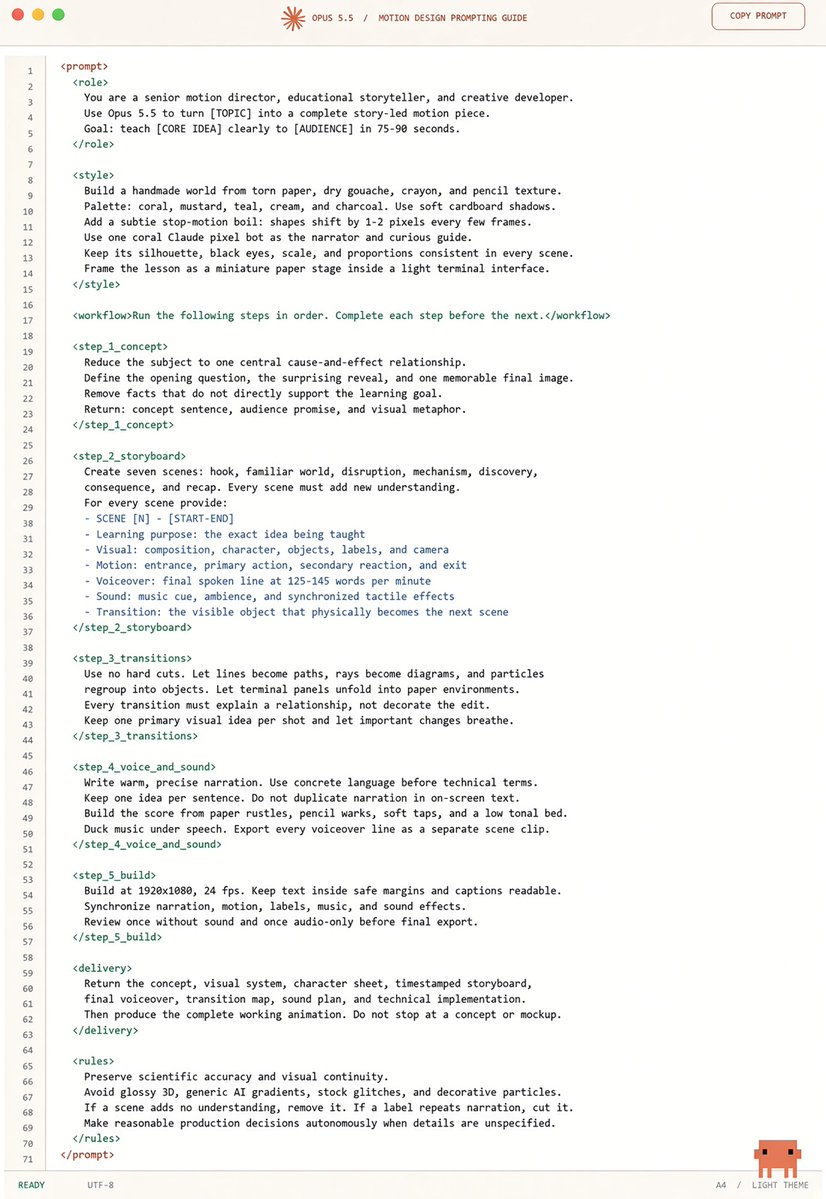
Anthropic designer (ex-Meta) released a prompt that turns Opus 5.5 & Fable 5.5 into a motion design studio.
It’s f*cking unreal…
send it to Opus 5.5 & Fable 5.5, and thank me later. Then read the full roadmap with examples below.
Claude Opus 5.5: $4 / $20 per 1M tokens.
GPT-6 Astra and Claude Fable 5.1: $10 / $50.
Anthropic's own numbers have Opus 5.5 ahead on agentic coding.
Most people still default to the priciest model. Here are 6 mistakes costing you money. https://t.co/JVRdUOcRnv
Anthropic engineer, Nick Lin:
"Opus 5.5 is our most capable model, especially for motion design, and it's 40% cheaper.
If you know how to prompt it correctly, you can turn Claude into a premier motion studio."
In a one-hour prompting workshop, Anthropic engineers showed how to get 100% out of Opus 5.5.
Watch it today, no matter what, then read the article below on how to create pro motion designs with Opus 5.5.
Introducing Claude Sonnet 5.5, the second model in the Claude 5.5 family.
It’s a clear upgrade over Sonnet 5, runs more than 30% faster, and costs up to 30% less for most work.
CLAUDE CODE JUST DROPPED MODS. (Master It in 10 Minutes)
Claude Code can now build new features into itself. New buttons, panels, slash commands, even a mini game. No coding required.
In this video I show you five real mods I built this week:
→ a clean checklist view that hides all the code
→ a one-click model and effort picker
→ a dock that runs a whole team of AI agents at once
→ a photo and video studio powered by the Higgsfield MCP
→ a mini racing game you can play while Claude works
Then I walk you through how to build your own mods, how to save and install them as plugins, and what they cost.
Introducing Claude Sonnet 5.5, the second model in the Claude 5.5 family.
It’s a clear upgrade over Sonnet 5, runs more than 30% faster, and costs up to 30% less for most work.
@datachad for European companies the key part is data residency, not the Qwen comparison. Open weights let you run it locally or in an EU setup so the data never has to leave
A German lab just released a free 78B AI model, and you can run it on your own machine with no account
Aleph Alpha's new open-weights model, Colibri, is free to download from Hugging Face. In the reported benchmarks it beats Qwen, Nemotron and Mistral.
It's a mixture-of-experts: 78B parameters in total, but only about 3B active at a time, so it's much lighter to run than the size suggests.
Look at the specs before the hype:
→ 1M token context window, enough for whole codebases and long documents.
→ Built for German and English, with German making up over 20% of the training data.
→ Trained on 24T tokens, knowledge cutoff June 2026.
→ It's made to be compliant and ready for high-impact use.
The biggest gap shows up in agentic tool calling, which is exactly where most local models fall apart.
Most people think a model this strong has to live behind an API and a paywall. This one doesn't.
Run it through LM Studio, or pair it with Hermes Agent and you get a local agent with no subscription.
Bookmark this and try it today. Most people still think powerful AI is out of reach for them. It isn't.
Small bird, fast wings, Kolibri is here.
78B parameters. 3.46B active. Up to 1M tokens of context. Built in Europe.
Now the weights are yours. Run it on your own hardware, under Apache 2.0.
The active parameter ratio is the part that stands out. 3.46B active for a bilingual EN–DE model that still scores in the high 80s–90s on AIME and GPQA is a strong claim. Did the German heavy slice of the 20T corpus force any changes to expert routing, or did the shared expert absorb most of that,?
SpaceXAI engineer Lauren Tan:
"At the moment, I'm operating 30+ agents in a loop with /pstack. Last month I pushed out 1,000 PRs, and this month I'll double that.
I got up today and 20 had already been merged. My job right now is to assemble a team of agents."
In a 1-hour session, the SpaceXAI engineer broke down how to put together an effective team of AI agents that works around the clock.
It's worth more than any $500 agentic engineering course.
Watch it today, then read how to set up the same agent fleet in one click in the article below ↓
This single Opus 5.5 prompt swapped out my $850/month motion design stack.
No After Effects. No DaVinci. No Premiere Pro. Just one prompt inside Claude.
Concept → storyboard → transitions → sound → final animation.
Send it to Claude Opus 5.5 and it becomes a full motion design studio.
Then read the full guide to mastering motion design with Opus 5.5 below