Why does Fluton make transaction intentions private?
On normal blockchains, your transaction can reveal things like:
• How much you’re trading
• Where you’re routing funds
• Your strategy
• What you plan to do next
That information can be watched, copied, or exploited.
@FlutonIO takes a different approach.
You submit an encrypted intent, basically telling the network what you want to happen without publicly revealing the details of how you want it executed.
The intent stays encrypted through routing, execution, and settlement.
So instead of broadcasting your strategy to everyone, Fluton keeps it private while still allowing the transaction to be executed.
Your intention stays yours. 🛡️
That’s the idea behind confidential execution.
Blockchain taught us to value transparency.
But what if everything being public isn’t always a good thing?
Your balance, transaction size, strategy, and activity can all become visible making users vulnerable to tracking, front running, and MEV.
@FlutonIO changes the idea of blockchain privacy.
Instead of hiding activity after the transaction, Fluton makes the execution itself confidential.
⁕ Encrypted intents
⁕ Computation on encrypted data
⁕ Private cross-chain execution
⁕ Hidden balances & strategies
⁕ Privacy from intent → execution → settlement
The goal isn’t to hide the blockchain.
It’s to make blockchain useful without forcing users to reveal everything.
That’s a different way to think about on-chain privacy.
Privacy shouldn’t be an extra feature.
It should be part of how blockchain works.
Most blockchains are transparent by design.
That's great for verification, but not always great for users.
Every wallet, transaction, and strategy can often be seen by anyone. As Web3 grows, that level of transparency won't work for every use case.
That's why @FlutonIO is so interesting.
Instead of asking users to choose between privacy and decentralization, Fluton aims to bring both together. It acts as a confidentiality layer where applications can process sensitive information without exposing it to the public.
Why this matters:
▪️Keep financial and personal data private.
▪️Build DeFi, AI, and cross-chain applications that don't reveal sensitive information.
▪️Reduce risks like front-running, MEV, and strategy copying.
▪️Open the door for more real-world businesses and users to adopt Web3 with confidence.
Privacy isn't about hiding bad things,it's about giving users control over their own data.
If Web3 is going to support millions of people and businesses, privacy will need to become a core part of the ecosystem, not an optional feature.
Fluton is building toward that vision by making confidential computation and private blockchain interactions possible.
Privacy shouldn't be an extra feature it should be the foundation.
That's the future @FlutonIO is working toward.
Instead of forcing developers to build complex privacy solutions from scratch, Fluton aims to provide the tools needed to create confidential applications that work across multiple blockchains.
The roadmap isn't just about adding more features. It's about making privacy easier to use and more accessible for everyone.
What does that future look like?
• Better developer tools and SDKs to build faster.
• Stronger cross chain support for seamless interactions.
• More powerful intent-based execution that keeps user data private.
• New possibilities for confidential DeFi, AI, and automated applications.
• A smoother developer and user experience without giving up security.
As blockchain adoption grows, users will expect their transactions, strategies, and sensitive data to stay private by default not as an optional add on.
Fluton is building toward that future by making confidential computing practical, scalable, and easy to integrate into modern Web3 applications.
The journey is just getting started, and it will be exciting to see what developers build with these tools.
Real World Use Cases for Fluton Developers:
Blockchain is powerful, but not everything should be visible to everyone. That's where @FlutonIO comes in.With Fluton, developers can build applications that keep sensitive information private while still benefiting from blockchain security.
Some real world examples include:
🔸Private DeFi trading without exposing strategies
🔸Confidential voting where every vote stays secret
🔸Secure payment apps that protect transaction details
🔸Healthcare solutions that keep patient data private
🔸Web3 games with hidden moves and fair gameplay
🔸AI applications that process sensitive data securely
Instead of forcing developers to choose between transparency and privacy, Fluton helps them build applications that offer both.
As more users care about data privacy, tools like Fluton will make the next generation of Web3 apps more secure, practical, and user friendly.
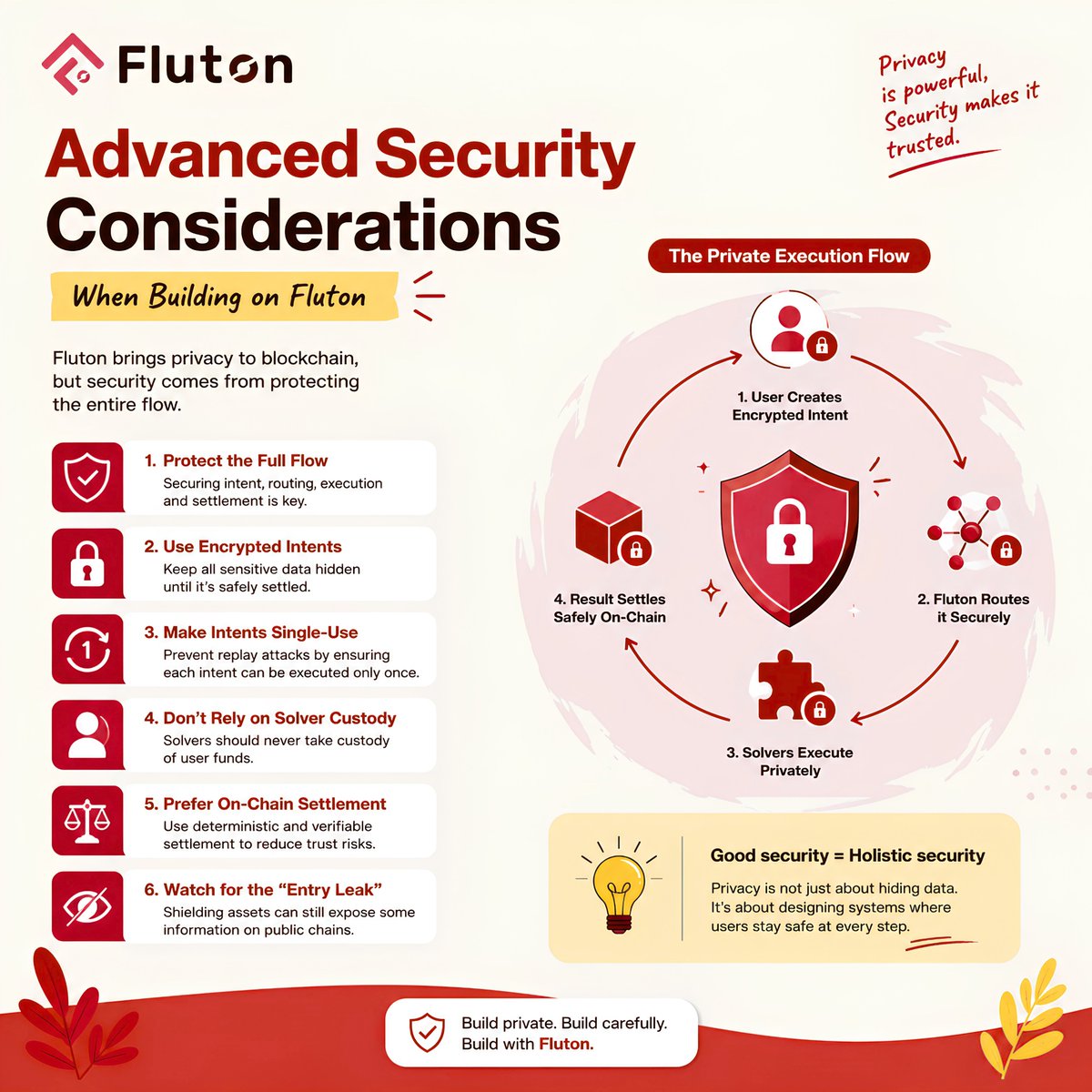
Building on @FlutonIO? Security needs to go beyond simply encrypting data.
When designing private applications, think about the entire journey of an operation:
🔹User creates an encrypted intent
🔹Fluton routes it securely
🔹Solvers execute without exposing sensitive details
🔹The result is settled safely on-chain
A few advanced things builders should keep in mind:
🔸Make intents single-use to prevent replay attacks
🔸Minimize what gets exposed on public chains
🔸Don’t depend on solvers taking custody of user funds
🔸Keep settlement deterministic and verifiable
🔸Think about leaks that can happen before data is shielded
Privacy is powerful, but good security comes from protecting the whole system.
That’s the real mindset when building on Fluton.
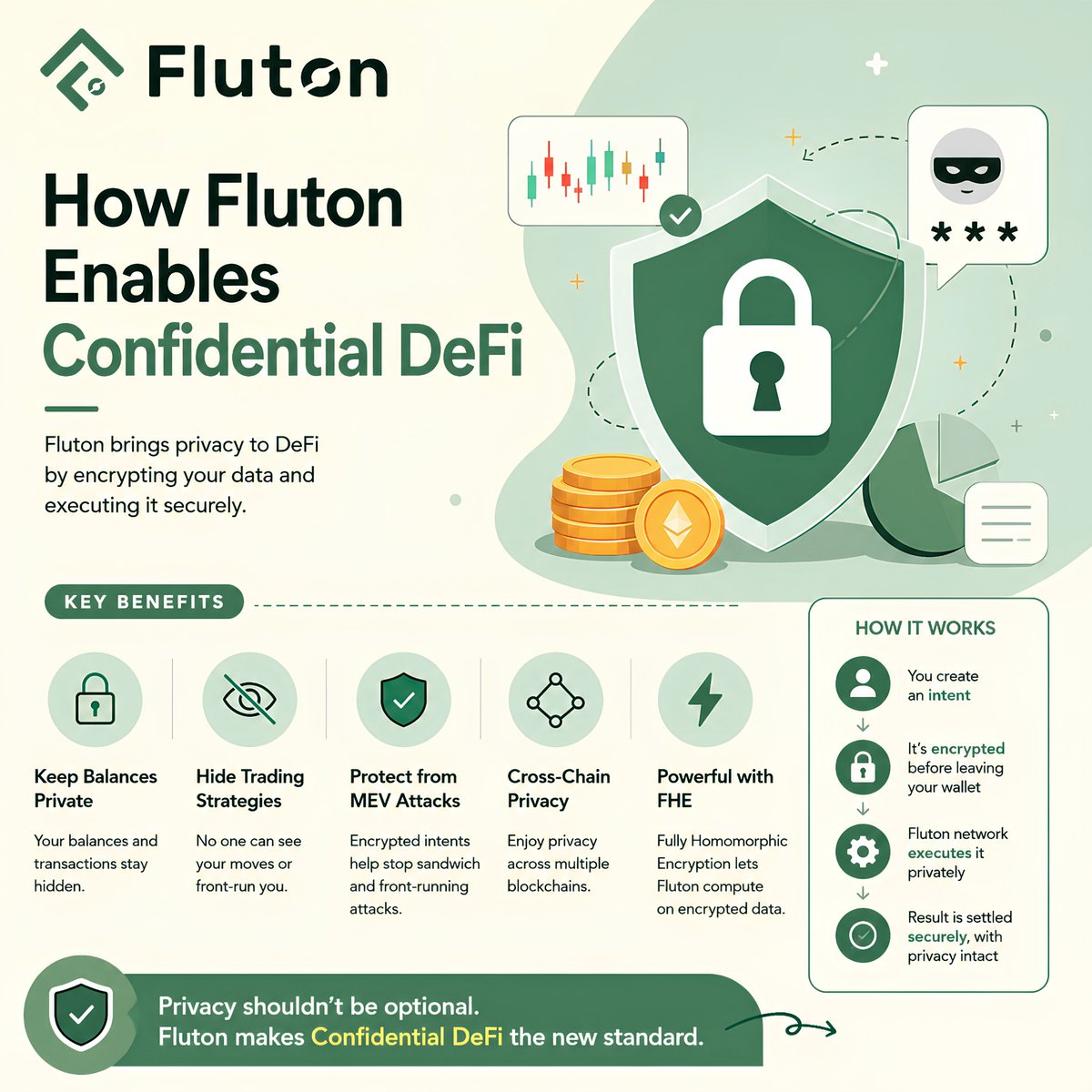
How Fluton Enables Confidential DeFi
Most DeFi apps are transparent by default. That means your wallet, balances, and even your trading strategy can be seen by anyone.
@FlutonIO changes that.
Instead of sending public transactions, Fluton lets users submit encrypted intents. The network can execute them without revealing sensitive details, thanks to Fully Homomorphic Encryption (FHE).
✴️Keep balances private
✴️Hide trading strategies
✴️Reduce front running & MEV risks
✴️Use DeFi across multiple chains without giving up privacy
Privacy shouldn't be an extra feature, it should be the default.
That's the future Fluton is building.
AI is set to revolutionize the way we engage with blockchain.
An AI agent that could perform trades, optimize your portfolio, or execute DeFi protocols on your behalf would be incredibly useful.
But what would such an agent do with your private information?
The transparency of most blockchains is incompatible with strategically valuable information that an AI agent might need to know.
Meet @FlutonIO that allows:
🔹AI agents to submit encrypted intents
🔹Keep sensitive information private during the computation process.
🔹While still allowing applications to operate on a broad range of chains.
🔹Creates opportunities
For much more sophisticated autonomous applications while maintaining the privacy and strategic value of user data.
As AI develops, user privacy will be of paramount concern, and
Fluton provides the infrastructure for applications that optimize for both data security and functional automation.
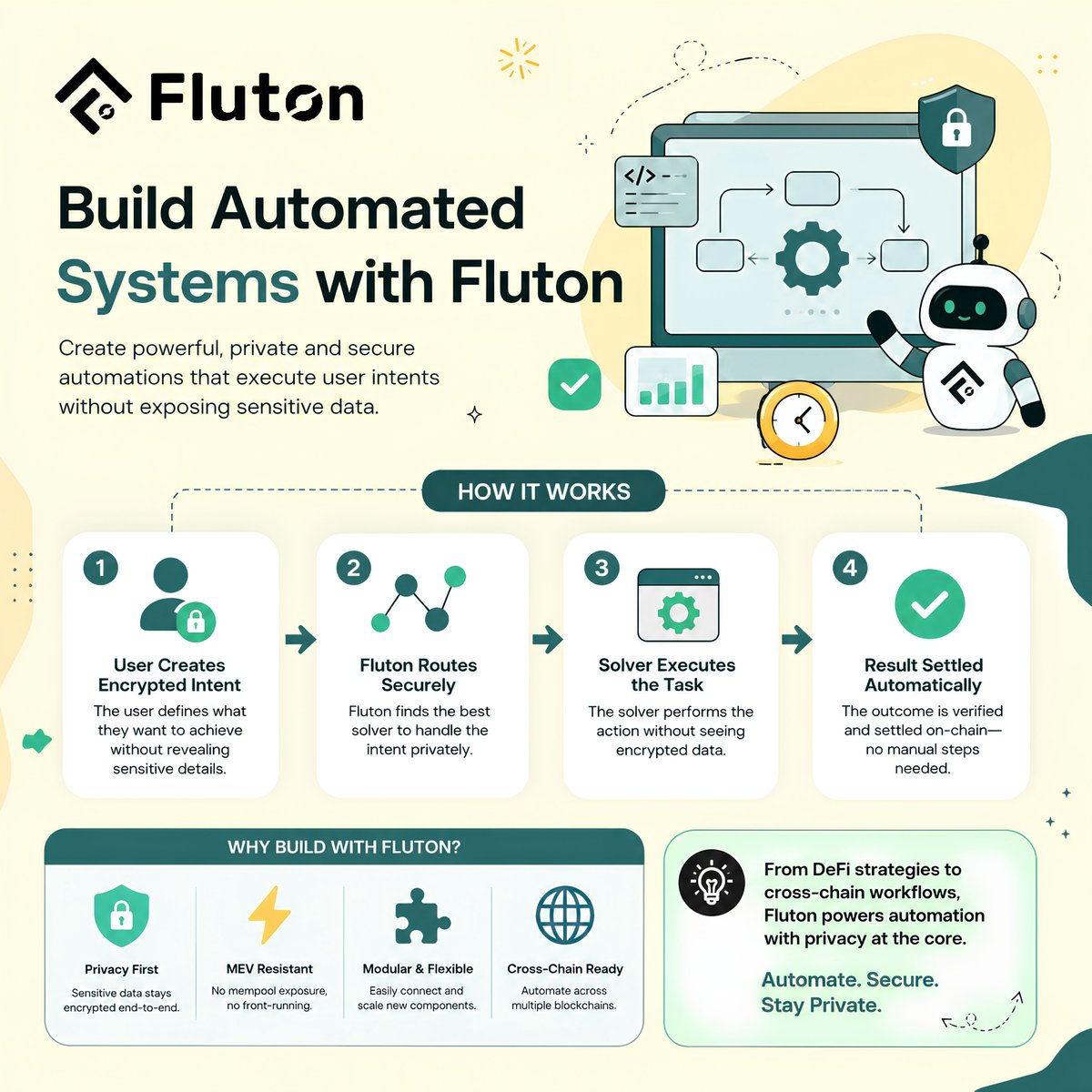
How to Build Automated Systems with @FlutonIO
Building automated blockchain apps shouldn't mean giving up privacy.
With Fluton, you can create systems that automatically execute user requests while keeping sensitive information encrypted from start to finish.
Here's how it works:
🔹A user submits an encrypted intent.
🔹Fluton securely routes it to the right solver.
🔹The solver performs the requested action without seeing private data.
🔹The transaction is executed and settled on chain automatically.
This approach lets developers build everything from automated DeFi strategies to cross chain workflows without exposing trading plans or user data in a public mempool.
Fluton's modular architecture also makes it easy to add new features, customize workflows, and scale your application as it grows, all while keeping privacy at the core.
Automation is powerful. Private automation is even better.
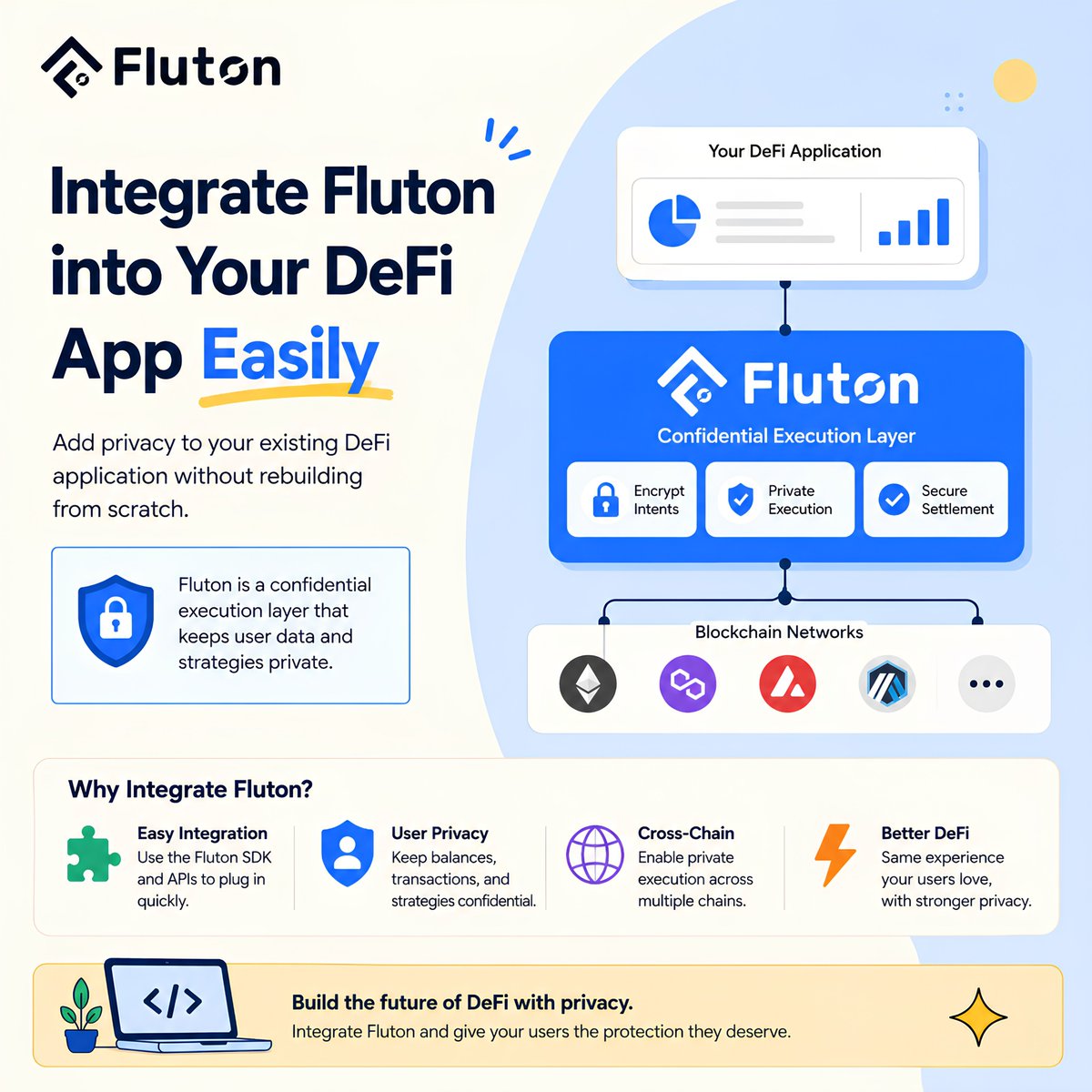
Most DeFi apps already have great products. The missing piece is often privacy.
That's where @FlutonIO comes in.
Instead of rebuilding your application from scratch, Fluton lets developers integrate a confidential execution layer through its SDK. Your app can continue using existing chains and DeFi protocols while giving users a more private experience.
With Fluton, users can:
🔹Keep balances and transaction details confidential
🔹Execute private intents across supported chains
🔹Enjoy the same DeFi experience with stronger privacy guarantees
The goal isn't to replace DeFi, it's to make the DeFi we already use more secure and privacy friendly.
A small integration can make a big difference for your users.
Every app works differently.
That's why @FlutonIO lets developers create custom workflows instead of forcing a one size fits all process.
Think of it like building with LEGO blocks.
You choose how users interact with your app, how encrypted intents are handled, and how different steps connect together all while keeping sensitive data private.
With custom workflows, you can build apps for:
🔹Private DeFi trading
🔹Secure payments
🔹Cross chain interactions
🔹Automated on chain actions
The best part? You focus on creating a great user experience, while Fluton provides the confidential execution layer behind the scenes.
More flexibility for developers. More privacy for users.
That's what building with Fluton is all about.
Most blockchain apps are transparent by default.
That means wallet balances, transactions, and even trading strategies can be visible to everyone.
@FlutonIO's changes that.
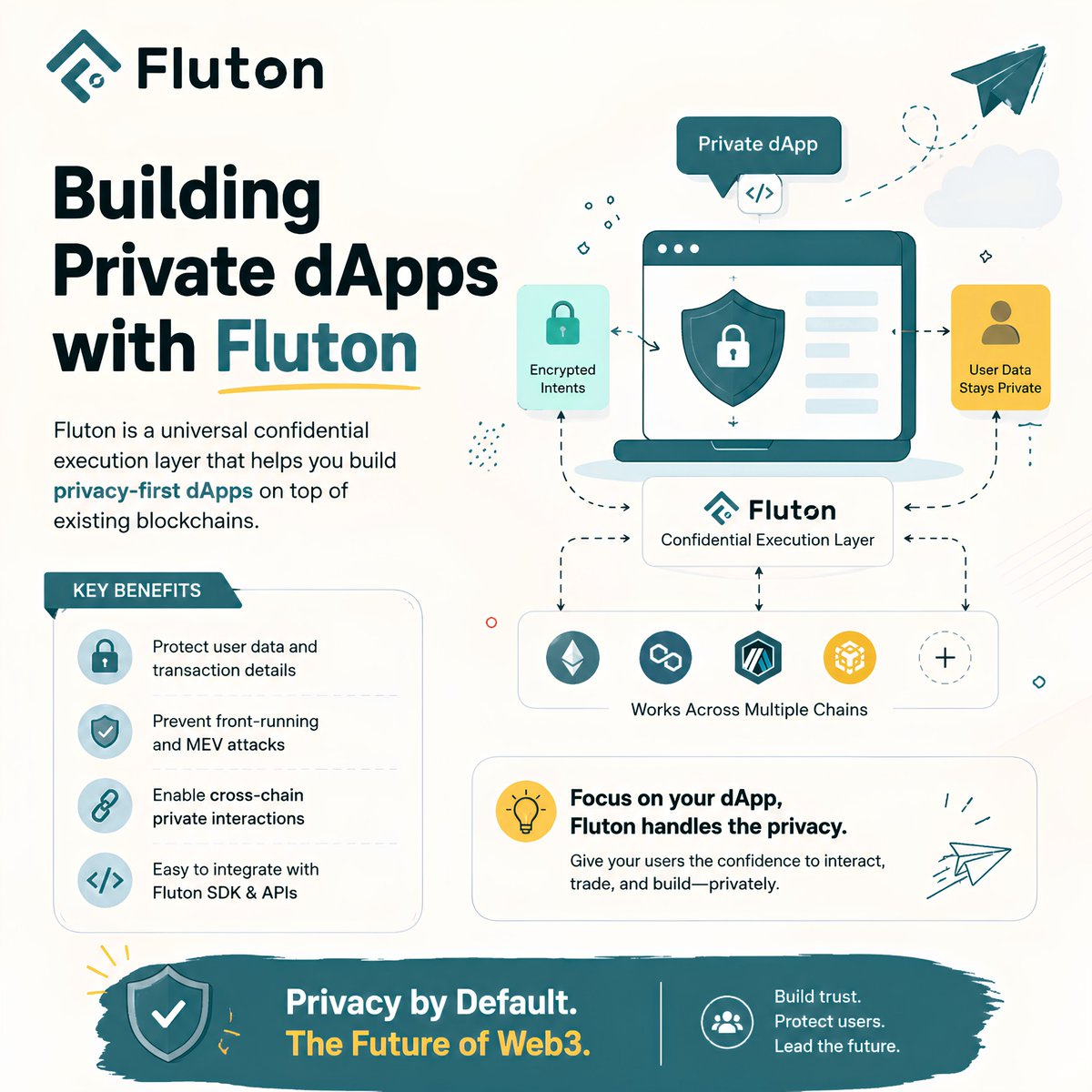
Instead of exposing sensitive data, Fluton lets developers build dApps that execute encrypted intents while keeping user information private. You can add confidentiality to your application without creating a new blockchain or changing how users interact with your app.
Why does this matter?
Protect user data and transaction details
Reduce the risk of front-running and MEV attacks
Build privacy-enabled apps that work across multiple chains
Focus on your dApp while Fluton handles confidential execution
Privacy shouldn't be a premium feature, it should be part of every great Web3 experience.
That's the future Fluton is building.
Building with the @FlutonIO's SDK? Here are a few best practices that can make your app more reliable and easier to maintain.
🔹Create a single FlutonClient and reuse it across your application instead of creating a new one for every action.
🔹Always request a quote before executing an operation. This helps users understand what they're about to approve.
🔹After submitting an intent, track its status until it's completed. This creates a much better user experience than leaving users guessing.
🔹Start with Fluton's high-level Bridge APIs for common use cases. If your application needs more flexibility, you can move to the low-level Intent APIs.
🔹Build with privacy in mind by taking advantage of Fluton's confidential execution features whenever sensitive data is involved.
Following these practices keeps your code cleaner, improves reliability, and helps you build secure, user friendly Web3 applications from day one.
Managing offers is one of the most important parts of any intent based app and the @FlutonIO's SDK makes it surprisingly simple.
Instead of hardcoding routes or manually comparing execution options, your app can work with offers directly through the SDK.
A typical flow looks like this:
✅Create and submit an intent
✅Receive offers from available solvers
✅Compare the available options
✅Pick the best offer automatically or let the user choose
✅Execute the selected offer
This approach gives developers more flexibility while keeping the user experience smooth. Users don't have to worry about finding the best execution path the SDK helps manage the entire offer lifecycle, from receiving offers to selecting one for execution.
Less complexity for developers.
A better experience for users.
That's one of the reasons Fluton makes building intent powered applications much easier.
Working with multiple blockchains can get complicated fast. Every chain has its own rules, transaction flow, and bridge process.
That's where the Bridge Functions in the @FlutonIO's SDK come in.
Instead of building cross-chain logic from scratch, the SDK provides simple functions that help you:
✅ Request a bridge quote
✅ Start the bridge transaction
✅ Track the bridge status until it's complete
This lets you focus on building your application while Fluton handles much of the bridge workflow. Your code stays cleaner, development becomes faster, and adding cross-chain support is much easier.
If you're building apps that need assets to move across different networks, Fluton's bridge functions give you a straightforward way to integrate that functionality without unnecessary complexity.
Simple APIs. Less boilerplate. Better cross chain development.
How to Track Intent Status with the Fluton SDK
Submitting an intent is only the beginning.
With the @FlutonIO's SDK, you can track your intent in real time using its intentId. That means your app always knows what's happening, whether your intent is waiting, executing, completed, or failed.
✅Submit your intent
✅Get the intentId
✅Track its status as it updates
No need to guess. Just keep users informed every step of the way.
Building a better Web3 experience starts with better visibility. 👀
Here's the way to Submit Intents Using the Fluton SDK
Most blockchain apps require users to go through multiple transaction steps to complete a single task. @FlutonIO takes a different approach. Instead of telling the network how to do something, you simply tell it what you want to achieve.
With the Fluton SDK, the process is simple:
✅ Create an intent that describes your desired outcome.
✅ Sign the intent with your wallet or signer.
✅ Submit it to the Fluton network.
✅ Solvers compete to find the best execution for your request.
✅ Review the available quotes, choose the best one, and execute it.
By focusing on the end goal instead of every individual transaction, Fluton makes cross-chain interactions much simpler for both developers and users. Less complexity, better execution, and a smoother Web3 experience.
Every Fluton app starts with one thing: a client.
Think of it as the connection between your app and Fluton's confidential network. Without it, your application can't interact with @FlutonIO's privacy powered infrastructure.
Getting started is straightforward:
🔹 Install the Fluton SDK
🔹 Import the client package
🔹 Initialize your client with the required configuration
🔹 Start sending private requests through Fluton
That's it.
Once your client is ready, you have the foundation to build applications with encrypted execution, private intents, and secure cross chain interactions, all through a single entry point.
Great apps don't start with complexity. They start with a solid client.
Understanding the Core Modules of the Fluton SDK
The @FlutonIO SDK is split into simple modules, each with a specific job. Instead of one giant library, you only use what you need.
🔹Supported➡️Check supported chains, tokens, and features.
🔹Bridge➡️Get quotes, bridge assets, execute transfers, and track progress.
🔹Intent➡️Create, sign, submit, and execute intents with full control.
🔹Offers➡️Receive offers from solvers and choose the best one.
🔹Utils➡️Handy helper functions for formatting amounts, converting chain IDs, and more.
This modular approach keeps apps cleaner, easier to build, and simpler to maintain, whether you're building a wallet, DeFi app, or cross chain experience.