The irony and ridiculous nature of the market in the short-term is this:
$MSFT has gained nearly the value of a whole $MU in 3 days due to excitement around AI. Yet, Micron, who will likely make more profits than Microsoft in the next year, is valued at around $900 Billion.
If AI is exciting for Microsoft, it should be doubly exciting for Micron.
BERNSTEIN SEES $1T SERVER MARKET BY 2028
Bernstein raised its global server and GPU AI server shipment forecasts to 15% and 22% CAGRs through 2028.
8-GPU-equivalent server shipments are expected to grow 48% in 2026, with rack shipments reaching 61,000 this year and 88,000 in 2027. $NVDA Rubin and $AMD Helios racks are expected to begin shipping in Q4.
Planned and under-construction data center investment now totals roughly $1.2T. Major cloud providers’ 2026 capex estimates have risen nearly 15% since March, with combined spending projected to reach around $1.1T by 2027.
Bernstein expects custom ASICs to represent roughly 45% of CoWoS-based AI chip shipments, while Google TPU shipments are projected to grow about 90% in 2026.
BofA: US Semis
AI Capex and Spending Growth
> Surging Outlook: AI capital expenditure (capex) forecasts for CY26 and CY27 have been revised up by +78% and +35% year-over-year, respectively.
> Hyperscale Spending: Total CY26 hyperscale capex is projected to exceed $860 billion (+80% YoY), with a path toward $1.2 trillion (+38% YoY) by CY27.
> Key Beneficiaries: Primary semiconductor beneficiaries include compute, memory, semicaps, power semis, and optics.
Demand Visibility and Customer Backlog
> Massive Commitments: Multi-year customer cloud commitments and backlogs across the top four Cloud Service Providers (CSPs) have reached $2.3 trillion+ (up +16% QoQ).
> Individual Backlogs:
Microsoft ($MSFT): Reported $678 billion in commercial RPO (Remaining Performance Obligation).
Oracle ($ORCL): Disclosed $638 billion in RPO alongside $75 billion in prepaid hardware contracts, which help alleviate upfront capital pressure.
Alphabet ($GOOGL): Google Cloud backlog reached $514 billion.
Amazon ($AMZN): AWS backlog surpassed $496 billion (>100% YoY growth).
Financial Impact and Free Cash Flow (FCF)
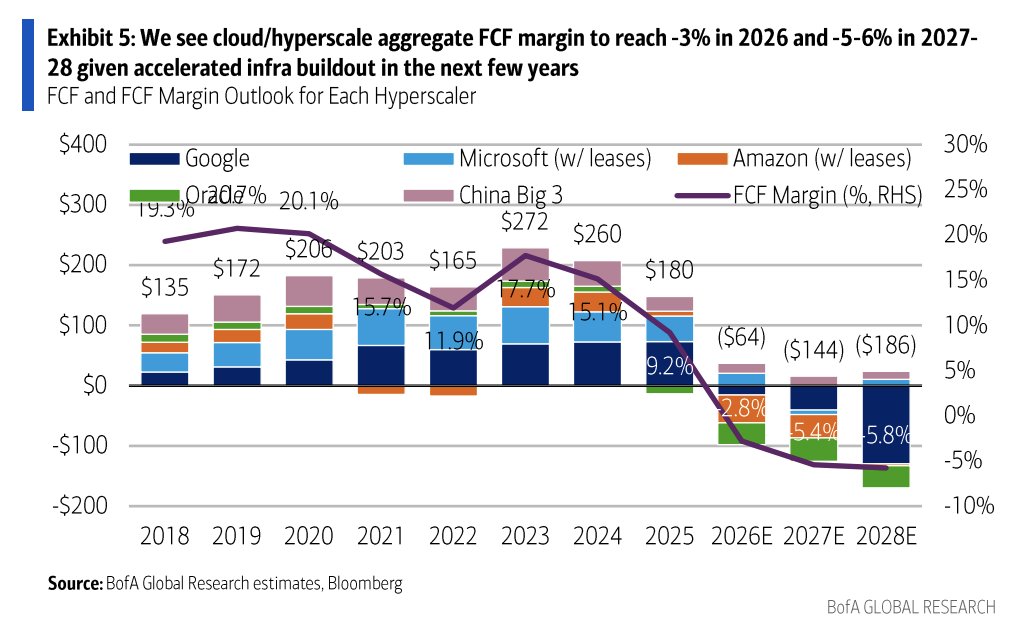
> Pressure on FCF: Cloud capex is expected to reach 100% to 115%+ of operating cash flow through CY26–28, driving aggregate FCF margins down to roughly -1% in CY26 and -5% to -6% in CY27–28 (compared to historical levels of +15–20%).
> Robust Capital Access: Top 5 hyperscalers have collectively raised $270 billion in 2026—primarily via long-dated debt and permanent equity—viewed as balance sheet optimization rather than financial distress.
> Improving AI ROI: Hyperscale AI sales are growing near triple-digit rates YoY, with cloud/AI margins expanding ahead of schedule (e.g., AWS AI and chips revenues both surpassed $25 billion annually).
Structural Drivers (Frontier Labs & Token Velocity)
> Frontier Lab Expansion: Leading labs are scaling rapidly; OpenAI projects revenue to surge from $13 billion in 2025 to $283 billion by 2030, while Anthropic's annualized revenue run rate (ARR) has inflected past $47 billion.
> Agentic Workflows: Transitioning from simple chat to token-intensive agentic workflows drives a 10x to 1,000x increase in token generation, transitioning cloud monetization from seat-based to usage-based models and sustaining long-term compute demand.
BofA released a major semiconductor update that memory investors should note carefully.
The key takeaway is a sharp upward revision in the AI capex outlook. 2026 is now seen rising 78% year over year and 2027 by 35%.
The four major US hyperscalers, Google, Microsoft, Amazon, and Meta, have reported stronger multi-year spending plans.
Hyperscale capex is tracking above $860 billion in 2026, up 80% year over year, and heading toward $1.2 trillion by 2027.
The spending is backed by more than $2.3 trillion in multi-year customer cloud commitments and backlog, which rose 16% quarter over quarter. That visibility is significant.
Free cash flow will face pressure as capital expenditures exceed operating cash flow. The big tech companies are funding it comfortably through debt and equity, and capital markets remain open.
The main beneficiaries are ranked as:
1Compute
2Memory (HBM, DRAM, SSD)
3Semiconductor equipment
4Power semiconductors
5Optics
As AI agents scale, memory demand is expected to grow even faster than GPU shipments.
Stronger cloud backlog leads to higher utilization, more accelerators, and ultimately more memory purchases.
This is not a short-term spike. It is a multi-year infrastructure buildout with improving return visibility.
Memory names have received another bullish signal.
How do you see this level of hyperscaler commitment affecting memory pricing and supply through 2027?
#semiconductors #AI
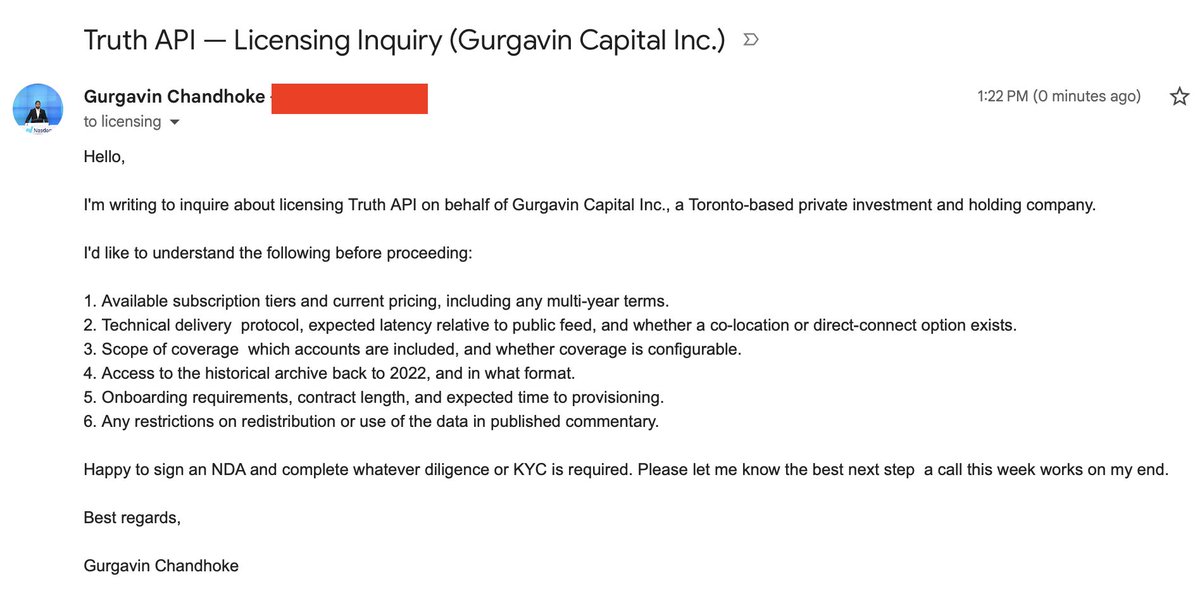
JUST EMAILED TRUMP MEDIA ABOUT THE $100K A MONTH TRUTH API TO GET TRUMP'S TWEETS BEFORE ANYONE ELSE
HEDGE FUNDS ARE PAYING $100,000 A MONTH TO SEE TRUMP'S POSTS BEFORE YOU DO
IF THEY LET ME IN I AM PAYING OUT OF POCKET AND POSTING IT HERE FOR FREE 🤝
Biotech:
My whole focus on biotech right now is looking for the best in class companies with strong management, broad pipelines of good assets and big upside potential.
$INSM has 2 already blockbuster potential drugs that are approved and a 3rd working its way through the pipeline with TPIP. They also have a big pipeline of early stage drugs to keep the party going. They could easily hit $10 billion plus revenues in the next 7 to 10 years.
$BBIO has 1 commercial drug which could do a few billion in revenues and 3 late stage drugs waiting for approval that could build out a pipeline of winning drugs over time. I could see them doing $10 billion or more in sales in the next 7 to 10 years.
$PTGX has 2 commercial drugs which have very big potential. The issue is their partners take 80% to 90% of the sales. Everything for them rests on them having more success in the early pipeline and keeping that revenue for themselves. Not quite as glamourous as the first two companies, but it has the potential to get there. Sure, they will do $10 billion revenues in the next 7 years or so, but they will only keep a few hundred million of it for themselves.
$MIRM has 1 approved drug which is approaching blockbuster status. They have several others in mid to later stage development which can also be blockbusters. There are no huge winners in here. This is a play on solid and consistent execution by building, licensing and buying additional pipeline assets. I cold see them reaching $4 to $5 billion revenues in 7 to 10 years.
$PRAX is approaching commercial approval for its first 2 drugs. Its lead drug could do well over $10 billion in revenues alone. That is a huge winner. They have several others in development around DEEs and seizures. If they get approved for the first and only FDA approved drug in Essential Tremor, I don't think it takes long before big pharma pounces on them. It could be upward of $20 billion revenue blockbuster.
$IDYA has 1 drug approaching approval that could do a few billion in revenues. They also have a broad pipeline of earlier stage drugs that could also build upon that success. This is far more risky as its earlier in development.
Morgan Stanley raised its cloud infrastructure spending outlook.
The top 14 listed global cloud service providers are now expected to spend nearly $1.3 trillion in 2027.
That is 24% higher than current consensus estimates. The figure excludes sovereign AI projects.
The data shows clear acceleration. Cloud capex has climbed steadily over the past decade, but the jump from 2025 onward stands out.
Projections put 2026 around $900 billion plus and 2027 at the $1.3 trillion mark.
A large and growing share of this spending, around 65% in the later years, is going into short-lived assets.
That includes GPUs, specialized AI accelerators, high-bandwidth memory, and networking gear that depreciates quickly as new generations arrive every 18 to 24 months.
The surge is driven by relentless demand for AI training and inference capacity.
Hyperscalers including $AMZN Amazon, Meta $META , Alphabet $GOOG , and their peers are racing to build the compute needed for ever-larger models and broader enterprise adoption.
For context, total cloud spending by these providers was only in the low hundreds of billions just a few years ago.
Reaching $1.3 trillion in a single year represents a structural shift in capital allocation across the tech industry.
The implications are significant. Sustained pressure on supply chains for advanced chips and packaging, rising demand for energy and cooling solutions, and potential upward revisions to revenue forecasts for the entire AI hardware ecosystem.
Amazon, Meta, Alphabet, Microsoft $MSFT , and the broader semiconductor complex remain at the center of this story.
This is not a one-year spike. It is the continuation of a multi-year investment cycle that shows little sign of slowing.
How do you see this level of cloud capex affecting the semiconductor supply chain over the next two years?
#semiconductors #AI
Mark this.
Revenue: >11 billion
EPS: > $45
Why? $MU reported for NAND
ASP: increased 80%
Revenue: increased 99%
Note $MU fiscal Quarter from March to May. $SNDK from April to June
IBM reported that they did not meet projections because their clients had to invest heavily in Ai especially memory.
KIOXIA reported nonGAAP EPS rose more than 100 percent QoQ (more like 120%)
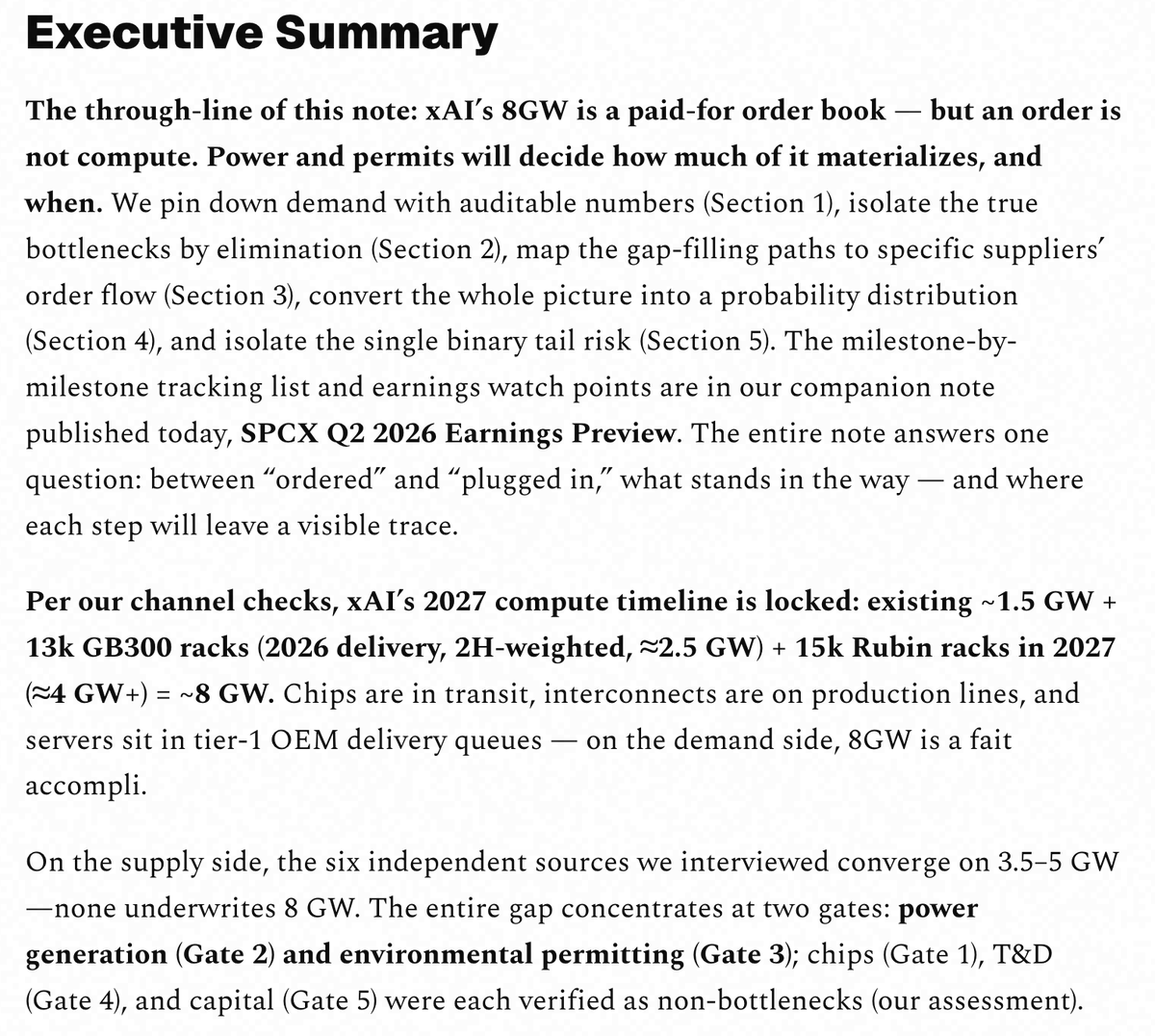
I don’t understand why this FundaAI report hasn’t received more attention. SpaceX plans to build 4 GW of compute capacity using Rubin racks next year.
$NVDA $SPCX
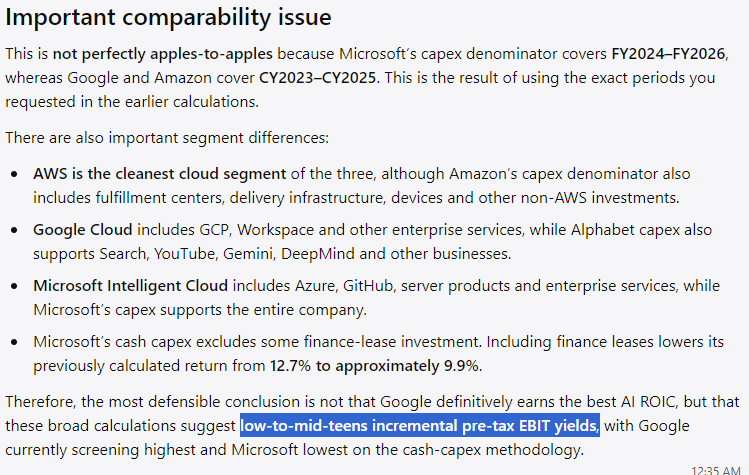
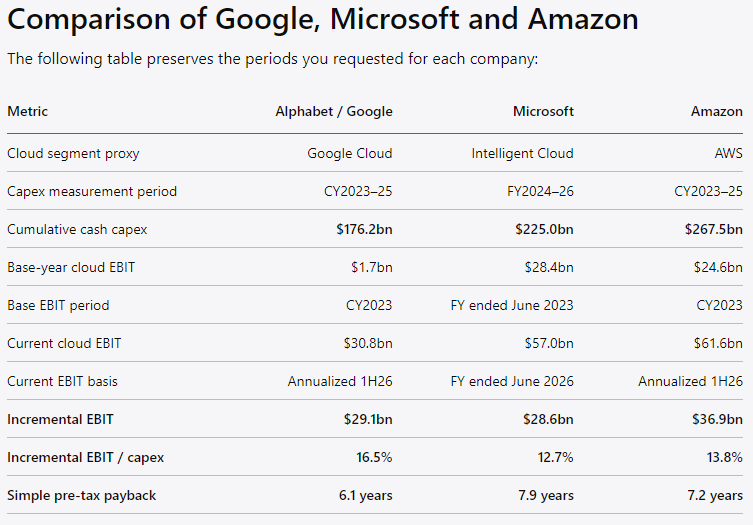
pretax returns on AI capex for Google, Amazon, and MSFT: 13-18%
According to my Mickey Mouse style calculation, which is as follows:
-incremental cloud ebit: 1H26 annualized vs FY 2023
divided by
-cumulative AI capex 2023-25
mid teens is not the best investment ever, specially compared to the massive ROICs they were generating for the last 15 years, but at least above cost of capital
Caveats:
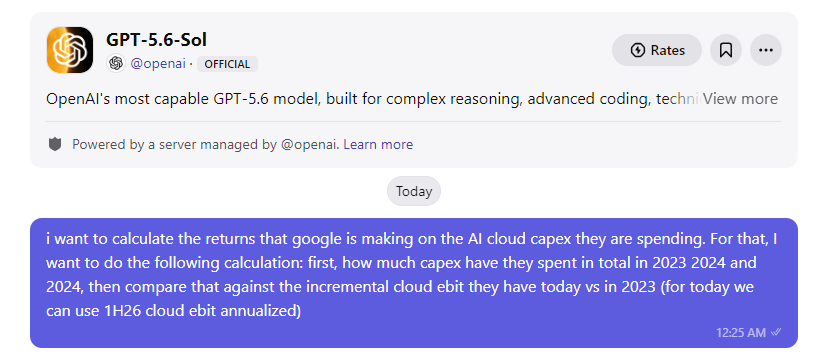
1-It could be that GPT Sol is pumping up the numbers so that we don't switch him off
2-the EBIT is probably overstated, as part of the incremental cloud ebit since 2023 relates to the installed base pre AI-capex orgy. in addition, "cloud" division has more things besides AI
3-the capex is overstated too, as not all goes to AI cloud
If you haircut the incremental ebit by 50% to account for #2, and haircut the capex say 30% to account for #3, the returns on capex get close to just 10%
4-the numbers the LLM is pulling for Google seem correct, I haven't bothered to check amazon and msft. ask your analyst to do it. make no mistakes
ah im going to ask for the same calculation for Alibaba
🚨 SANDISK $SNDK EARNINGS PREVIEW
Sandisk reports fiscal Q4 earnings on Wednesday, August 5, after the market closes.
WALL STREET EXPECTATIONS:
• Revenue: roughly $8.2B to $8.3B
• Adjusted EPS: roughly $33 to $35
COMPANY GUIDANCE:
• Revenue: $7.75B to $8.25B
• Adjusted EPS: $30.00 to $33.00
• Gross margin: 79% to 81%
LAST QUARTER:
• Revenue: $5.95B
• Adjusted EPS: $23.41
• Datacenter revenue: $1.47B
• Datacenter growth: +233% QoQ
• Gross margin: 78.4%
WHAT $SNDK NEEDS TO DELIVER:
✅ Revenue above $8.3B
✅ Adjusted EPS above $34
✅ Gross margin at or above 81%
✅ Continued enterprise SSD and AI data center strength
✅ Strong NAND pricing commentary
✅ Clear progress on its long-term customer agreements
BUT THE MOST IMPORTANT NUMBER WILL BE GUIDANCE.
Current expectations for fiscal Q1 2027 are already around:
• Revenue: ~$10.5B
• Adjusted EPS: ~$41
A solid Q4 beat followed by weak guidance could still send the stock lower.
MY TAKE:
Expectations are extremely high now.
The market already expects Sandisk to report roughly 4x the revenue it generated in the same quarter last year, while adjusted EPS is expected to rise from just $0.29 to more than $33.
Simply meeting guidance probably will not be enough.
For $SNDK to really pump, investors need a beat, strong forward guidance and proof that the current NAND and enterprise SSD boom is becoming a durable multi-year cycle rather than another temporary memory peak.
High expectations. High volatility. Massive earnings report.
$SNDK $MU $WDC $STX
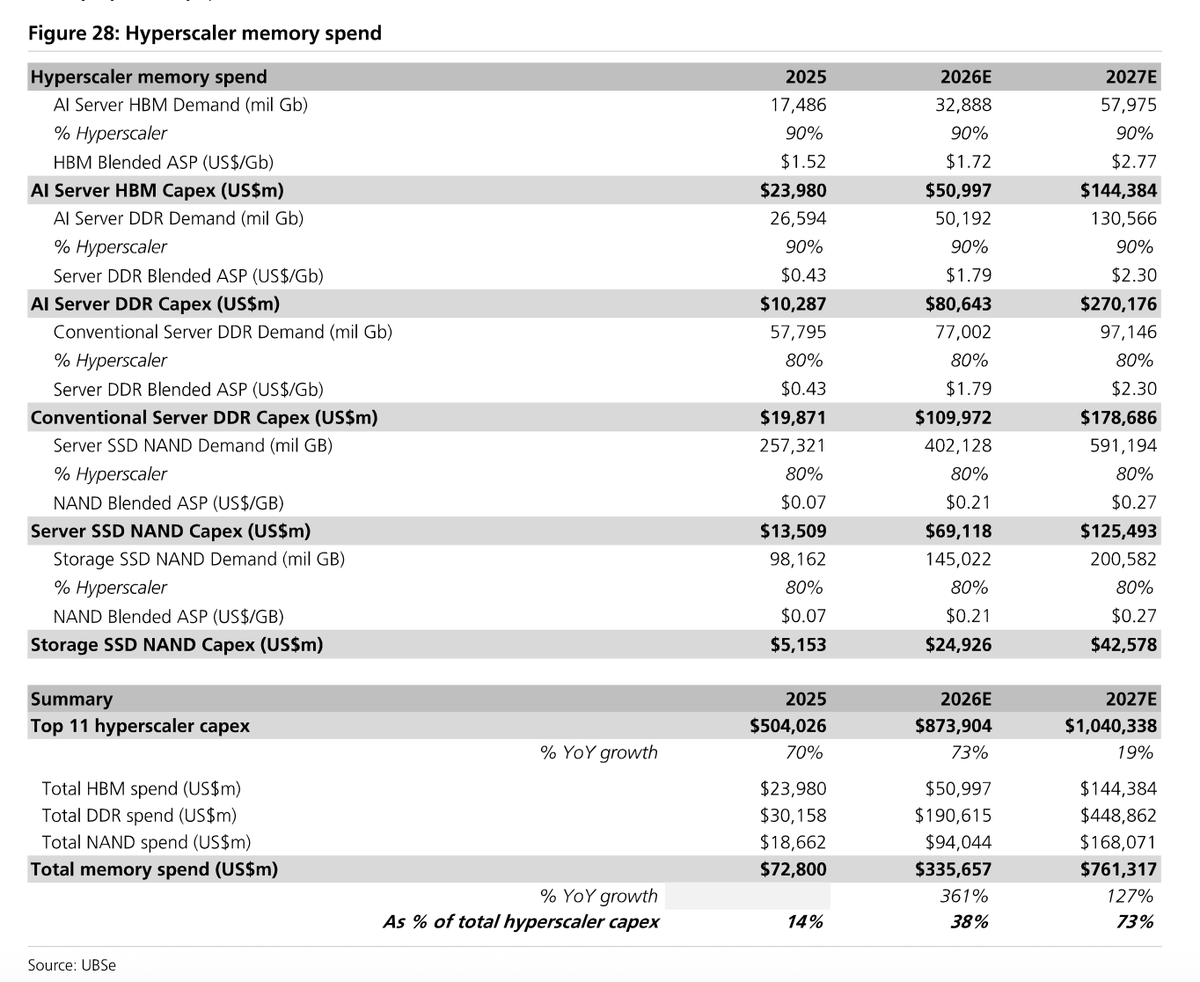
Breakdown of the memory spend for hyperscalers. UBS projects DDR spend of $190.6 billion in 2026 and then $448.9 billion in 2027, an increase of ~135%. Total memory spend to increase by 127% in 2027.
$MU $DRAM $EWY
Going back to 1986, here's what August through December looks like in every midterm year:
• August: choppy, either a really bad month or a really good month. +4.2% median gain, but -1.0% average gain.
• September: bad month.
• October: +4.8% median, 80% win rate. This is the midterm rally.
• November: +4.5% median, 70% win rate. The rally continues.
• December: worst month typically with only a 40% win rate. Tax loss selling hits hard.
The total Aug to Dec return is +7.9% median with a 60% win rate, which is a good sign.
If this follows the historical playbook, expect chop through September, a strong October and November, then give some back in December.
BREAKING: Trump says he has canceled the planned U.S. strike on Iran, adding that the two sides have agreed to the “parameters” of a deal that includes reopening the Strait of Hormuz.
Tim Cook called memory pricing a "100 year flood." Best thing a memory bull could hear, and it came from the buyer.
Apple's quarter was strong, revenue up 16% to $109.4 billion, iPhone up 22%. But margins are getting squeezed and the CFO said more than 100% of the sequential decline is explained by memory costs alone.
They also raised prices on iPad and Mac because of it. Cook said memory went up in March, up in June, goes up again in September, and keeps rising after that.
Cook pointed out the DRAM market has only three primary suppliers and said Apple is evaluating all options for supply flexibility.
That's Apple. Best supply chain on earth, trillion dollar balance sheet, and they're scrambling for allocation.
$SKHY said sold out past 2030. $MU has customers prepaying for volume. $META locked in multi year deals. Now $AAPL confirms it from the buy side and passes the cost to consumers.
Three suppliers, vertical demand, and the biggest customer in the world calling it a hundred year flood.