what's heavier
a kilogram of steel or
the weight of knowing that in the end the whole of life is an act of letting go everything you ever loved and grief is all you will be left with knowing everything you did, you did it alone, and for nothing. only to be left with nothing.
I think ambitious people should treat life in “seasons” rather than trying to balance everything every day.
A few years massively overallocated to work. A period getting seriously fit. A year or two nomading. Then family takes priority for a while. Then maybe at 35 you go completely insane again and spend four years building a new company, and so on.
The mistake is thinking every metric needs to stay green all the time. Most great outcomes (building a company, writing sth serious, training for an event) need uninterrupted runs, not daily moderation. Sometimes work should suffer cause you’re travelling, sometimes your social life should suffer cause you’re building, sometimes career progression should slow cause family matters more. That’s fine.
And tbh it probably makes life more fun too. You get actual chapters and completely different versions of yourself instead of spending 40 years maintaining the same perfectly optimised routine. A few intense years in one city, a weird nomad phase, an obsession that takes over your life, then something completely different. Probably much more memorable than one very long well-optimised Tuesday.
It's why I encourage everyone to think of balance in years, not days. A good life can look horribly unbalanced on some random Tuesday and still be very balanced over 10 years.
The Electricity Grid
I post a lot of stuff about the electricity grid, here the CEO of the largest grid in America (PJM) lays it out pretty clearly.
• What worked for 2 decades… no longer works
• This is structurally different from history
• You are facing an era of scarcity
• The situation is not tenable
PJM are facing a demand explosion. Now a demand explosion in some industries is +500% demand. But this is infrastructure, this is tens of trillions of dollars of assets and it takes time to mobilise and deploy things at this scale.
In infrastructure, when demand growth shifts from +1-2%/yr to +8%/yr, then you suddenly need to be building 4-8 times more assets per year, than you previously did.
If you were deploying $1 trillion / yr to grow at 1%, you now need to deploy $8 trillion / yr to grow at 8%.
Suddenly you need to deploy many trillions of dollars per year to meet this growth. If you cannot get it done, prices will rocket for everyone. Failure leads to inflation.
This is not a PJM problem, this is not even a US problem, this is a global problem. PJM are formally validating what some people have been saying for a while now.
This is not temporary, we cannot uninvent the technologies that have precipitated this change. The world has changed and we must adapt.
Global retail electricity sales are about $3.6 trillion per year, of that, around $900 billion goes to transmission and about $2.7 trillion goes to wholesale generation.
The transmission system many developed countries have is the wrong system going forward. Our transmission systems in the West are built for transporting power from big coal plants to power big towns. That’s not what we are doing now.
We have replaced most of the coal plants with two largely decentralised but highly correlated fleets of intermittent generators (wind and solar), that are growing like fracking wells because they are also quick to deploy.
Their quickness to deploy new generation projects is massively destabilising for the grid. The grid was designed for coal plants. The grid is a $50 trillion machine. It is by far the biggest asset in any country. It isn’t something you can toss away, it isn’t something you can swap out overnight.
We also have new categories of industrial demand (hyperscalers) that will capture an increasing share of GDP. This new demand category is going to set the marginal price of electricity for everyone else, and these guys are not as price sensitive as your widowed grandmother.
This is a difficult problem to address because of:
i) the scale
ii) the capital intensity
It’s also a global problem, because it’s born out of a new technological paradigm. It will not spread around the world at equal pace, but everywhere is going to eventually face it down.
Some people are fleeing to space for solutions to avoid this snafu, but that’s only a temporary fix.
Once the hyperscalers have their demand satisfied, the next demand explosion immediately follows, and this second wave is 20x the scale of the current problem.
The second wave is how do you power billions and billions of robots and billions of autonomous machines, doing work that currently can’t be done?
This industrial revolution is very much a two stage revolution, first you power up the chips, then you power up the actuators.
Chips scale down, actuators scale up.
There’s no Moore’s Law for actuators, they obey Newton’s Laws of motion instead.
This is the crux of the energy problem facing our civilisation. The energy system we have today is the one we wanted 20 years ago. The energy system we will have in 20 years from now, is the one we start building today.
It’s time to build this solution.
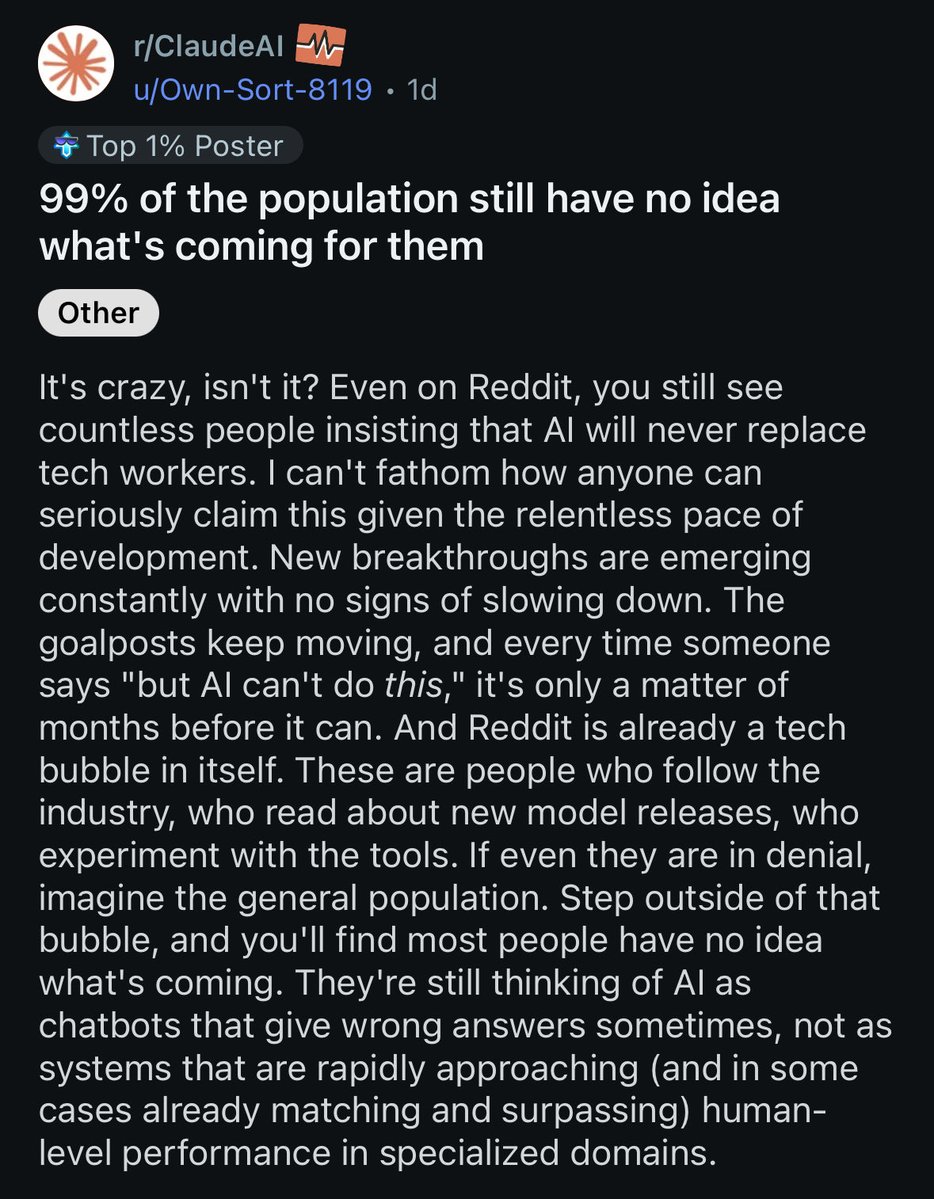
Almost no one is prepared for what is actually coming
Within the span of 3 years since launch of ChatGPT:
> AI has become a component of every white collar job’s workflow
> AI has caused hiring slowdown or layoffs at some of the biggest corporates
> Capex spent on AI and AI data center buildout has gone from billions to trillions
> The amount of AI startups coming to market every day has gone exponential
> AI has become a core skill set listed on almost every job description for office jobs
> AI has gone from simple text box answers to generating sophisticated research papers, excel spreadsheet templates, video generation and image editing
> There are now creators across social media platforms making millions of dollars through AI generated content
And the scariest part is that the progress is exponential. Think about where we will be 10 years from now
High agency advice for finding your next role, with a lot of examples
This applies to not just startups by the way.
Encourages second-order thinking, which is a prerequisite for a great life.
the weirdest brain rot antidote: when AI is researching, don’t switch tabs. don’t check twitter. just… wait. stare at claude is thinking. stay in context. the impulse to fill those 5 seconds with anything else is what’s rotting your brain.
"ai will replace anyone who doesn't use ai" sounds urgent until you realize it's like saying "the internet will replace anyone offline." eventually everyone went online. the tool became baseline. competition moved elsewhere.
ai can generate perfect market analysis, detailed plans, optimized copy. but then someone has to choose which plan to bet on, with real stakes. that's when you feel the difference: ai has no skin in the game.
taste isn't aesthetic preference. it's knowing which micro-decision fits your specific situation, with your constraints, learning from your feedback loops. the work doesn't disappear when tools improve. it just moves to the part machines can't touch: living with the consequences.
noticed something about the stuff i actually use
onitsuka slip-ons are easier to put on than my slippers once i have socks on. so i wear them way more.
never wear watches with buckle straps. wear simple clasp watch all the time.
pull-up bar in my room and suddenly hanging there daily because it's right there.
the products i love aren't necessarily better. they just made it stupidly easy to do the thing i already want to do.
@ShanuMathew93 Exactly what we are doing with Microsoft in Southern Finland; 40% of heat demand for 250,000 citizens will be sourced from datacenter waste heat.
As an engineer, can't help but find the approach beautiful (more visuals in the vid)
https://t.co/0NLmIRCQYC
In our mythology, Lakshmi never stays where there is chaos.
She gravitates toward spaces of order, discipline, and creative energy —
a poetic way of expressing a scientific truth:
prosperity is concentrated, directed energy.
Economies grow when a society learns to channel energy into structure —
trust, institutions, craft, innovation.
They decline when energy scatters and disorder spreads —
when entropy takes over.
Mahalakshmi isn’t just a symbol of wealth;
she is the reminder that
prosperity appears wherever human energy aligns, compounds, and resists entropy.
And she quietly leaves where everything collapses into noise.
Physics, economics, and mythology might speak different languages,
but they describe the same principle:
to create wealth is to keep entropy at bay.
(Random morning musings edited with help of ChatGPT)
An underrated skill: knowing when to quit. A relationship. A habit. A job. An idea. We worship perseverance so loudly that we fail to hear the whispers of strategic clarity.
hey all claim to have solved AI memory
every single one is just fancy search, yes including open ai
they retrieve your old conversations, they don't connect them
real memory links ideas across time builds context, not archives
we built that with https://t.co/CoGpKMnmvj
If you feel inclined to show us some love, please go to https://t.co/CkRMbiDLmC, and then find my post and upvote.
"Show HN: An AI to match your voice to songs and artists you should sing"
Life is short 🙏
Maintain a 10-20% enjoyment fund to spend on yourself & your family.
Simply take out 10% of your monthly savings & put it in a seperate bank account, call it Enjoyment Fund. Have enjoyment goals - Travel to X location with family or buy Y thing. Once your Enjoyment Fund reaches that amount, do it immediately. Life is short.