@harry I lost my cat unexpectedly a few weeks ago - seems like they had similar energy based on these pics :) it will get better, lean on these memories and the love you had for her, as well as the love you still have in your life 🩵🐈🐈⬛
the legendary Hayao Miyazaki was pitched an AI animation demo in 2016. his reaction was brutal:
It's an awful insult to life.
I fear the world's end is near.
it does for sure. but a towel + jumping in every 20-30 minutes makes it kind of perfect. I prefer Fullerton Beach - you can picnic in the grass or lay out on the concrete steps
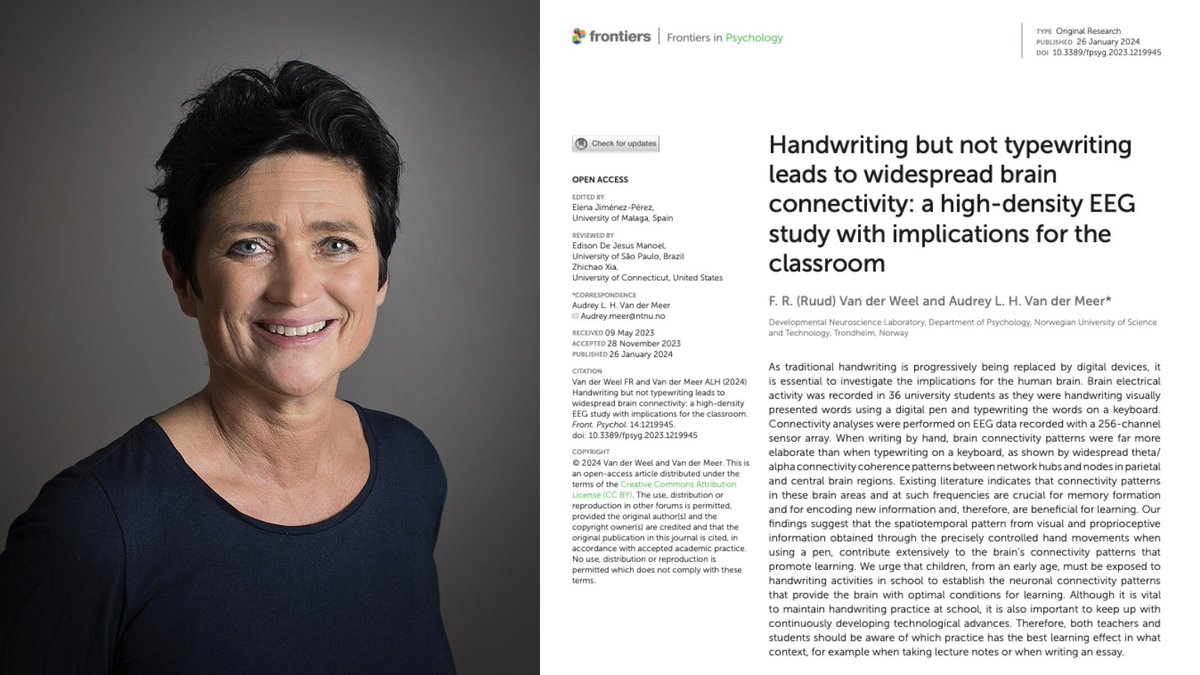
A Norwegian neuroscientist spent 20 years proving that the act of writing by hand changes the human brain in ways typing physically cannot, and almost nobody outside her field has read the paper.
Her name is Audrey van der Meer.
She runs a brain research lab in Trondheim, and the paper that closed the argument was published in 2024 in a journal called Frontiers in Psychology. The finding is brutal enough that it should have changed every classroom on Earth.
The experiment was simple. She recruited 36 university students and put each one in a cap with 256 sensors pressed against their scalp to record brain activity. Words flashed on a screen one at a time.
Sometimes the students wrote the word by hand on a touchscreen using a digital pen, and sometimes they typed the same word on a keyboard. Every neural response was recorded for the full five seconds the word stayed on screen.
Then her team looked at the part of the data most researchers had ignored for years, which is how different parts of the brain were communicating with each other during the task.
When the students wrote by hand, the brain lit up everywhere at once.
The regions responsible for memory, sensory integration, and the encoding of new information were all firing together in a coordinated pattern that spread across the entire cortex. The whole network was awake and connected.
When the same students typed the same word, that pattern collapsed almost completely.
Most of the brain went quiet, and the connections between regions that had been alive seconds earlier were nowhere to be found on the EEG.
Same word, same brain, same person, and two completely different neurological events.
The reason turned out to be something nobody had really paid attention to before her work. Writing by hand is not one motion but a sequence of thousands of tiny micro-movements coordinated with your eyes in real time, where each letter is a different shape that requires the brain to solve a slightly different spatial problem.
Your fingers, wrist, vision, and the parts of your brain that track position in space are all working together to produce one letter, then the next, then the next.
Typing throws all of that away. Every key on a keyboard requires the exact same finger motion regardless of which letter you are pressing, which means the brain has almost nothing to integrate and almost no problem to solve.
Van der Meer said it plainly in her interviews.
Pressing the same key with the same finger over and over does not stimulate the brain in any meaningful way, and she pointed out something that should scare every parent who handed their kid an iPad.
Children who learn to read and write on tablets often cannot tell letters like b and d apart, because they have never physically felt with their bodies what it takes to actually produce those letters on a page.
A decade before her, two researchers at Princeton ran the same fight using a completely different method and ended up at the same answer. Pam Mueller and Daniel Oppenheimer tested 327 students across three experiments, where half took notes on laptops with the internet disabled and half took notes by hand, before testing everyone on what they actually understood from the lectures they had watched.
The handwriting group won by a wide margin on every question that required real understanding rather than surface recall.
The reason was hiding in the transcripts of what the two groups had actually written down.
The laptop students typed almost word for word, capturing more total content but processing almost none of it as they went, while the handwriting students physically could not write fast enough to transcribe a lecture in real time, which forced them to listen carefully, decide what actually mattered, and put it in their own words on the page.
That single act of choosing what to keep was the learning itself, and the keyboard had quietly skipped the choosing and skipped the learning along with it.
Two studies. Two countries. Same answer.
Handwriting makes the brain work. Typing lets it coast.
Every note you have ever typed instead of written went into your brain through a thinner pipe. Every meeting, every book highlight, every idea you captured on your phone instead of on paper was processed at half depth.
You did not forget those things because your memory is bad. You forgot them because typing never woke the part of the brain that would have made them stick.
The fix is the thing your grandmother already knew.
Pick up a pen. Write the thing down. The slower road is the faster one.
watching my mom bust her ass to clean the house and cook dinner before my dad got back from work trips, only for him to get home and immediately point out the dirty dishes in the sink
"What radicalized you?"
Watching my female relatives plan, cook, shop, decorate, clean, and organize for the holidays while the men just show up and watch TV the whole time.
In 1935, two American doctors examined seven women's ovaries and saw small lumps. They called them cysts and named the disease after them. They were wrong. It took 91 years to fix.
What we called PCOS is now Polyendocrine Metabolic Ovarian Syndrome (PMOS), announced today in The Lancet by an international panel of doctors and patients. The renaming followed more than a decade of consensus work and 22,000 patient and clinician survey responses.
The lumps Stein and Leventhal saw were never cysts. Modern imaging shows they were follicles, the tiny sacs inside the ovary that grow and release an egg each month, frozen partway through by a hormonal imbalance. PMOS is a multi-system disorder centered in the endocrine system, the body's network of glands that produces hormones like insulin (controls blood sugar), cortisol (the stress hormone), and thyroid hormones (set the body's metabolism). The ovary trouble flows downstream from there.
The naming choice is not academic. When doctors hear "ovary" in a diagnosis, they look at the ovary. "Metabolic" and "endocrine" send them to the whole body.
PMOS affects roughly 1 in 8 women worldwide, more than 170 million people. The WHO estimates 70% have never been diagnosed. Among those who do, 1 in 3 wait more than 2 years, and nearly half see 3 or more doctors first. The CDC reports more than half of women with PMOS develop type 2 diabetes by age 40, a risk 5 to 10 times higher than women without the condition. Around 37% have clinically significant depression, compared with 14% in women without it. Anxiety runs at 42% versus 8.5%.
A label born from a 1935 look at seven ovaries is finally going away. The new diagnostic guidelines roll out fully in 2028. By then, a woman walking into a clinic with these symptoms should hear questions about her blood sugar and her mood alongside her cycle. Those are the parts of the disease the old name hid for 91 years.
Doctors say that fluoride helps build strong teeth. A guy who snorts cocaine off toilet seats and takes raccoon penises home for “further study” says it causes autism. For busy parents, it can be hard to know who to trust.
Women: I want to go for a run.
Society: You can’t go alone. You’ll get raped.
Women: I want to walk to my car in the parking garage.
Society: Alone? You better get someone to escort you, or you’ll get raped.
Women: I want to live alone.
Society: You need a gun, an alarm system, a dog and probably a gun for the dog too.
Women: What about going to the park?
Society: Dangerous.
Women: Okay, I’ll just go out for a drink then.
Society: Don’t take your eyes off your drink. Watch out for predators spiking your drinks. Stay alert at all times.
Women: I was raped.
Society: Are you sure? That just seems impossible.
“unprecedented level of transparency” GIVE ME A FUCKING BREAK!!!!!! EVERYTHING IS A FUCKING JOKE TO THIS ADMINISTRATION. RELEASE THE UNREDACTED EPSTEIN FILES AND START PROSECUTING. USELESS FUCKS
PRESIDENTIAL UNSEALING FOR UAP ENCOUNTERS.
Per President Trump's directive, the @DeptofWar has declassified & released unresolved UAP records. This is an unprecedented level of transparency, no other admin has gone this far.
Files now live on https://t.co/MogyohpeQE — additional files will be released by the Dept. of War on a rolling basis.📂
American women can only stay with their babies for 6 weeks before they must return to work. This policy was lobbied by Nestle so that American women are forced to buy formula and don't rely on their own breast milk to feed their babies. The American government works for corporations, not their people & until this system dismantles, people aren't going to have babies. This is just common sense.