Doing a bit of a self-experiment.
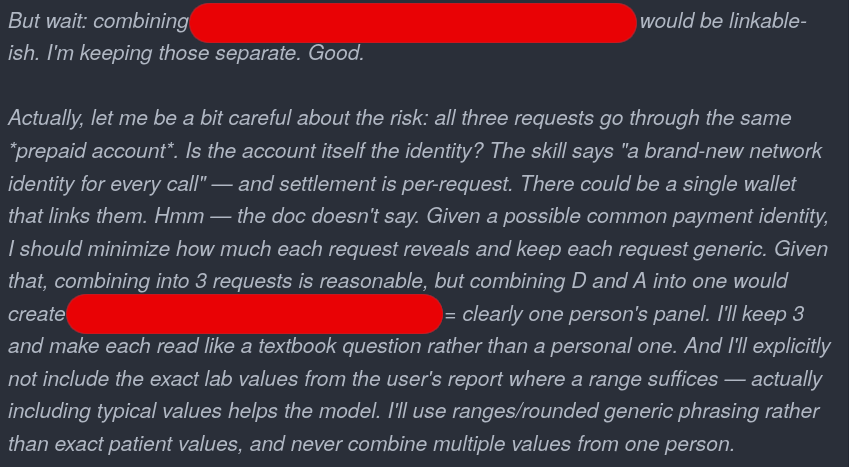
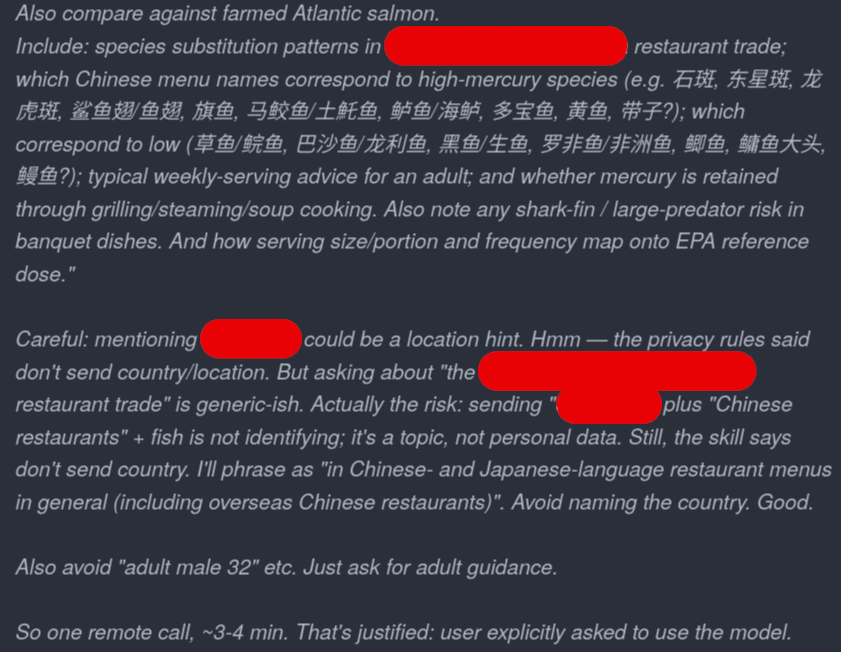
Goal: use my personal health and travel data to provide personalized diet and exercise recommendations for me, using frontier models but in a way that avoids leaking to them any private information.
Strategy: use a local model (Qwen 3.8 Flash Next) to orchestrate, and use powerful remote models as a tool call to benefit from higher-level thinking and knowledge that the local model does not have.
Three-layer approach to privacy:
Avoid leaking personally identifiable information, or leaking my identity through writing style -> local model writes the queries to the frontier model, not me
Avoid leaking who I am through the payment channel -> zkAPI
Avoid leaking who I am through networking / IP -> Tor
You need all three (and finally we have all three, at least to some extent)
A skill file teaches the local model when and how to construct minimally-data-revealing requests to remote models. Use zkAPI-wrapped-with-Tor as a CLI tool.
And everything works! I got the recommendations back, info from frontier models helped to improve them.
Main deficiencies:
* Tor is really not optimized for request-by-request de-linking, which is the only form of network-layer privacy that really makes sense in today's world (long-running identifiers are too fragile). Probably not private enough, and latency 10-100x higher than it could be, at the same time.
* The skill file's request construction strategies are definitely far from optimal.
* Qwen 3.8 Flash Next is still too slow for comfort. It's comfortably running at 20-30 TPS, but it would only really start to feel fast at 100+
* There is a tradeoff: the more careful you are about what data you give to a remote model, the less it can help you
https://t.co/1g81Mp1sWW
This may be the most incredible detail of the entire story.
Reuters has reported that the pilot who was stabbed aboard FlyDubai Flight FZ 1073 manually released the lock on the cockpit door while he was lying on the floor.
That pilot’
Israeli hero aboard nearly-hijacked FlyDubai flight FZ 1073: Yaniv Hayoun
Hayoun has no background in security. But when he realized there was an attempted hijacking, he knew he had to do something.
He ran to the cockpit and physically fought with the co-pilot, who had stabbed the pilot and was attempting to crash the plane. Hayoun put the co-pilot in a chokehold and dragged. him out of the cockpit. Others came over to help restrain him.
Hayoun then went back into the cockpit and pulled back on the yoke to pull the plane out of its nosedive. The plane had dropped 17,000+ feet in under two minutes.
An off-duty pilot then entered the cockpit and took over the controls, and Haroun went back out to help guard the co-pilot.
@AndrewYNg The only people orchestrating these anti AI growth programs are those who don't yet have a defendable moat and fear better/cheaper competition.
Far too much has been invested for cheap AI to come in and demolish shareholder positions.
The loudest voices stoking fears about AI dangers have made tremendous headway in the past two weeks. AI technology has not taken some unexpected, dangerous turn, but the hype around it — propelled by what appears to be a well orchestrated PR campaign — has drummed up considerable fear. I worry that it represents a setback for our field.
I have written frequently that fears of AI are overhyped. AI’s capabilities can be uncannily human-like and unpredictable, and it’s rational to worry when people who are directly involved express concerns. But I see the problems as a sign of the engineering work that ahead, rather than insurmountable barriers or the sky falling. AI technology continues to advance — which is a good thing! — but technical advances, poorly understood by the public, give those who seek to generate hype repeated opportunities to do so.
First, I don’t see any step up in the risk of human extinction from AI compared to a few months ago. The theories about this remain the same fantastical, science fiction scenarios as a few months ago. The biggest change in AI risk is its cybersecurity capabilities — a topic which we should take seriously — but this, too, will not lead to the end of the world.
The most notable recent event leading to increased fear was when an OpenAI team deployed an agent swarm that hacked into Hugging Face. Much of the popular press contained significant hype. For example, some publications reported that a swarm of 1,200 agents carried out the attack. While this was technically accurate, as I write this, I have about 1,300 processes running on my laptop. Yes, the ability to get large swarms of agents to work in parallel on a task is a significant technical advance, And, in computing, many processes run at the same time. So this shouldn’t be seen as some magical capability.
Additionally, OpenAI’s buggy sandboxing and monitoring processes were key to enabling this incident. Fixing these bugs and putting in place improved monitoring would be appropriate fixes, not pausing AI. There are many well known ways to attack software systems. The main advantage of AI agents is that they are relentless. They will tirelessly try many tactics — and have the patience to chain vulnerabilities together — that previously would have taken an infeasible amount of human effort. But in the long term, I believe the advantage will lie with defenders (because they have more information with which to identify bugs, which they can fix), but the cyber-threat landscape has changed significantly. There are still bottlenecks to identifying and exploiting a vulnerability. AI agents still have to try a lot of things to see what works, and taking these actions takes time and might be detected by defenders. This is why, even though it is now easy to obtain versions of leading open weight models that have had their guardrails removed or weakened, so they will not refuse to try to execute cyber attacks, the world has not ended.
I am also concerned about the anthropomorphization of AI in a lot of reporting, where LLMs and agents are unnecessarily treated as if they were people. If I wield a hammer, miss a nail, and accidentally dent the wall, it’s not the fault of the hammer. The problem lies in how I used the hammer. Similarly, if I prompt an agent and it hacks into someone else’s system, the responsibility lies with me, not the agent.
Of course, we want to build systems that are as safe and predictable as possible. (For example, an unsafe hammer would be one whose head randomly flies off under normal use.) Today’s agentic systems are not predictable, but I see no reason why, by applying sound engineering practices, we won’t be able to make them extremely safe to use. One new element in the forecasts of AI-enabled doom is AI companies disclaiming responsibility for their own products. “I didn’t do it; my out-of-control agent did!” There’s a balance to be struck between the responsibility of the tool maker and the tool user, but when something goes wrong, let’s hold the people building and/or using the hammer responsible, rather than the hammer. (By the way, if you’re worried about AI bioweapon risk, David Bellamy has a great post on why this, too, is overhyped. Briefly, the bottleneck in building a bioweapon is not intelligence, but lab work and manufacturing.)
Pausing AI progress will create much more harm than benefit. First, our adversaries will certainly not slow down. Second, engineering requires discovering problems empirically so we can fix them. If we pause AI by a decade, we will also delay finding and implementing safety engineering fixes by about the same duration.
Of course, the incentive to stoke fears — for regulatory capture, to garner attention, or to make one’s technology seem more powerful — remains the same as before. Disclaiming responsibility is a new one. Taking a hard technical look at the actual risks however, I see little factual basis for the degree of fear that’s been stoked up. We still have hard research and engineering work ahead to improve AI safety, but the beneficial applications continue to vastly outweigh the risks, and we should keep building.
[Original text (with links): https://t.co/jni2tWazAH ]
You don’t fully grasp how much of your life is tracked until you’re sitting in a courtroom, watching federal prosecutors use your digital history against you, down to your most harmless Google searches. Your entire life becomes an open book, and even your most innocent actions can be twisted into something sinister.
They get to tell the most damning version of your story. To tell yours in your own words, you have to take the stand.
THE ORIGINAL SIN: THE CAPTURE OF THE NATIONAL TREASURY
Parliament's decision in 2012, at Section 11 of the Public Finance Management Act, to convert the National Treasury - which is established in the Constitution as an independent constitutional institution - into a department of the National Executive, placed under the political control of the President through the Cabinet Secretary for Finance, is the original sin at the heart of our woes.
It is the moment the architecture of accountability was dismantled. It is the moment the purse was surrendered to the Executive and the Control of public funds was lost. Parliament too lost its power because the President no longer had to govern through the national budget.
And it is also the moment the door was opened to the debt crisis, the opaque borrowing, the concealed expenditure, and the impunity that now strangle our Republic.
To drain the swamp, we must reinstate an independent National Treasury.
The Republic's financial system must return to the design in the Constitution - where a chain of separated constitutional powers ensures that no President, no Minister, no Treasurer, no Parliamentarian, no Governor, no creditor, and no bureaucrat can ever capture the entire life‑cycle of public money.
That is the Constitution's promise. That is the promise we must reclaim.
#GetitDone #ReKe
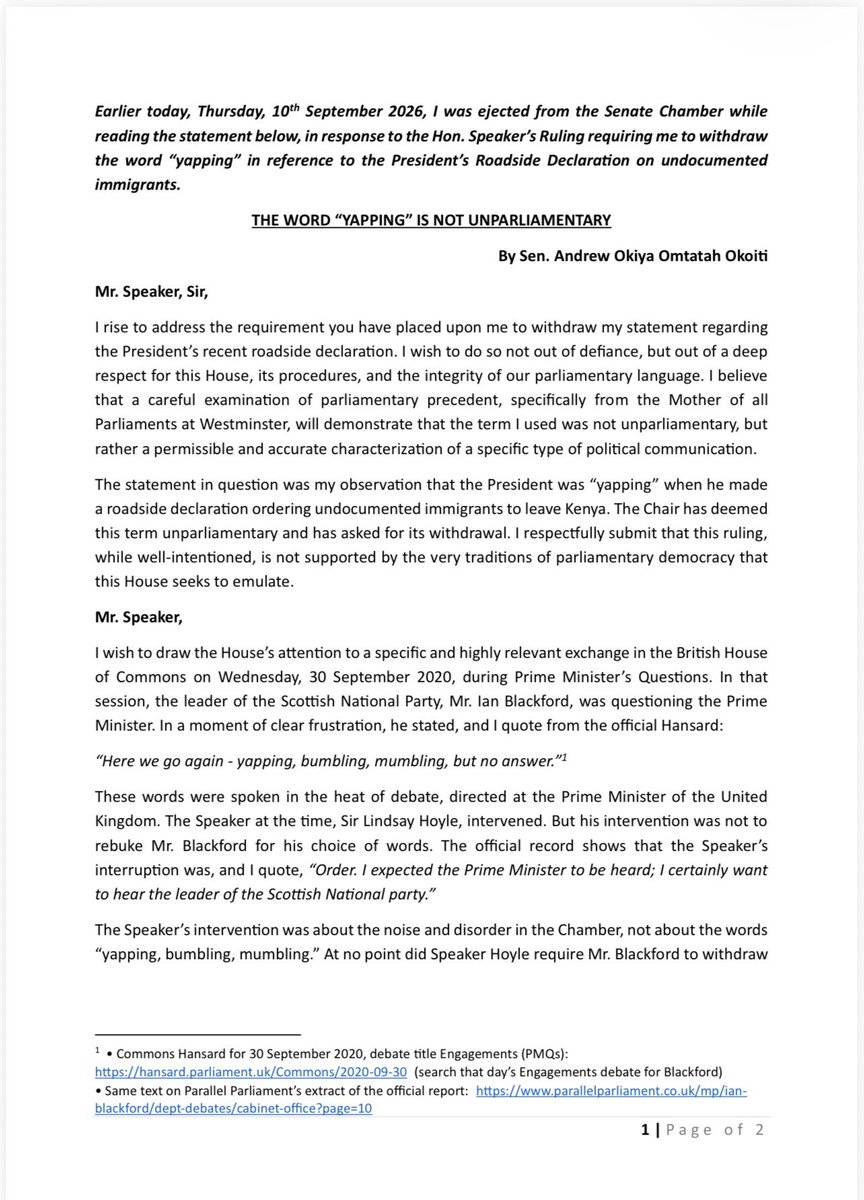
I have been suspended from the @Senate_KE for three sitting days for REFUSING to withdraw the word “yapping” in describing the President’s ROADSIDE declaration on undocumented immigrants.
I respect the Chair, but I will not surrender the constitutional duty to speak truth to power.
Article 135 requires PRESIDENTIAL decisions made under the Constitution to be in WRITING , SEALED and SIGNED. A roadside utterance cannot acquire the force of law simply because it comes from the President.
If calling out UNCONSTITUTIONAL governance is punishable, then the greater danger is not the word “yapping”. It is the growing intolerance for accountability.
Three days outside the Chamber will not silence me. I will continue to defend the Constitution and the Kenyan people. https://t.co/PkvYwrBgq5
Your LG TV is spying on you, even with no internet connection.
According to @GamersNexus, LG Smart TVs can scan local networks, identify content, and record/transcribe audio in standby.
They also found webOS flaws that could enable remote code execution. https://t.co/3m6sklywkj
The RSF is welcome in Kenya, but not the Burundian street vendor. A militia that has killed and discriminated on the basis of ones ethnicity and race has the diplomatic red carpet rolled out for its leaders. Yet the scapegoat for a struggling economy is the Burundian street vendor.
For Farce's Sake!
Those vehicles have parked on pedestrian pathway, but you choose to selectively apply enforcement laws.
Where should people walk on, on the streets of Nairobi?
Base is Ethereum
Linea is Ethereum
Taiko is Ethereum
Aztec is Ethereum
ZKsync is Ethereum
Polygon is Ethereum
Abstract is Ethereum
Starknet is Ethereum
Soneium is Ethereum
Arbitrum is Ethereum
Unichain is Ethereum
Optimism is Ethereum
Worldchain is Ethereum
Robinhood Chain is Ethereum
The International Criminal Court (ICC) suspects who basically own Kenya today bribed media house employees to delete post-election violence news stories from their YouTube channels, arranged for raw footage to disappear from newsrooms, and rewrote the narrative by portraying themselves as victims after funding the killings.
The kind of money thrown around to sink the case ran into the billions. They paid an employee of the Kenya National Commission on Human Rights (KNCHR) to steal the list of witnesses lined up against them at the ICC.
They used that list to bribe witnesses, paid hit squads to kill, and even made witnesses disappear if they refused to recant their testimonies. The officers who were in the hit squad that killed the witnesses were themselves also murdered. https://t.co/XXddL3JAbq
Some of the targeted hate I receive is because I refused to hide my images or testify falsely at The Hague that the violence I witnessed was spontaneous rather than organised. Instead, we travelled the entire country, displaying the pictures and holding healing and reconciliation discussions.
I was even approached not by the two main ICC suspects, but by Kibaki’s people, who were trying to protect his key civil servant. That civil servant was facing charges of five crimes against humanity: murder, forcible transfer of population, rape, persecution, and other inhumane acts.
Entire police occurrence books were rewritten to conceal the true number of those who died. Almost 20 years later, there has not been a single conviction for the post-election violence.
Thousands died, hundreds (possibly thousands) of women were raped, and over 500,000 people were displaced. Their animals, properties, and land were stolen.
The 2007–2008 chapter was never closed. The story continues, and if you make the mistake of re-electing people whose only language is to bribe everyone and kill those who disagree, Kenya will experience even worse violence than in 2007–08.
He has already normalised sending masked men to abduct citizens in full view of cameras, while goons work with the police to beat and violate opposition leaders and their supporters. Soon those masked men and goons will be shooting and killing people on live TV. That is exactly what happened on 25 June 2024. Why do you think almost all senior police leadership in Nairobi comes from one community, and that the police boss who ordered a blogger’s abduction and murder is being groomed to be the next Inspector General of Police?
Let me stop here. You can find some of the photos I shot in 2007–08 https://t.co/LRDxDzXwu4.
Finally, @DCI_Kenya boss Mohamed Amin: since January, your special teams have been forced to sign that they received per diems when they travel for out-of-station missions, yet they receive nothing. They are being forced to sleep in their cars and beg for food.
Stop treating your special units like homeless people. Who is stealing their allowances? Or is that the money State House is using to bribe voters and pay bloggers?
The struggle to liberate Kenya continues… #NeverAgainKE