When we started the discount brokerage (flat fee per trade) model in India in 2010, we decided to charge the same fee regardless of trade size. The logic was simple: if the effort to execute a trade is the same, why should customers pay differently? We applied the same logic to mutual funds. We didn't launch MFs until we could sell exclusively direct plans.
You can't call yourself a discount or a low-cost broker if you charge a percentage fee on transactions, because there's no incremental effort in executing a larger order. This logic has informed all our product and pricing decisions from day one.
Anyway, @CoinByZerodha today is the largest direct mutual funds platform in India, with nearly ₹1.6 lakh crores in direct MF AUM, and all our customers have saved thousands of crores in commissions. Direct mutual funds are a no-brainer if you're a DIY investor.
It's interesting that most of the direct MF platforms that started when we launched Coin have either disappeared or pivoted to something else. The few remaining platforms are also rethinking their choice of offering direct plans. However, at Zerodha, we will continue to offer direct mutual funds for free.
A lot of investors still don't know the difference between direct and regular plans. If you are investing in mutual funds, it's worth checking if your investments are in regular or direct plans. If you are in regular plans and want to switch to direct, we can help.
For most people, buying a broad basket of stocks or ETFs is a better investment strategy than picking specific sectors and building concentrated stock portfolios. For example, over the last 5 years, the Nifty IT index fell by 8%, while TCS dropped by about 40%.
By the way, we are working on a new Kite Nudge that will alert you when you are placing an order, if your exposure to a single sector exceeds X%
Whenever I'm at events or am meeting young entrepreneurs through @Rainmatterin, the one recurring question I get is what makes Zerodha what it is.
We'd created this page to explain what makes us different.
Link in comments.
Akshayakalpa has 13 years of data showing that simply introducing bee boxes increases the average coconut yield per farm by 20%. It’s such a massive win-win that they’ve now integrated 7,500 bee boxes across all their farms.
Shashi from @akshayakalpa recently brought over two bee boxes for my home to get us started with beekeeping. In this clip (full video in comments), he walks through how incredibly simple it is to set up a bee home, even in smaller or semi-urban spaces.
The bigger takeaway here is about how we view sustainability. We often look for grand, complex technological solutions to environmental issues. But the reality is that our survival is deeply tied to basic, interconnected ecosystems.
Without pollinators, our food systems collapse; roughly a third of what we eat depends entirely on them. Taking care of them isn't just a good deed; it's an absolute necessity for our own survival. And I think education is the key, which maybe the bee boxes in urban spaces can do.
Can’t be prouder of everything that the Akshayakalpa team is doing for improving the quality of life of farmers, their economics, their cows, and everything else.
I used to think the Indian broking community is perhaps a few thousand strong. Turns out, I was wrong by a huge margin. Stockbrokers employ 1.2 lakh people in India. And this does not even take into account the lakhs of authorised persons that work with brokers.
@prayagverma has built another dashboard tracking everything about all brokers using publicly available data.
Link - https://t.co/SrGSgX9huh
Sure, things can be better, but it's crazy how transparent and safe the Indian markets are compared to the US, all thanks to SEBI and the exchanges. It's not just Fidelity; even other big brokers seem to have 'flipping' restrictions in place.
In a landmark judgment on May 22, 2026, the Delhi High Court held Google liable for trademark infringement.
The case was between Hindware and Google. The court held that, by allowing competitors of Hindware to purchase the keyword “Hindware” (a trademarked name) through Google Ads, Google enabled trademark infringement. The court said that “Hindware” is not a generic English word but a specific brand trademark. By allowing competitors to place ads on that keyword, Google is enabling competitors to divert traffic that should have legitimately gone to Hindware.
This has been a big challenge for companies, both big and small. Even today, if you search for Zerodha, you will see search results from competitors. This has been happening for well over a decade.
Although it is hard to quantify, we have lost a lot of business to this. Think about what happens. Whenever someone searches for "Zerodha", the traffic should rightfully come to Zerodha. But what often happens is that the first couple of results on Google Search are ads, leading the customer to a competitor's website. In the process, we lose business that should have come to us.
This is made worse by the fact that we do not advertise.
There is also an even more ironic thing here. A lot of brands, just to capture the traffic that should have come to them organically, end up bidding on their own keywords. Think about it. If you own a business and have a trademarked name for your business, you still have to pay Google just to hopefully make your name too expensive for your competition to run ads on it.
But now, thanks to the Delhi High Court judgment, we have the option of taking legal action whenever we come across instances of other companies squatting on our keyword.
The other brilliant part about this judgment is that it levels the playing field. And this matters even more for startups, who are already starved for resources and have the odds stacked against them. The last thing they need is for competitors to bid on their brand keywords and steal their traffic.
This judgment now opens up a route for legal recourse whenever such deceptive practices occur.
While keyword squatting is most visible in Google web results, it is an even bigger problem when it comes to app stores. Whenever someone searches for your brand, the first couple of results, both above and below your app listing, often tend to be those of your competitors. And in the case of app stores, I think the ads are even more problematic. When a user clicks on an app-store ad, they often end up installing an app. That is a much higher-commitment action than clicking on a competitor’s web search result and then just closing the page. Because the user has installed an application, the conversions, at least anecdotally, tend to be much higher.
Again, brands that do not advertise are at the receiving end of this. So I welcome this ruling and hope this changes the unfair norms we've been living by for so long.
In the last year or so, we've continued to launch new features, both big and small to make life easier for traders and investors. The latest feature that went live on the Kite mobile app is position grouping.
If you actively trade and have multiple positions across different indices and expiries, tracking those positions can be messy. Odds are, you may end up making a mistake because of this. To make this easy, we've built position grouping on Kite. What you can now do is group your positions based on things like the underlying index of an F&O contract and expiry.
You can also use the feature to exit multiple groups of positions in one go.
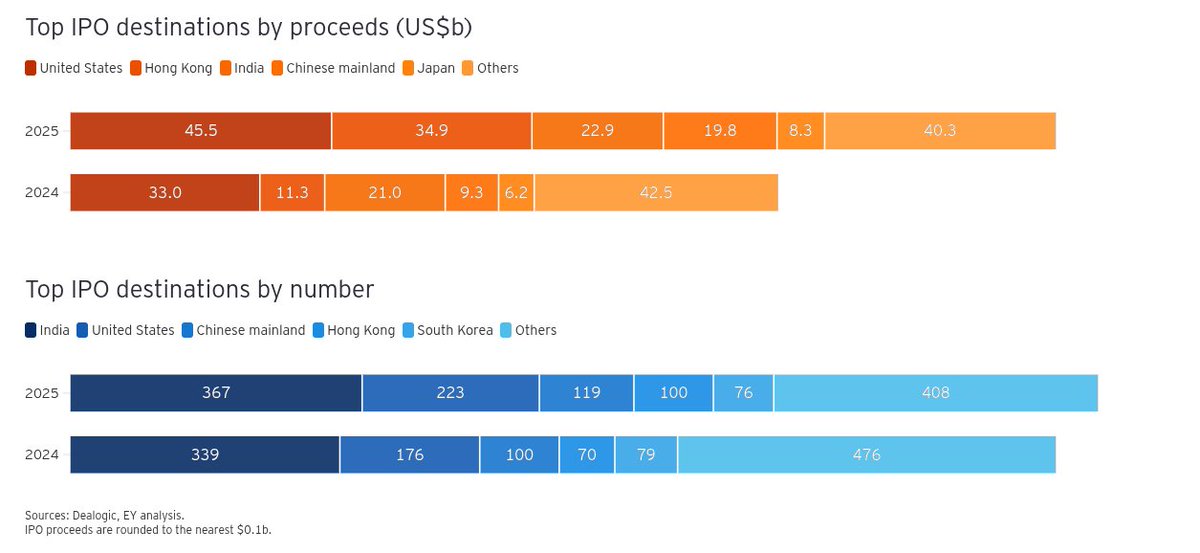
India had the highest number of IPOs in the world in 2025, with 367 listings, more than the US and mainland China combined. In terms of funds raised, it was 3rd largest.
This surge in listings is also why SEBI tightened the eligibility norms for merchant bankers this year. The net worth requirement for Category-I merchant bankers was raised 10x, from ₹5 crore to ₹50 crore. Merchant bankers handling SME IPOs now need a networth of ₹10 crore, along with a separate liquid net worth requirement in cash and government securities, not capital tied up in group entities or illiquid assets.
This is the first change to the networth requirement since 1995. Given that this might reduce competition for merchant banks in India, it will be interesting to see whether this increases the fees the large merchant This is the first revision to merchant banker net worth requirements since 1995.
Given that a higher threshold could reduce competition in the industry, it will be interesting to see whether larger merchant banks start charging even higher fees once the IPO cycle picks up again🙃
This was such an incredible event! Mega thanks to @babubasu sir for adding the energy and charm to the grand finale! For all of us at @ZerodhaVarsity this will be super special🙂
I've known @karthikrangappa for almost 30 years. My first interaction was me trying to sell him a Reliance Money demat account as a sub-broker. 😄
In 2014, he was teaching markets on the side while figuring out his next thing. I asked if he wanted to build a proper financial education platform at Zerodha. He said yes on the spot. That's how Varsity started.
12 years, millions of readers. No paywall, no ads, no signups, no spam. He still personally replies to reader questions in the comments.
In between, he built Varsity Live, Varsity Junior, Rupee Tales for kids, and more. And now he's turned Varsity's first module into a book, A Beginner's Guide to the Indian Stock Market.
Bodybuilder, photographer, teacher, author, coder. What isn't he doing. 😄
Btw, we keep joking with him, is all this education obsession really just a 25-year project to fix his image with his father-in-law, who happens to be a legendary educator himself? 😄
Since we published the 1st module on @ZerodhaVarsity (2014), there has been one constant request - to release the module in book format. I think many still prefer holding a book in hand, flipping through pages, highlighting, and taking notes. For all of them, here is the book 😊
This book is for those who want to get started with the stock markets, but dont know where and how to start.
Thanks to Trisha Bora and @HarperCollinsIN for nudging me constantly to work on this book :)
It feels odd to say this - but the link to preorder the book is in the comments below 😬
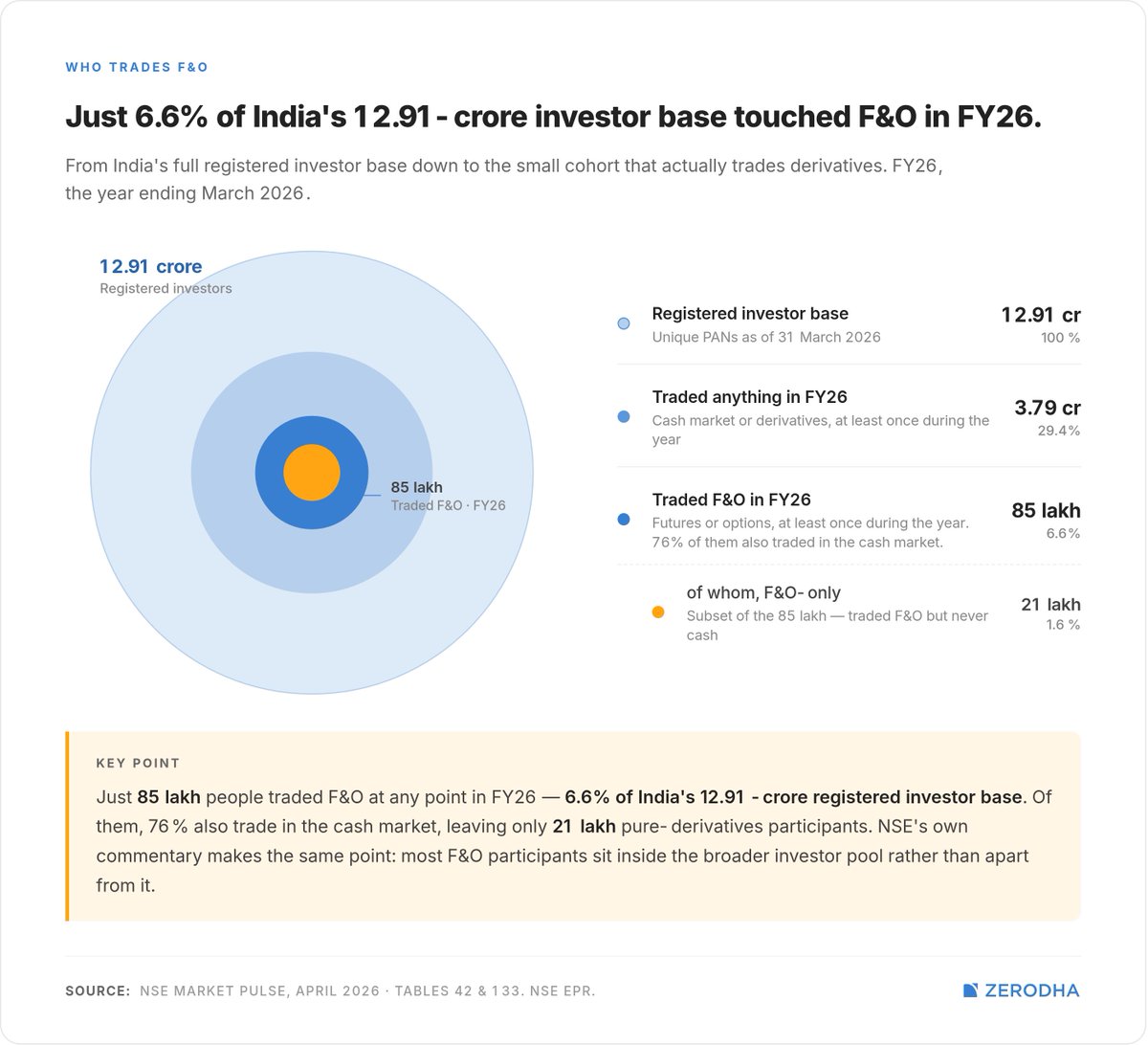
Despite what people think about F&O trading in India and all its problems, it is still a very, very small market compared to almost anything else. In fact, in the month of March, only about 30 lakh people traded an F&O contract. Across FY26 as a whole, only about 20 lakh people traded only in F&O. If you combine people who traded in equities and F&O, that number goes up to roughly 64 lakh.
So this is still a very small market. Altogether, out of nearly 13 crore unique investors, only around 3.8 crore investors were active across cash and F&O. That means only about 30% of investors traded anything at all.
And yet, the only reason broker revenues have held up is that a small number of people are trading more. Pretty much the entire revenue pool of the broking industry comes from this relatively small pool of traders.
If you look at F&O turnover, around 60–70% of trading volumes come from a tiny set of investors, roughly just 1–2%. That is the lopsided structure of the Indian markets.
For most parents, digital devices have become a pacifier😬, it's a way to keep em quiet, and it's understandable, but ends up creating a dependency in the long run.
At Kiaan's(son's) school, no digital device is allowed and at home, we restrict screen time to 30 mins a day. But even then, it is crazy the addiction to reels/clips, I normally catch him browsing through that.
We've been thinking for a while about how to teach financial concepts to kids without it feeling like a lecture, and that's the whole idea behind @ZerodhaVarsity Junior. Along with this, we also recently allowed the ability to open minor accounts. Also, each video takes a real finance concept and explains it through a story that kids can relate to.
The latest episode is about risk and reward. A farmer loses his entire watermelon crop. His son goes to deliver the last batch of mangoes to an old family friend, a pickle seller who's been buying from the same family for 24 years. And over some buttermilk and guava, he explains why some risks pay off, and some don't, using nothing more than his own experience with a chili pickle that nobody bought.
It's not an easy concept to explain to kids but @karthikrangappa has nailed it😉
Worth watching with your kids this weekend. Link in comments.