🚀 Our paper (with @JoseMoralesA) on the GLocal dataset is now published in Nature's @ScientificData!
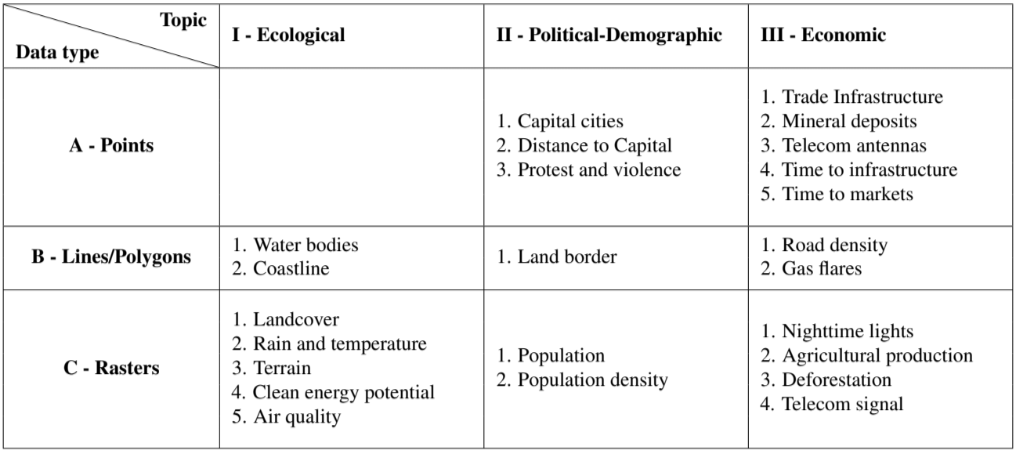
GLocal aggregates several satellite imagery-derived datasets and other complex data sources to administrative boundaries, making it easier than ever to work with these datasets.
Our paper "GLocal: A global development dataset of subnational administrative areas" w. @shreyasgm was just accepted at @ScientificData. Supported by @HarvardGrwthLab, we developed a global panel of local administrative units with a large set of development-relevant features.
Does geopolitics affect international R&I collaboration?
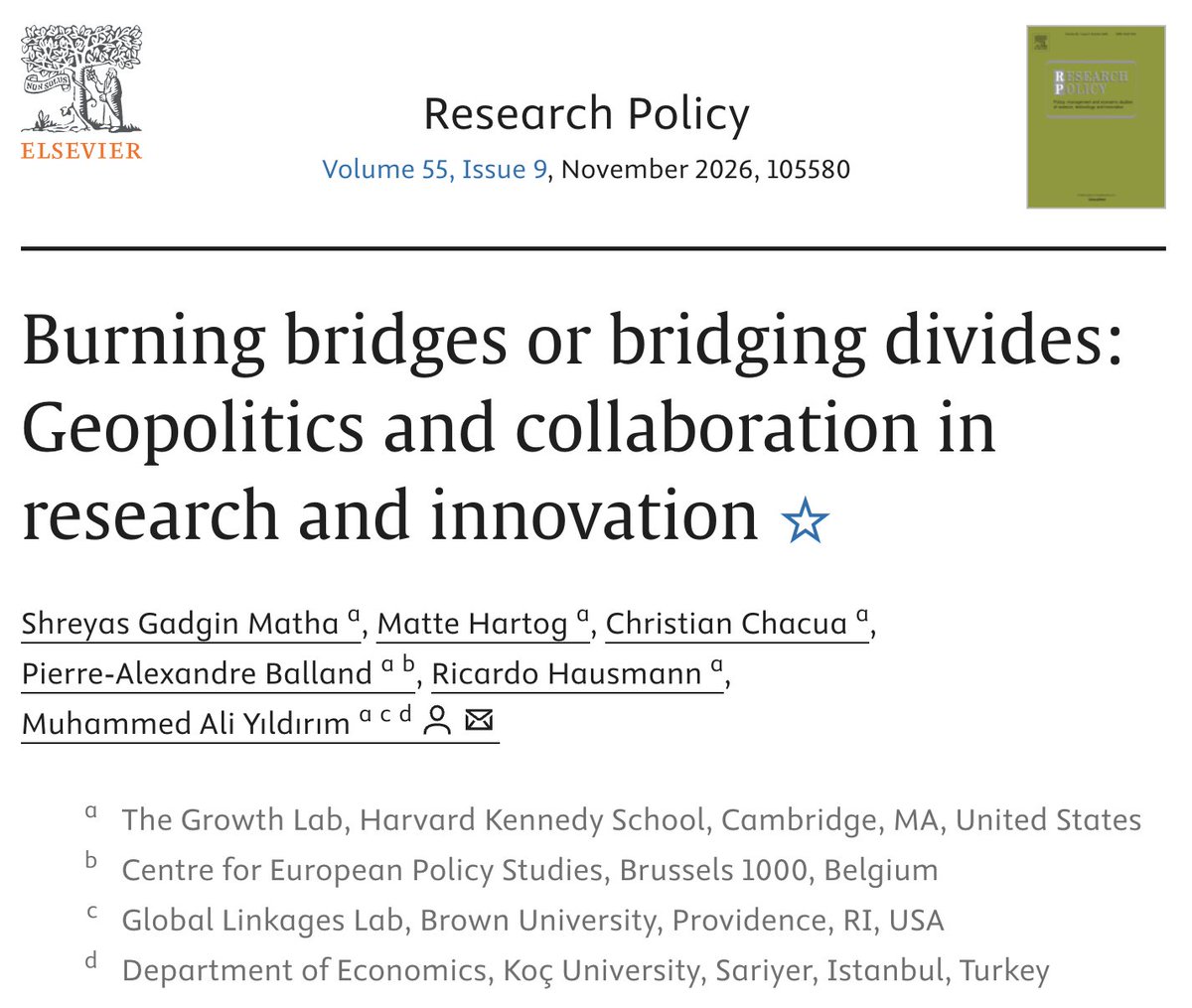
Lovely to see our new paper out today in Research Policy. The question is particularly relevant in today’s geopolitical context, as countries increasingly debate how much to protect strategic technologies - and how open their international research and innovation networks should remain.
We looked at more than two decades of global research and innovation networks to understand what happens when countries drift apart geopolitically. Three important findings:
(1) When geopolitical relations deteriorate, scientific collaboration quickly declines.
(2) Scientific bridges are hard to build, but easy to burn. Collaboration are much more sensitive to worsening geopolitical ties than to equivalent improvements.
(3) And perhaps most importantly, critical technologies are much more internationally collaborative than other technologies - but also much more sensitive to geopolitical tensions.
This creates an important tension: the technologies countries increasingly want sovereignty over are often precisely those built through the deepest international knowledge networks.
This has major implications for both technological progress and the global governance of critical technologies.
There is some good news too! Despite all the geopolitical turbulence of recent years, the global research system has so far proved remarkably resilient. But that resilience should not be taken for granted.
Shout out to an amazing team of colleagues from the @HarvardGrwthLab: @shreyasgm, Matté Hartog, @chchacua, @ricardo_hausman and Muhammed Ali Yildirim.
Databases are arguably the most commonly used enterprise tool, and enterprises typically have many of them. Yet no popular AI agent benchmark actually tests how well agents can query, join, and make sense of data across different databases!
So, we built DAB (Data Agent Benchmark): 54 queries, 12 datasets, 9 domains, and 4 database management systems, grounded in a formative study of real enterprise data agent workloads. The best frontier model only gets 38% pass@1 (across 50 trials). Lots of room for improvement!
📢 Register now for our next Development Talk:
AI and Economic Development: An Open-source Angle on Opportunities, Challenges, and Policy Implications featuring @Thom_Wolf of @huggingface.
🗓️ Thursday, October 30th
🕛 12 - 1 PM EST
📍 Allison Dining Room @Kennedy_School / Zoom
Thomas will discuss how AI is influencing dynamics in economic development, and explore the key challenges facing policymakers and researchers as they work to understand and guide these transformations.
@pa_balland will moderate.
RSVP: https://t.co/2KDRimKIic
Our paper on emissions trading to reduce industry pollution in India finally accepted in Quarterly Journal of Economics. ETS cut emissions by 20%. Longest project ever-12 yrs, 1 kid, 1 marriage, 500 concalls, career shift from engineering to Econ. (1/n)
https://t.co/MBDjMDXmb0
GLocal was born at @HarvardGrwthLab. We thank @ricardo_hausman and the Growth Lab team for their support and guidance. We also thank the many researchers who have provided feedback on the dataset and its applications.
Please reach out to us with any questions or feedback!
🚀 Our paper (with @JoseMoralesA) on the GLocal dataset is now published in Nature's @ScientificData!
GLocal aggregates several satellite imagery-derived datasets and other complex data sources to administrative boundaries, making it easier than ever to work with these datasets.
Our paper "GLocal: A global development dataset of subnational administrative areas" w. @shreyasgm was just accepted at @ScientificData. Supported by @HarvardGrwthLab, we developed a global panel of local administrative units with a large set of development-relevant features.
🌍 Explore the GLocal dataset in our app: https://t.co/VZBx7MSwuc
📊 Download the data as CSVs or parquet files: https://t.co/YTsCpJ4Zwi
📝 For a detailed overview, read our descriptor paper: https://t.co/mJohepbokl
Thread: After more than a year of work, we have now launched https://t.co/HfCaDCELD2, a public platform that seeks to expand access to Indian data for everyone, and deepen the understanding of the country that can come from this data
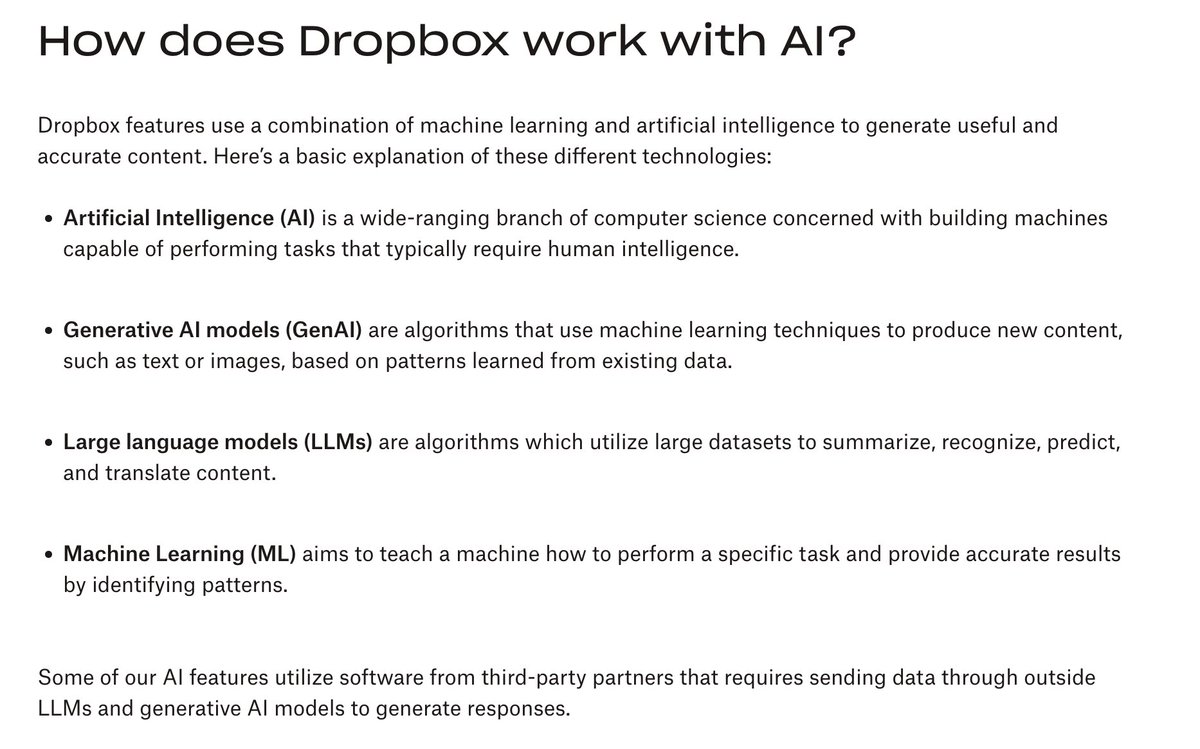
Hey @Dropbox when i looked this up i actually wasn't looking for a bunch of intro to CS definitions i was looking for an explanation as to what on earth you could be sending my data to OpenAI for that's so important you set the share toggle to "on" by default?
Gemini’s reasoning capabilities mean it can understand more about a user’s intent, and use tools to generate bespoke user experiences that go beyond chat interfaces.
Here’s what that looks like in action. ↓ #GeminiAI
This morning, Raj Chetty, @john_n_friedman and I released a new paper from @oppinsights about the determinants and causal impacts of admission at highly selective private colleges in the U.S. Here is the paper webpage https://t.co/wQwFpThokn 1/n
Congrats to our team for winning the Best Paper Award at #Druid23 for their research, "Eight Decades of Changes in Occupational Tasks, Computerization and the Gender Pay Gap."
@LjubicaNed@shreyasgm James McNerney @aassumpcao_ @dario_diodato@FrankNeffke 1/3