People forget computers were made to compute.
Exploiting a vulnerability is still making the system do what it was built for: compute.
A weird machine is only weird against human rules. To the system, it’s a natural machine.
Just published the writeup for my RCE in Google Cloud Application Integration, found last year - before this whole AI vulnpocalypse.
https://t.co/lDVlPDrvRc
If you haven't browsed the @SummerC0n research, I highly recommend Nicole Reichert's post/talk on packing malware and exploiting Apple's Rosetta 2 translation layer! 🧃
The TLDR is that Rosetta 2 bypasses Silicon code-signing checks, allowing her to inject unsigned libraries and malware into signed processes using f(x) swizzling without triggering Gatekeeper.
Great read and talk.
https://t.co/o8VaeP7vTN
Our @offensive_con 2026 slides are now publicly available:
https://t.co/OZ5RPkys7L
We got the highest privileges (EL3) on QSEE's Google's Wifi Pro, dumped the ROM and broke the /data partition encryption. Our technique may be applicable to other TrustZone TEEs as well.
Enjoy!
We are pleased to release tmp.0ut 5 Volume!
Get your viruses, rootkits, strange ELFs, weird machines, tiny files, cool art, and phresh beats here!!
https://t.co/tZLM50HOc0
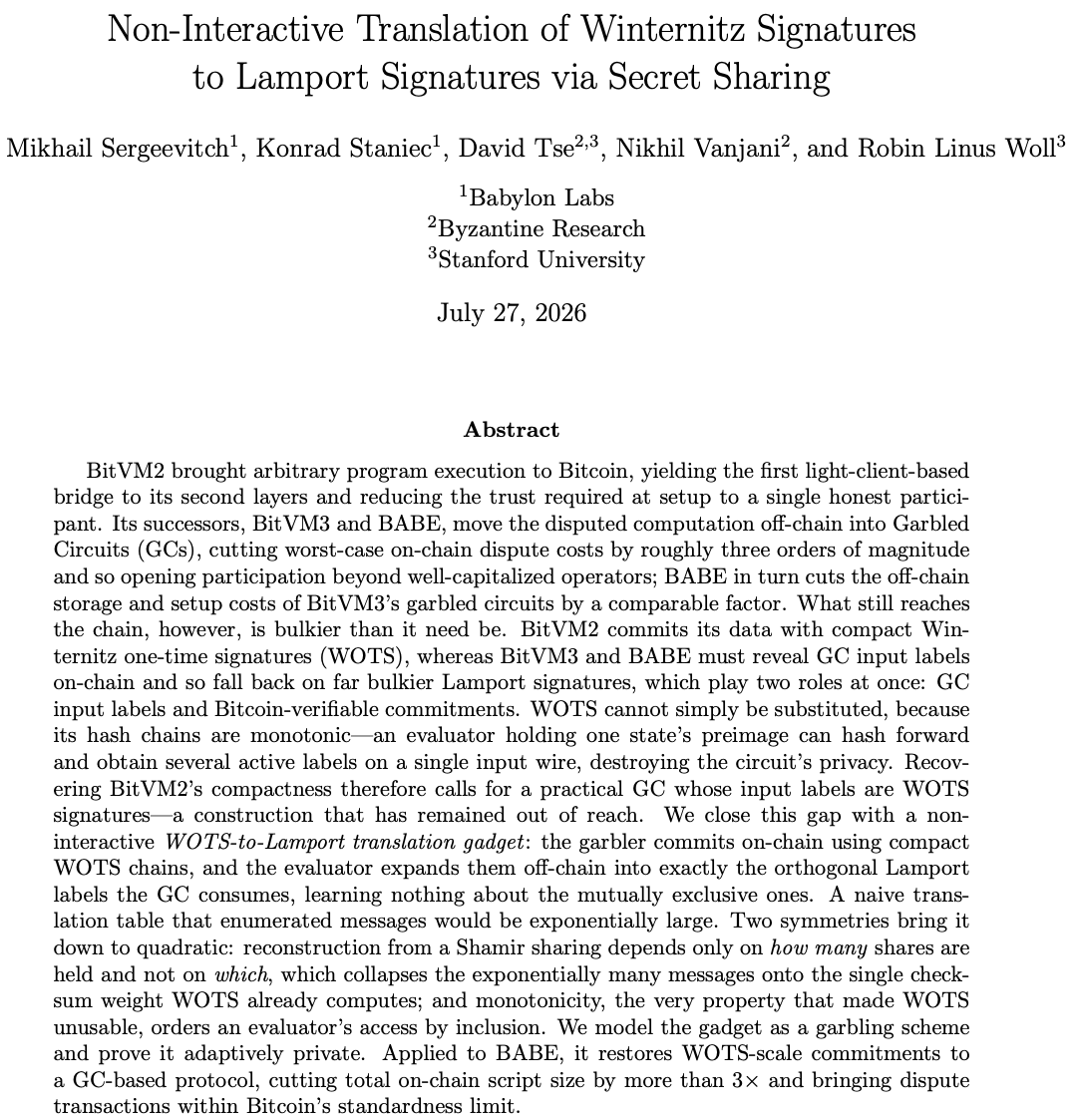
Bitcoin has a hard 10,000 byte limit on standard transactions.
The cheapest known way to settle a zero knowledge proof dispute on Bitcoin needed 66,360 bytes. Six times over the wall.
A new paper by @dntse@robin_linus and friends gets it to 9,869. Not by shrinking the proof. By fixing how you hand data to a garbled circuit.
Long thread, worth it 🧵
Introducing bad_query, a zero-day sandbox escape PoC for iOS 26 and 27.
This bug has been patched earlier today in iOS 27.0 beta 5, but not 26.6.1. Be careful out there, and use this for good.
Coordinated release with @0xjohnny and @rooootdev :p
https://t.co/UYYpqH37w6
pkexec ships SUID-root on every major Linux distro. it had a local root exploit in its very first commit, May 2009, hidden for 12 years. CVE-2021-4034, "PwnKit".
the bug isn't a clever overflow. it's what happens when you assume argc is never 0.
execve lets you run a program with an empty argument list: argv = {NULL}, argc = 0. here's main() processing the args:
534 for (n = 1; n < (guint) argc; n++)
if argc is 0 the loop never runs and n stays 1. a few lines down:
610 path = g_strdup (argv[n]);
639 argv[n] = path = s;
it reads and writes argv[1]. but argc was 0, so argv[1] doesn't exist. the kernel lays argv and envp back-to-back on the stack, so argv[1] is actually envp[0], your first environment variable.
so pkexec reads a program name from your env, resolves it via PATH, and writes the result back over envp[0]. that's an arbitrary write into the environment of a SUID-root process, the exact thing https://t.co/PvbQzY7EnP strips for SUID binaries.
re-introduce GCONV_PATH, point it at your own .so, trigger an error message, and pkexec loads your library as root.
no ASLR bypass, no ROP, no arch-specific offsets. instant, reliable, works even with the polkit daemon dead.
https://t.co/ZyuAv4JLbX
Another U-Boot Verified Boot bypass, this time in the SPL code!
Take a look at how we achieved arbitrary code execution on a real device running the latest OpenBMC build:
https://t.co/rClJR1kEi2
Patch is public:
https://t.co/wL9pQ99nmK
Created a very small page that explains the @COLDCARDwallet (not only) MK3 issue in simple terms, has a small demo and all relevant links including the firmware repo. I'll update this page as the situation develops. I verified everything, but it's possible I missed something.
https://t.co/BVdTnFCLbm


![LxlxIxlxlxL's tweet photo. pkexec ships SUID-root on every major Linux distro. it had a local root exploit in its very first commit, May 2009, hidden for 12 years. CVE-2021-4034, "PwnKit".
the bug isn't a clever overflow. it's what happens when you assume argc is never 0.
execve lets you run a program with an empty argument list: argv = {NULL}, argc = 0. here's main() processing the args:
534 for (n = 1; n < (guint) argc; n++)
if argc is 0 the loop never runs and n stays 1. a few lines down:
610 path = g_strdup (argv[n]);
639 argv[n] = path = s;
it reads and writes argv[1]. but argc was 0, so argv[1] doesn't exist. the kernel lays argv and envp back-to-back on the stack, so argv[1] is actually envp[0], your first environment variable.
so pkexec reads a program name from your env, resolves it via PATH, and writes the result back over envp[0]. that's an arbitrary write into the environment of a SUID-root process, the exact thing https://t.co/PvbQzY7EnP strips for SUID binaries.
re-introduce GCONV_PATH, point it at your own .so, trigger an error message, and pkexec loads your library as root.
no ASLR bypass, no ROP, no arch-specific offsets. instant, reliable, works even with the polkit daemon dead.
https://t.co/ZyuAv4JLbX](https://pbs.twimg.com/media/HPIhhqlWUAAn4xq.png)


![N45HTOfficial's tweet photo. $150,000 Apple Bug Bounty 🍎
[CVE-2026-20685] Beyond Prompt Injection: Hacking Apple's Private Cloud Compute 🤯🔥
🔗 https://t.co/vnMLxnaJ7w
🔗 https://t.co/aPKbVs0YKK https://t.co/aJ2zX9kuRd](https://pbs.twimg.com/media/HPmTVA0a0AE4hRj.png)
![LxlxIxlxlxL's tweet photo. pkexec ships SUID-root on every major Linux distro. it had a local root exploit in its very first commit, May 2009, hidden for 12 years. CVE-2021-4034, "PwnKit".
the bug isn't a clever overflow. it's what happens when you assume argc is never 0.
execve lets you run a program with an empty argument list: argv = {NULL}, argc = 0. here's main() processing the args:
534 for (n = 1; n < (guint) argc; n++)
if argc is 0 the loop never runs and n stays 1. a few lines down:
610 path = g_strdup (argv[n]);
639 argv[n] = path = s;
it reads and writes argv[1]. but argc was 0, so argv[1] doesn't exist. the kernel lays argv and envp back-to-back on the stack, so argv[1] is actually envp[0], your first environment variable.
so pkexec reads a program name from your env, resolves it via PATH, and writes the result back over envp[0]. that's an arbitrary write into the environment of a SUID-root process, the exact thing https://t.co/PvbQzY7EnP strips for SUID binaries.
re-introduce GCONV_PATH, point it at your own .so, trigger an error message, and pkexec loads your library as root.
no ASLR bypass, no ROP, no arch-specific offsets. instant, reliable, works even with the polkit daemon dead.
https://t.co/ZyuAv4JLbX](https://pbs.twimg.com/media/HPIh0GHWMAAQ84K.png)





